The Global Sourcing Hub for Marine, Subsea & Offshore Technology
Discover cutting-edge solutions from leading global suppliers
Oceanology International returned to ExCeL London in March 2026 with a show floor that felt, if anything, more densely packed with new hardware than previous editions. Editors from Ocean Science Technology spent time across the exhibition, talking with engineers, product managers, and integrators about the technologies they were showcasing and why.
What emerged from those conversations was a consistent preoccupation: How to keep systems in the water longer, with less intervention, and with enough sensor capability onboard to make those deployments genuinely useful.
This is a roundup of the technologies and developments that stood out.
Navigation and Inertial Sensors
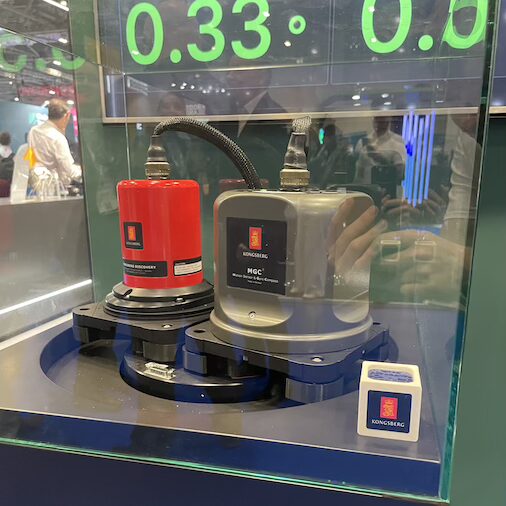
Kongsberg Discovery was on the floor showcasing a new north-finding MEMS device built around gyro technology from Silicon Sensing. At its core is the SGH03 gyro sensor, which also underpins several other high-performance inertial products from Silicon Sensing’s range, among them the tactical-grade DMU41 nine-degree-of-freedom IMU and the CRH03 single-axis gyro. The common thread across all three is a focus on compact form factors without sacrificing the long-term stability that precision marine navigation demands.
Honeywell was also in the navigation space, with the HGuide i700 MEMS IMU on the stand — notably, a working unit mounted on a hexapod demonstrating gyrocompassing while in motion. The i700 is positioned as near-navigation-grade MEMS inertial sensing within Honeywell’s no-licence-required HGuide range, a bracket historically occupied by higher-cost fibre-optic or ring-laser technologies.
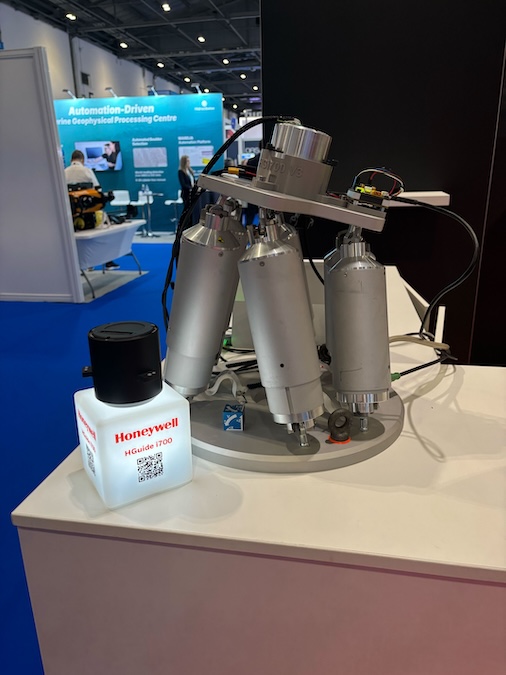
Speaking on the stand, Honeywell’s team were direct about what that shift means in practice: the ability to gyrocompass and north-seek in GNSS-denied environments, whether that’s jamming on the surface or the straightforward absence of satellite signal subsea, at a price point that makes higher-volume autonomous platform deployments more realistic.
Oceanographic Monitoring Sensors
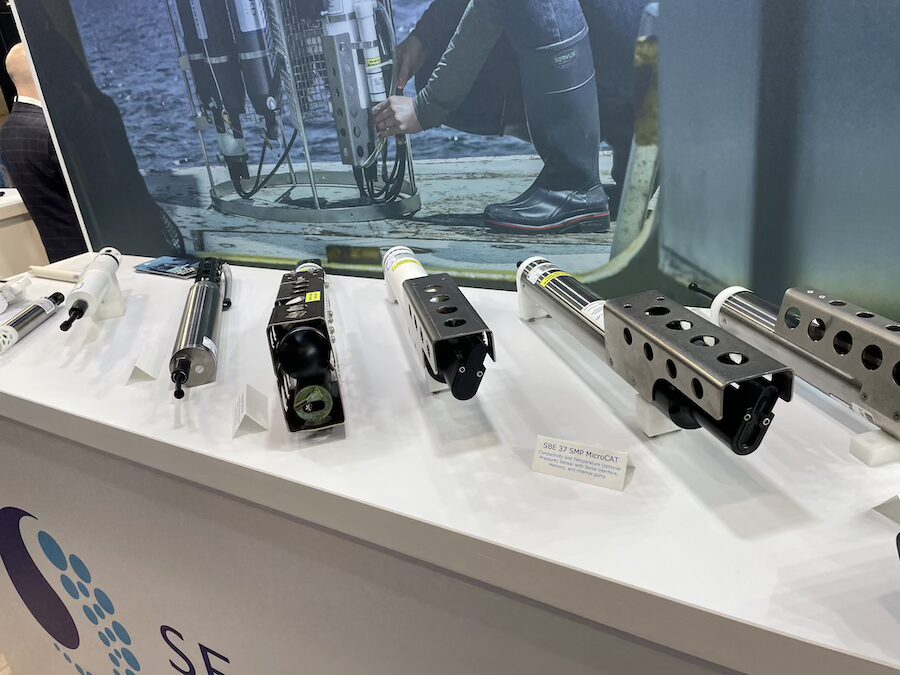
CTD and oceanographic monitoring technology drew considerable attention, with several companies approaching the challenge from different angles. Sea-Bird Scientific displayed a broad range of instruments including vessel-mounted profiling CTD systems and compact platforms suited to AUVs and autonomous deployments tools that turn up wherever precise conductivity, temperature, and depth data are needed.
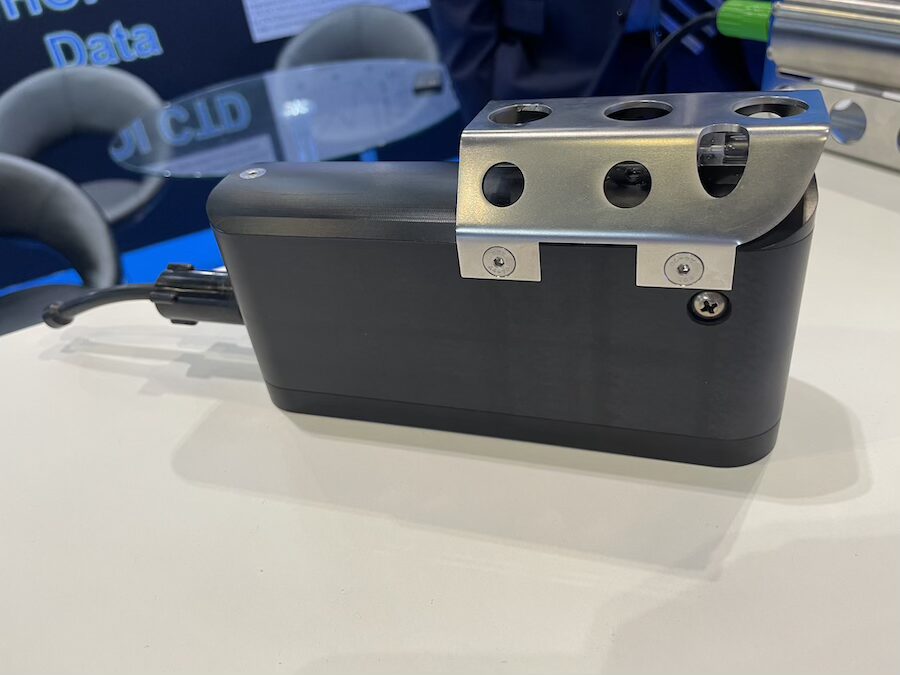
D-2 Incorporated showcased new CTD technology, with the AUV-CTD and the company’s wider profiling solutions the focus of the stand. The AUV-CTD is designed for low-power, long-duration deployments across AUVs, ROVs, gliders, floats, and USVs. Its pumpless design keeps operations quiet and cuts energy draw, while sampling rates of up to 32 Hz and onboard memory support high-resolution salinity and density profiling on extended missions. A full interview with the D-2 team will follow separately.
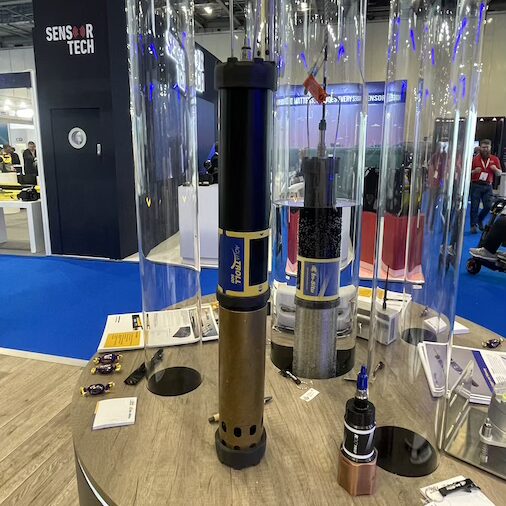
In-Situ brought a fuller range to the show than just its headline sensor. Alongside five and seven-port multiparameter instruments and rugged CTD loggers, the company highlighted the new RDO Trio; a compact optical dissolved oxygen sensor that also measures temperature and conductivity, enabling real-time salinity compensation. It is the first sensor of its kind with a built-in central wiper, a flat face to reduce bio-buildup, and a copper-infused guard, a combination designed to address the biofouling that degrades data quality on long unattended deployments.
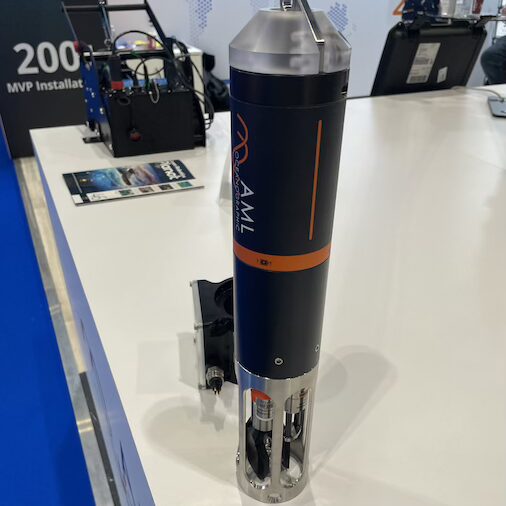
AML Oceanographic rounded out the monitoring picture with two products worth noting. The MVP Roam is a new underway profiler designed for smaller vessels, extending the company’s Moving Vessel Profiler range to platforms where space and budget are tighter. Alongside it, the Endura wirelessly charging loggers are designed for USV deployments, using inductive charging from the host vehicle’s power system to extend mission endurance without the need for manual battery changes or surface recovery.
Acoustic Survey and Imaging Systems
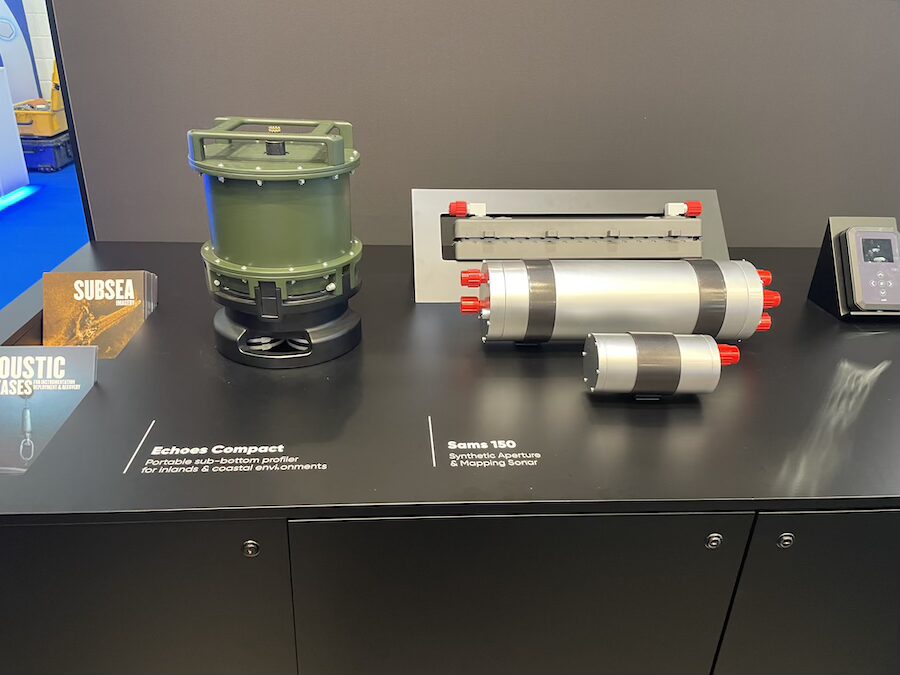
Acoustic survey technology occupied a large portion of the floor, and the range on offer reflected how varied seabed mapping requirements have become. Exail presented a broad sonar portfolio spanning synthetic aperture mapping and sub-bottom profiling. The SAMS 150 synthetic aperture sonar is capable of detailed backscatter imagery and bathymetric modelling to 6,000 metres across AUVs, ROVs, USVs, towfish, and submersibles. The Echoes Compact sub-bottom profiler is a more portable option for shallower coastal work, imaging sediment layers and buried objects in water depths down to 400 metres.
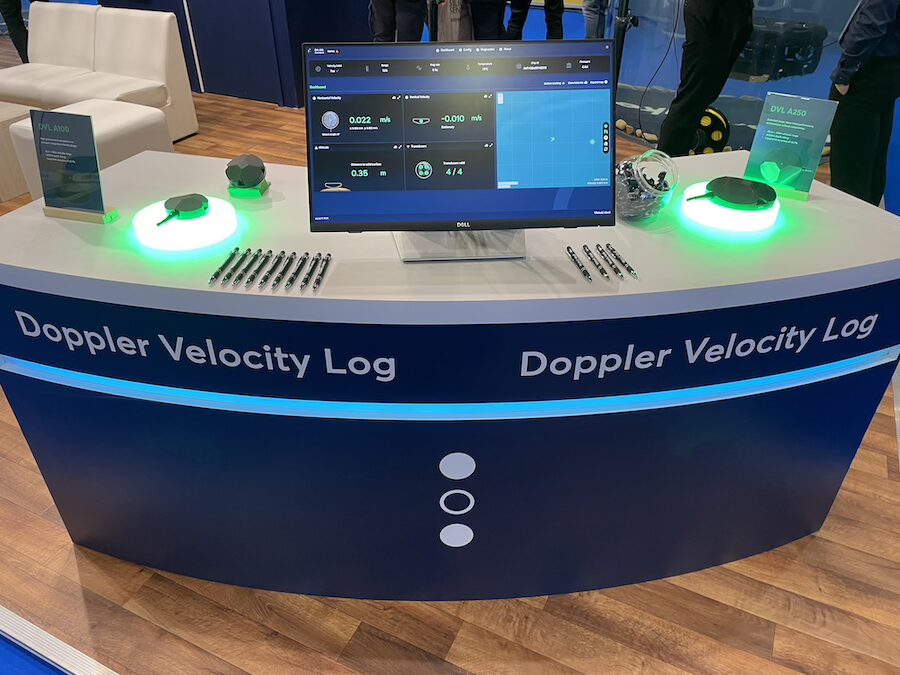
Water Linked showcased its new DVL range for the first time, with one system already delivered to Skarv Technologies and integrated into their new CORAX 600 AUV; a live example of the product moving from launch to operational deployment. The company also ran a live demonstration of the Sonar 3D-15 imaging sonar, including a new 2.4 MHz software update aimed at improving close-range inspection performance.
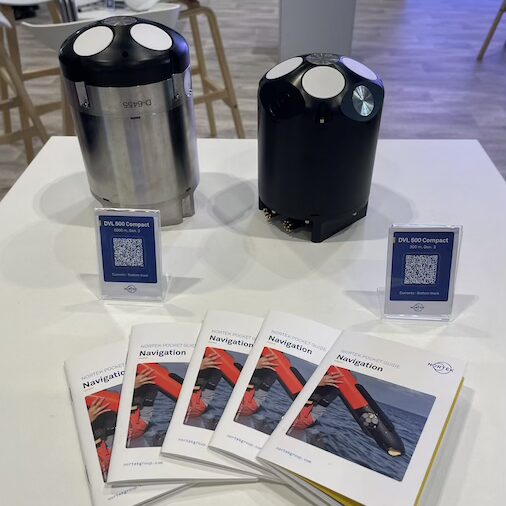
Nortek presented the DVL 500 Compact across different depth ratings alongside a broad selection from its wider product range, including the Signature 100 current profiler. The stand offered a comprehensive view of the company’s navigation and measurement portfolio for autonomous and survey platforms.
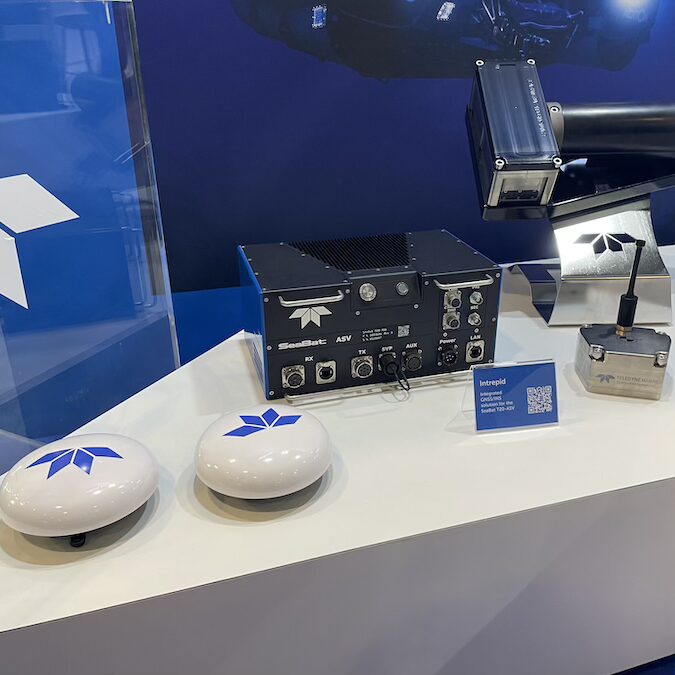
Teledyne Marine presented a broad sonar portfolio, including the SeaBat D100 portable or hull-mounted multibeam echosounder — launched just before the show — for mid-water surveys to 3,000 metres. The recently launched SeaBat T51-IDH integrated dual-head sonar was also on display, offering wider swath coverage for more demanding survey tasks, as was the updated HydroPACT 440 MK2. The stand also featured subsea cameras and other solutions that will be covered in upcoming coverage.
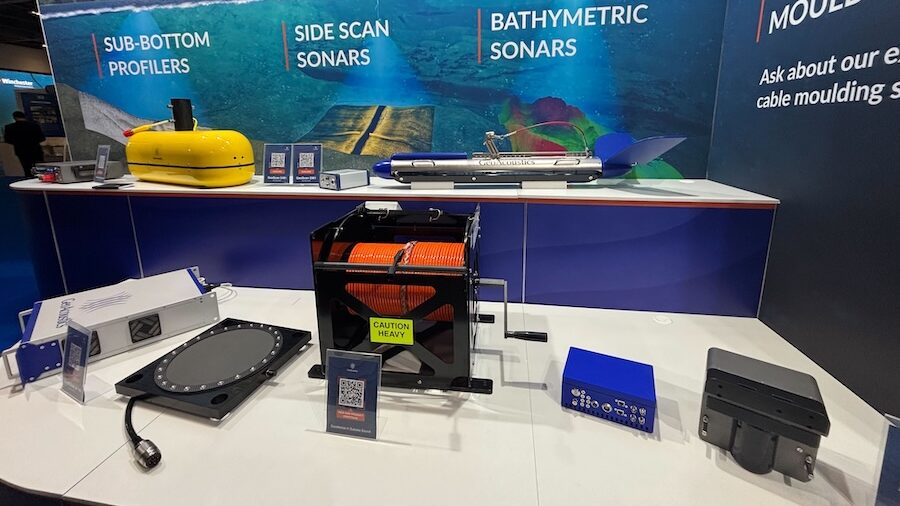
GeoAcoustics unveiled two new products: the GeoMB 401 multibeam echosounder, which integrates positioning, motion sensing, sound velocity measurement, and transducer in a single unit for surveys to 200 metres, and the GeoPulse LF 101 low-frequency boomer. Operating at around 1.5 kHz and 100 joules, the GeoPulse LF 101 achieved up to 80 metres of sediment penetration in testing — significantly deeper than higher-frequency alternatives.
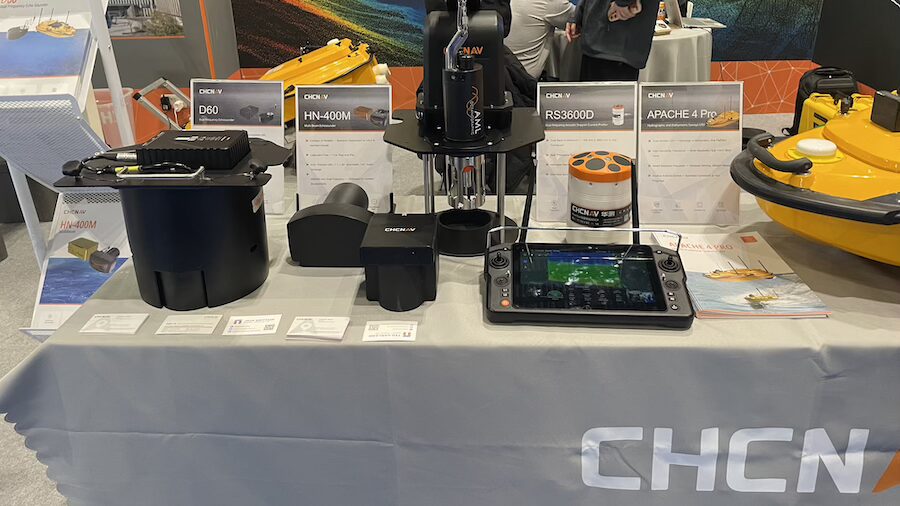
CHCNAV had a strong hydrographic presence, displaying multibeam and dual-frequency echosounders alongside ADCPs and survey control systems. The stand also featured the APACHE 4 uncrewed surface vessel, designed for bathymetric mapping in coastal and inland environments.
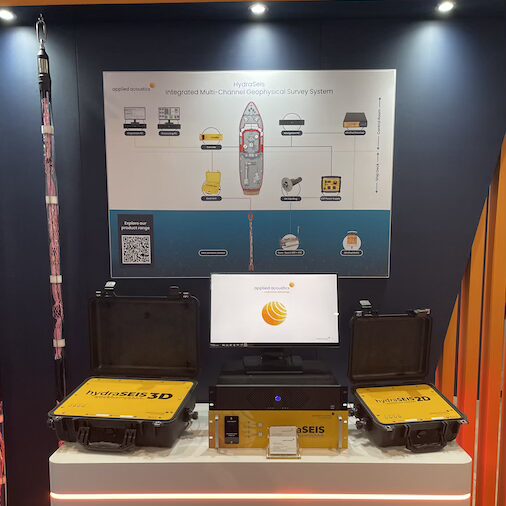
Applied Acoustics had a strong presence on the floor, with the HydraSeis multi-channel seismic streamer among the hardware on display alongside the company’s range of USBL positioning systems, acoustic release beacons, and subsea equipment. Further detail on what was showcased will follow in forthcoming coverage.
Subsea Infrastructure and Supporting Technologies
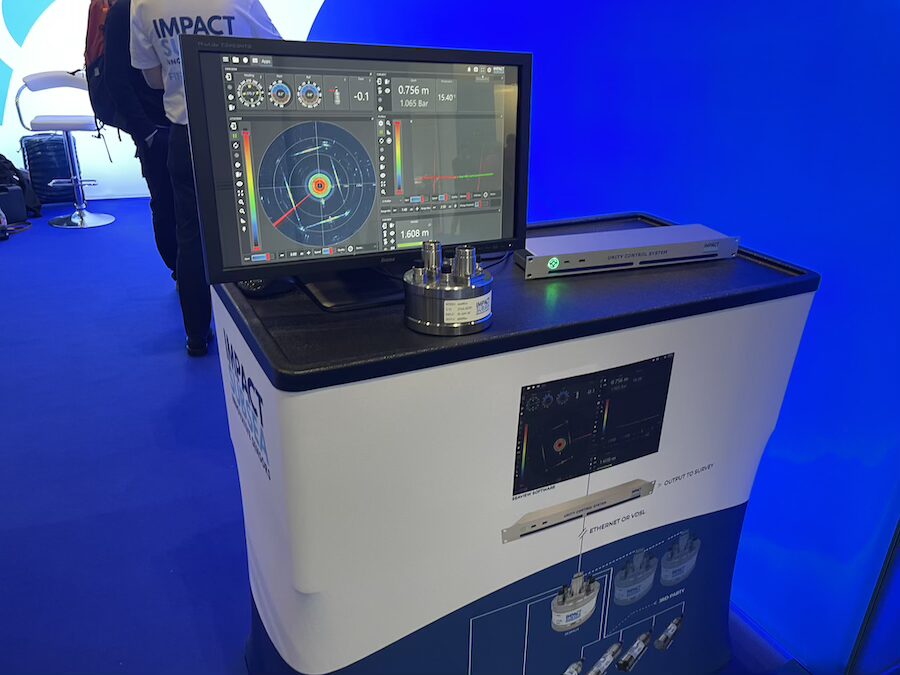
Impact Subsea used the exhibition to demonstrate its existing range of compact pressure, altitude, and sonar imaging sensors, and also launched two new products during the show — additions to its portfolio that had not been publicised ahead of the event.
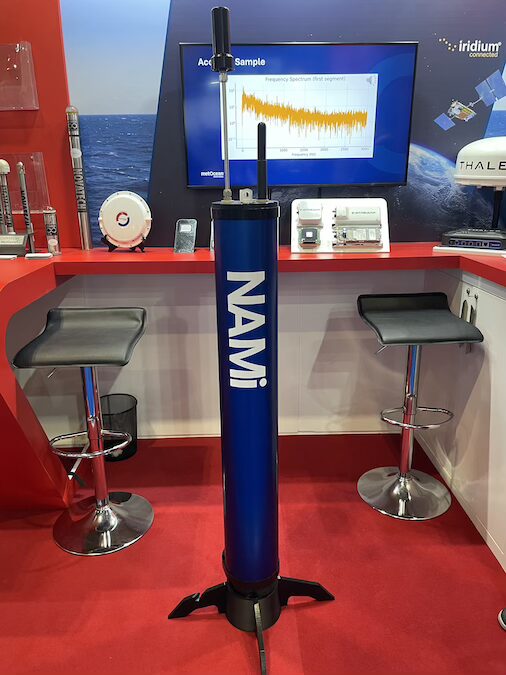
MetOcean Telematics focused attention on the NAMi autonomous acoustic float, designed to meet growing demand for long-duration, remotely deployable ocean noise monitoring. NAMi integrates a precision hydrophone with Iridium satellite communications to record and transmit underwater acoustic data from remote locations. It can operate as either a profiling or fixed-depth float, with power management designed to support missions exceeding twelve months. Applications include marine mammal studies, offshore noise impact assessments, and environmental monitoring in areas where regular retrieval is not practical.
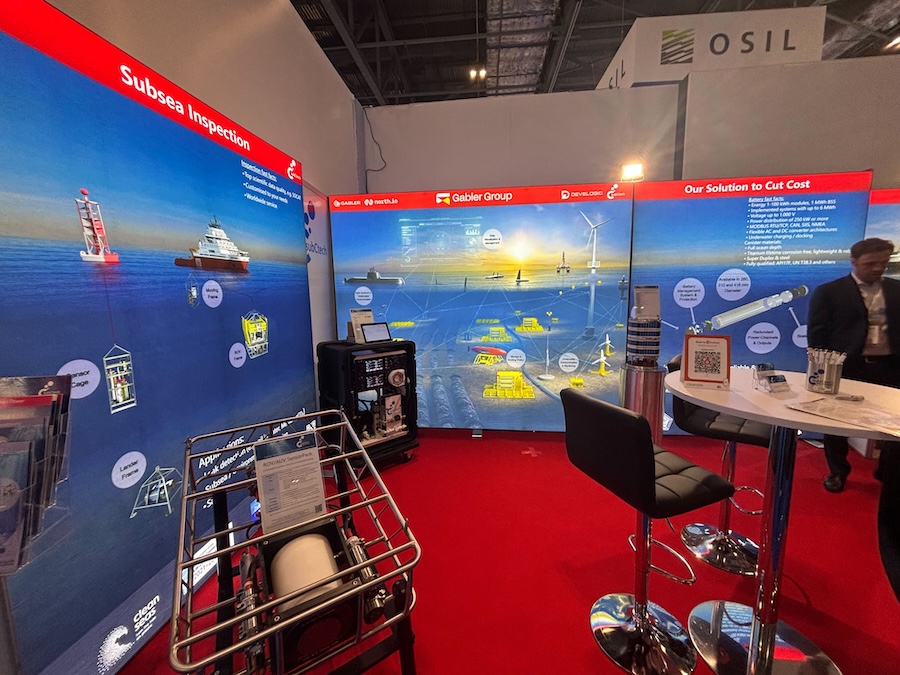
SubCtech, now part of the Gabler Group, discussed modular battery systems for ROVs, AUVs, and seabed-installed infrastructure, with future concepts extending to subsea docking and charging stations drawing on offshore wind or ocean current energy. The vision of underwater vehicles that recharge without surfacing would be significant for persistent monitoring operations.
Novacavi presented ROV tethers, fibre-optic transmission lines, and armoured cable systems. A thin-diameter fibre-optic tether optimised for long-distance data transmission while maintaining neutral buoyancy was among the highlights, alongside a new cable identification system designed to help operators quickly distinguish cables during deployment on research and defence vessels.
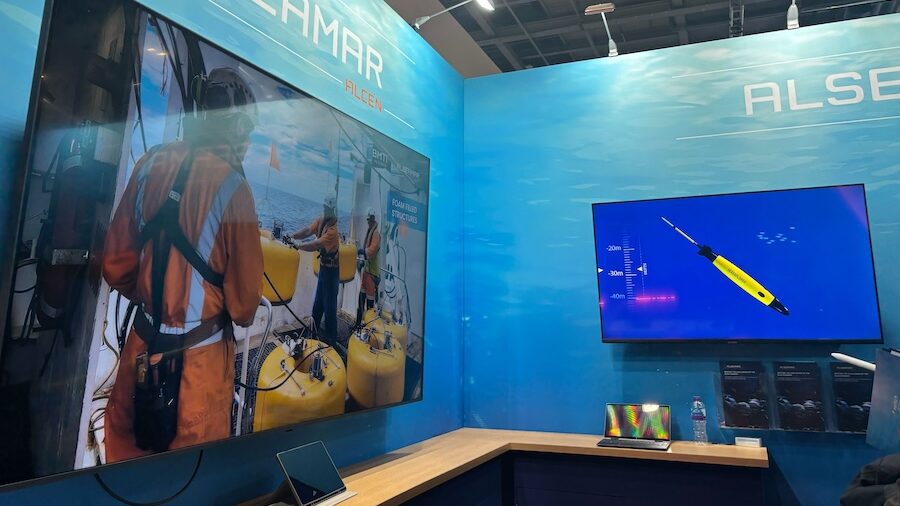
ALSEAMAR rounded out the structural picture with its BMTI buoyancy modules, engineered for the combination of low density and structural strength that extreme depths demand. With configurations supporting operations to 12,000 metres, these materials underpin the ROVs, AUVs, and other platforms that the rest of the show was working to equip.
Looking Ahead
Several conversations at the show touched on topics that will be explored in more depth in the weeks ahead, including a full Q&A with D-2 Incorporated. For now, the breadth of hardware on display at ExCeL made clear that development across sensing, acoustic imaging, navigation, and subsea infrastructure is advancing on multiple fronts simultaneously — and that the teams building these systems are increasingly thinking about how each piece fits into a longer, more connected picture of ocean operations.
As the Official Launch Partner for Oceanology International 2026, the team at OST had the opportunity to spend time directly with many of the engineers and companies behind these systems, hearing first-hand how they are being designed and where they are likely to be deployed next. The conversations and product launches on the exhibition floor offered a useful snapshot of a sector focused on longer deployments, richer data collection, and technologies that support the growing demands of the global blue economy.
Coverage from the event will continue in the coming weeks, with deeper looks at several of the technologies and teams featured here as OST continues reporting on the innovations shaping ocean science and subsea operations.