
Inertial Measurement Units
Discover cutting-edge solutions from 4 leading global suppliersAt Oceanology International 2026 in London, Honeywell Aerospace showcased its HGuide i700 MEMS IMU, a compact gyro-compassing inertial measurement unit designed to deliver near-navigation-grade motion sensing for unmanned and robotic platforms operating in demanding environments.
Speaking with Ocean Science Technology, Business Development lead for Resilient Navigation, Darren Fisher discussed how the system expands the company’s inertial sensing portfolio and supports emerging autonomous applications.
The HGuide i700 has been developed to extend Honeywell’s range of IMUs by providing higher-performance MEMS-based inertial sensing in a compact form factor, generally available without the need for an export license. Using the latest Honeywell high performance MEMS Gyros and Accels, the unit delivers stable inertial measurements that support navigation, stabilization, and control functions across a wide range of unmanned and robotic applications.
A key advantage of the system is its suitability for operation in GNSS-challenged environments. In oceanographic and subsea operations, where satellite signals are unavailable or unreliable, inertial measurement units play a critical role in maintaining navigation performance, positional awareness, and platform stability.
Fisher emphasized the importance of reliable inertial sensing in these conditions, including the ability to support gyrocompassing, or north-seeking, in GNSS-denied environments.
“Being able to gyrocompass or north seek to under a degree of accuracy in GNSS-denied environments is paramount,” Fisher said, noting that this applies both to subsea operations and to surface environments where GNSS signals may be disrupted.
In addition to supporting positioning, IMUs provide the attitude and motion data required to support stabilization and control, which are essential for autonomous systems operating in dynamic marine environments.
As demand for autonomy in GNSS contested environments continues to grow across marine robotics, offshore survey, and defense applications, inertial sensing technologies are becoming increasingly important. Fisher noted that advances in MEMS technology are improving performance while maintaining a low size, weight, power, and cost (SWaP-C) profile, helping to enable wider adoption across unmanned platforms. He added that this reduction in size and cost compared with legacy technologies allows operators to deploy higher volumes of systems more efficiently.
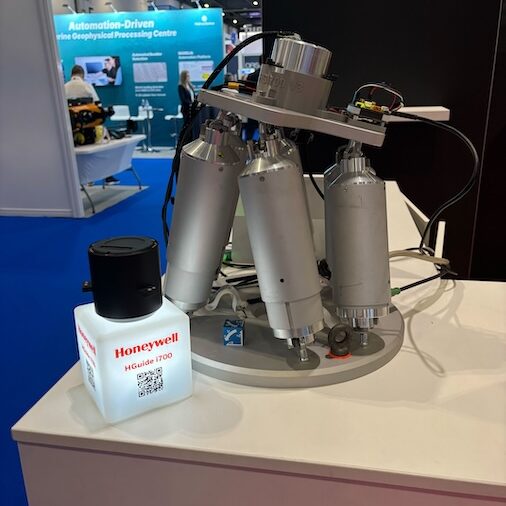
The HGuide i700 was demonstrated at the event on a hexapod platform, illustrating its inertial sensing and motion capabilities, including an ability to gyro-compass to an accurate heading in under 2 minutes, all while in motion.
Looking ahead, Honeywell Aerospace’s continued advances in inertial sensing are expected to support the growth of autonomous marine systems by enabling more reliable navigation, positioning, and data collection in environments where external references are limited or unavailable.
These developments were discussed during an on-site interview with Summer James from Ocean Science Technology at Oceanology International 2026.