

Multibeam Echosounders
Discover cutting-edge solutions from 8 leading global suppliers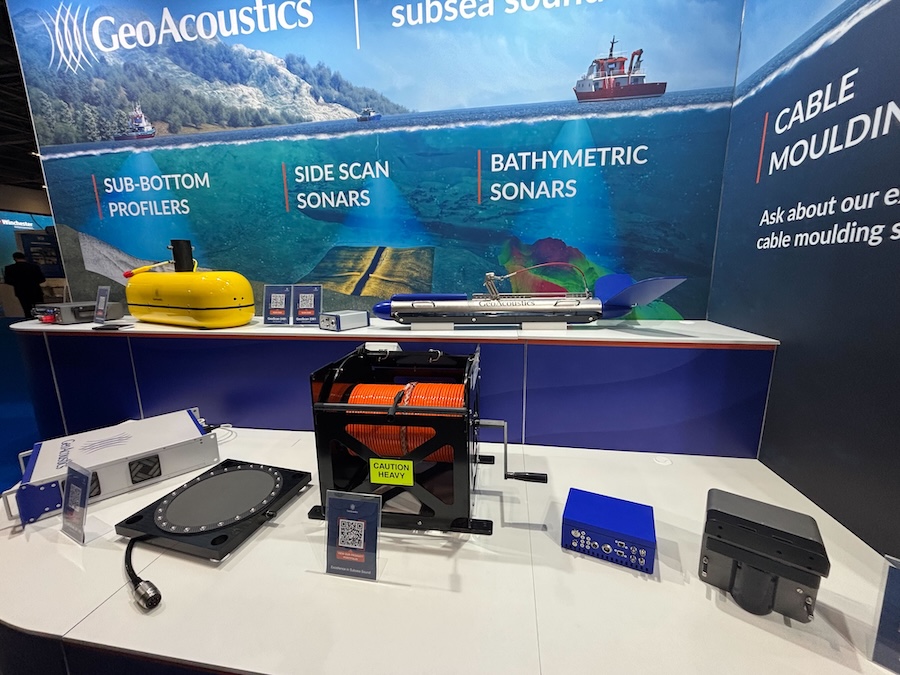
Speaking to Ocean Science Technology at Oceanology International 2026 in London, GeoAcoustics Chief Commercial Officer Richard Dowdeswell introduced two new systems that reflect both a broadening of the company’s portfolio and a wider shift toward more integrated survey workflows.
Currently at Stand P400 during Oceanology International 2026, GeoAcoustics has unveiled two new products: the GeoMB 401 Multibeam Echosounder and the GeoPulse LF 101, a low-frequency boomer system for deeper sub-bottom profiling.
Of the two launches, the GeoMB 401 marks the more notable strategic shift, taking GeoAcoustics into a beamforming multibeam segment that sits outside the interferometric systems the company has long been associated with.
GeoAcoustics has been defined for more than three decades by its GeoSwath interferometric sonar systems, but the wider bathymetric market has long been dominated by beamforming multibeam systems. The GeoMB 401 represents the company’s move to compete in that space directly.
GeoMB Multibeam Echosounder
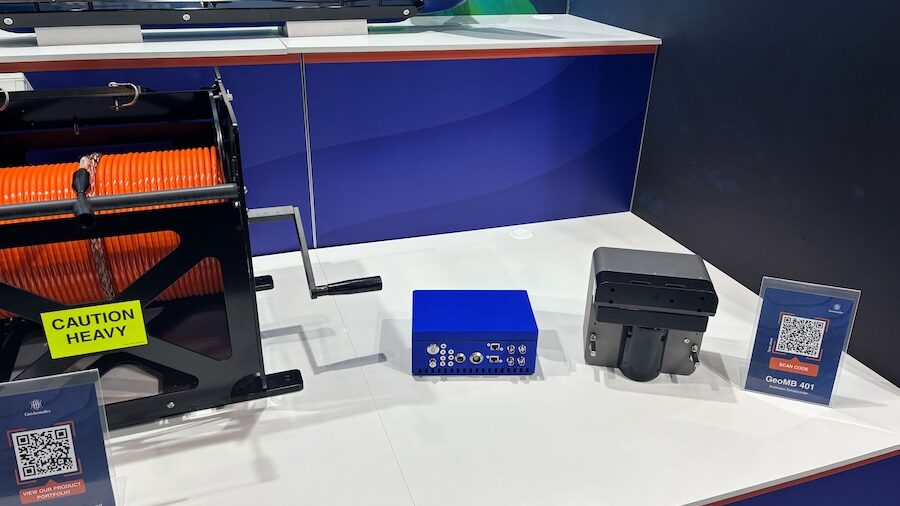
The system integrates an Applanix AP+ positioning and motion module, built-in sound velocity sensor, and transducer into a single unit, which connects to the topside via a single deck cable. Operators add two GNSS antennas, 24 VDC power, and a survey computer. Third-party motion or sound velocity sensors can also be integrated where vessels already carry them. The system operates to 200 meters depth with a beam angle exceeding 140 degrees.
GeoPulse Low-Voltage Boomer
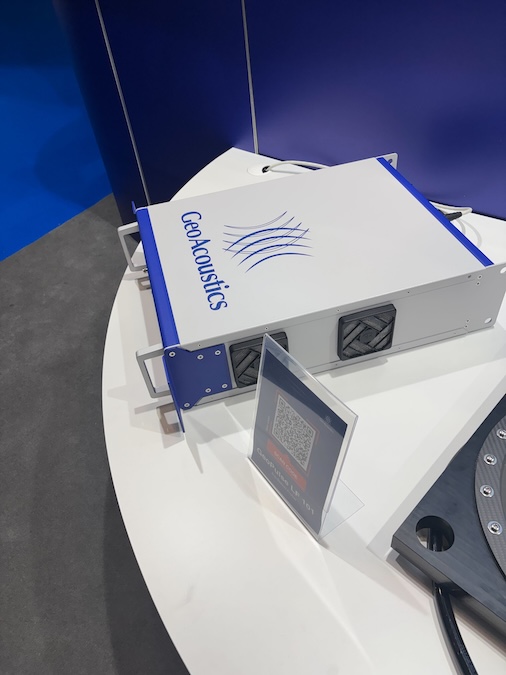
The GeoPulse LF 101 is a return to technology GeoAcoustics offered more than 30 years ago. Operating at a center frequency of around 1.5 kHz and initially at 100 joules, the system achieved up to 80 meters of sediment penetration in testing, which is well beyond what higher-frequency systems like the GeoPulse Compact typically reach.
Speaking with OST at the show, Richard Dowdeswell explained that the core sensing methods used in subsea surveys are likely to remain largely unchanged, with acoustic technologies continuing to dominate underwater measurement due to the limitations of optical systems in turbid marine environments.
“Underwater you’re still going to be relying on sound. A lot of the operating principles aren’t going to change, but over the past decade we’ve seen digitisation, systems getting smaller and more integrated, and more use of AI for data processing and interpretation.”
– Richard Dowdeswell, GeoAcoustics Chief Commercial Officer
Dowdeswell also discussed how artificial intelligence is expected to play an increasing role in survey operations, particularly in assisting with data processing and interpretation as modern acoustic systems generate larger volumes of information. Rather than replacing hydrographic surveyors, these tools are more likely to support them by automating routine analysis tasks and allowing specialists to focus on higher-level interpretation.
Dowdeswell pointed to increasing integration between sensing technologies as the industry evolves. GeoAcoustics recently announced a collaboration with Ocean Floor Geophysics to integrate a magnetometer with a side scan sonar towfish, allowing operators to deploy a single towed unit rather than managing multiple sensors. Such integrated approaches may become increasingly important as the sector moves toward uncrewed survey vessels, where simplifying towing arrangements and launch-and-recovery operations will be key for automated survey workflows.
These launches were discussed during an on-site interview with Summer James from Ocean Science Technology at Oceanology International 2026.