The Global Sourcing Hub for Marine, Subsea & Offshore Technology
Discover cutting-edge solutions from leading global suppliers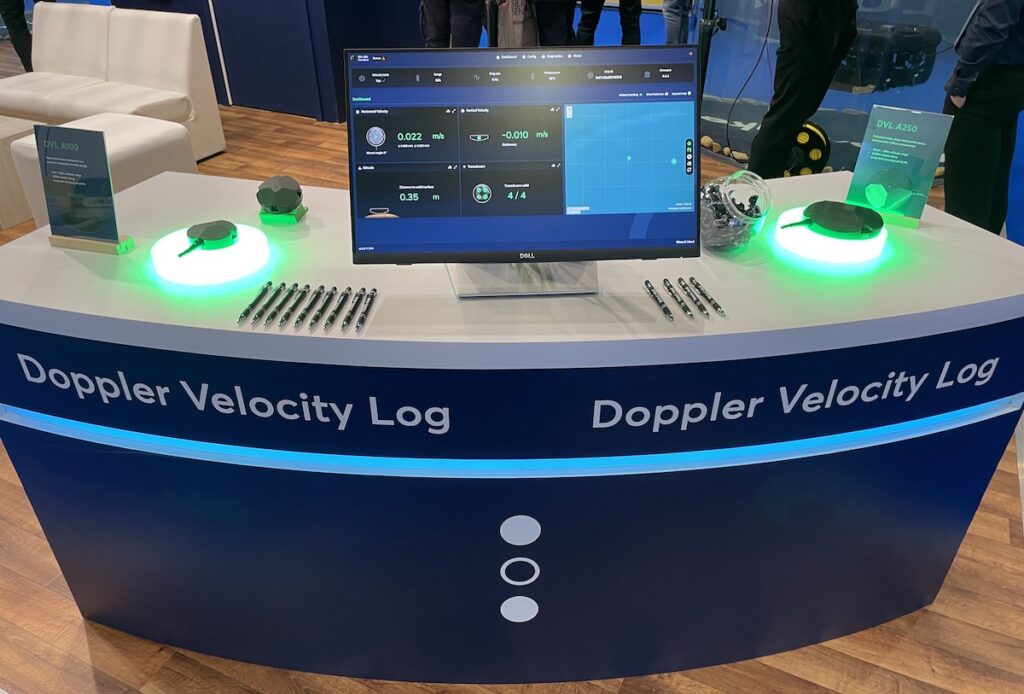
Water Linked used Oceanology International 2026 in London to discuss new Doppler Velocity Log (DVL) developments shaped by customer demand for tighter vehicle integration, increased bottom-lock range, and continued sensor miniaturization.
OST spoke with Scott McLay, Chief Commercial Officer at Water Linked, about the company’s latest DVL configurations, including the A250 and A100, and how future variants are expected to expand navigation capability for compact subsea vehicles.
Customer-Led Development for Integrated DVL Mounting
McLay explained that the latest DVL configuration was developed in response to customer feedback, particularly a request for a tightly integrated solution that could mount directly onto a vehicle without exposed external cabling.
The design was created for Scarv Technologies’ CORAX 600 vehicle, which required a system that could bolt directly onto the pressure housing. Water Linked addressed this using a piston seal interface, allowing the DVL to mount directly to the vehicle while eliminating external cables. This configuration also ensures the sensor can be removed and reinstalled without disturbing calibration.
“But it also allows you to remove and put the sensor back on again precisely in the same position,” McLay said. “Because if you’ve got a calibrated system and you remove something, put it back on, you’ve got to recalibrate it. Not if you’ve got it built in the way that we’ve done it here for this customer.”
A250 DVL for Extended Bottom Lock
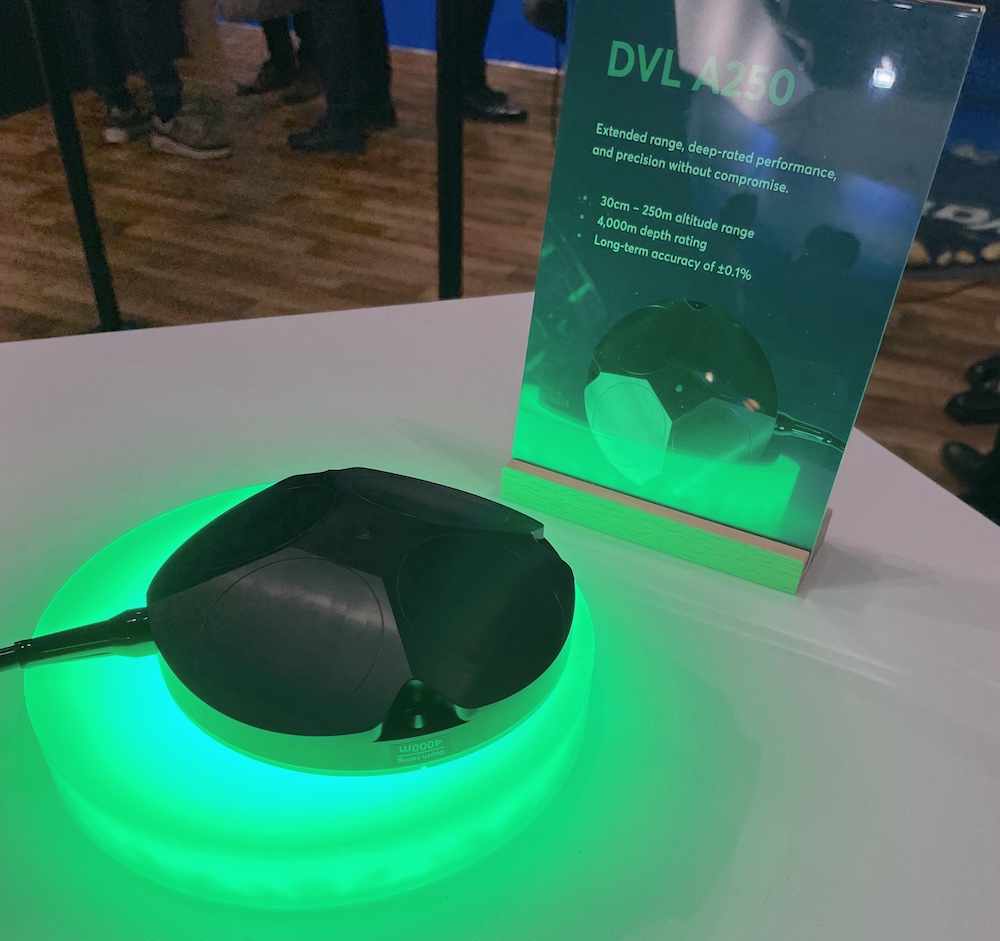
The same customer requirement also drove the development of the DVL A250, which combines the new mounting approach with increased operational range.
“The driving factor for the reason we came with the new DVL was to meet their requirements, which one was that mounting, but also was increased range,” McLay said. “So we came out with the A250.”
The system provides 250 meters of acoustic range, enabling vehicles to maintain bottom lock even when operating significantly above the seabed.
“This is 250 meters acoustic range. So it means that when you’re 250 meters from the seabed, you still have bottom lock to the seabed. So you know the speed at which you’re going over the seabed.”
The A250 is 4,000 meter depth rated as a standard product specification, even though the CORAX 600 itself is not depth rated to that level.
“This vehicle is not 4,000 meter depth rated, but we try and make them 4,000 meter depth rated so it meets all customer needs.”
The sensor is available with either the new rear piston seal entry or the traditional side cable entry, which has been the standard configuration on previous Water Linked systems.
A100 Targets Smaller Vehicle Classes
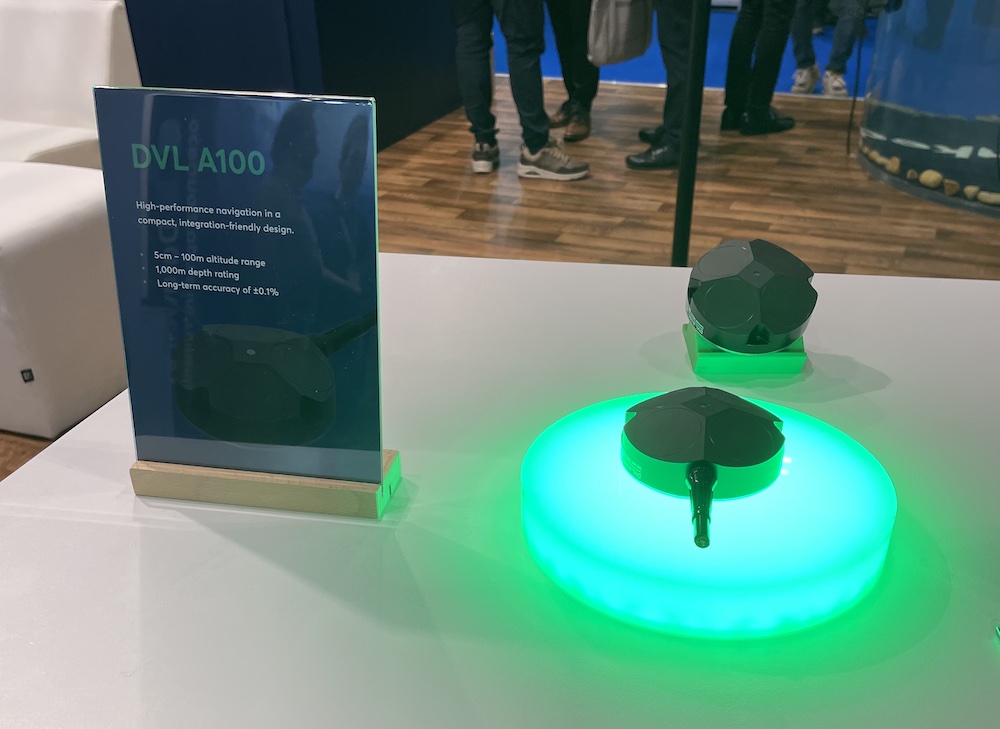
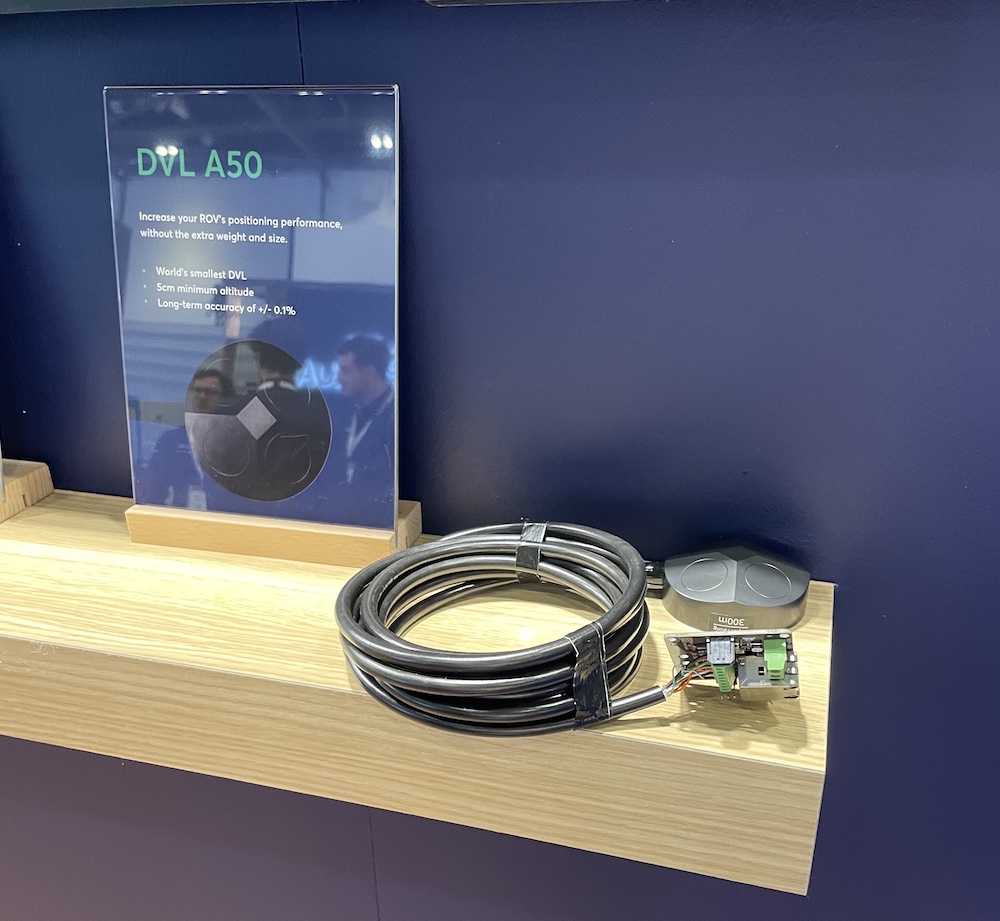
Alongside the A250, Water Linked is also presenting the DVL A100, a smaller system designed for compact subsea vehicles where hull diameter limits sensor size.
The A100 provides 100 meters of acoustic range to the seabed and is similar in capability to the company’s DVL A125, but with a reduced form factor better suited to torpedo-shaped survey vehicles.
“So a lot of the survey vehicles are like, torpedo shaped effectively, and they benefit from a sensor that is smaller than the diameter of the torpedo body shape,” McLay said.
Despite its smaller size, the system maintains comparable operational performance.
“This one is smaller, but it gives the same kind of range as A125, a realistic and highly accurate 100 meters range.”
Miniaturization Without Sacrificing Performance
McLay said the wider motivation behind the A250 and A100 was not only to meet the immediate requirement for tighter integration, but also to continue Water Linked’s focus on reducing sensor size without sacrificing performance.
“The motivation was basically to meet a demand for something that would fit tightly into the system, but also for continuing to miniaturize these sensors.”
He added that Water Linked has built a reputation for producing compact sensors while maintaining measurement capability.
Navigation-Capable Variants Planned
McLay also outlined plans for future variants that will expand navigation capability by improving rotational sensing and onboard data fusion.
Current Water Linked DVLs already include a small MEMS sensor that measures rotation and motion. However, these sensors have relatively high drift over time, which limits long-term navigation accuracy when using Doppler velocity alone.
“The Doppler measurement does not tell you if you’re rotating. It just tells you if you’re going forward, back, up, down, left or right.”
When a vehicle is bottom locked to the seabed, the DVL can track its movement and produce a track plot of its path. However, without accurate rotational measurement, that track can gradually drift or become skewed.
“So although I can do a track plot, if I just rely on the Doppler effect, I won’t get an accurate position because I haven’t taken into account the rotation.”
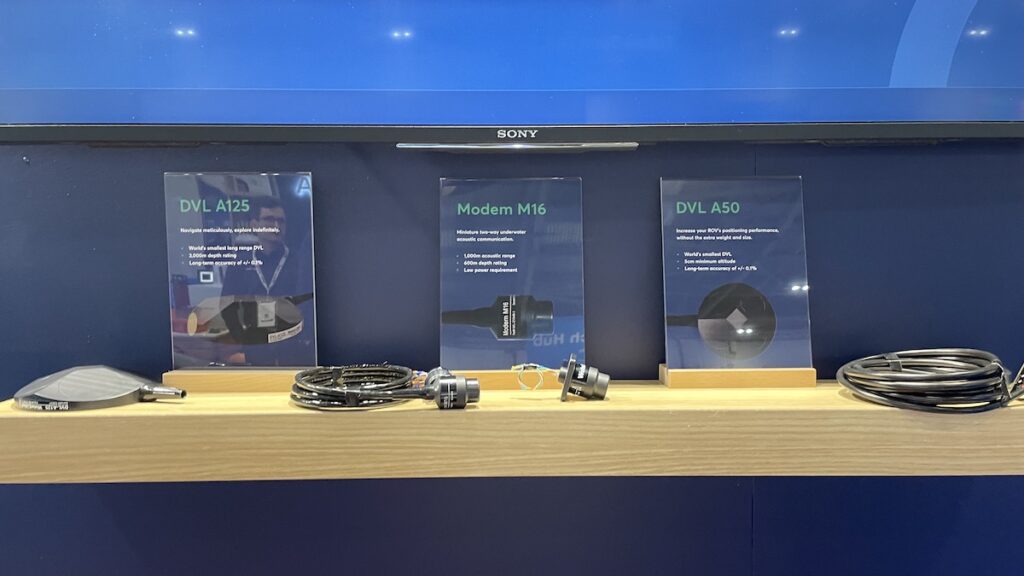
Water Linked therefore plans to integrate a higher accuracy rotational sensor into future DVL variants.
“What we intended to do was bring out a single axis rotational sensor onto the DVL that would give us a long-term dead reckoning, higher accuracy, so your track plot would be more accurate.”
Future versions may also incorporate deeper onboard data fusion so the DVL can provide navigation information directly to the vehicle.
“People don’t want to integrate at their level. They want us to do the data fusion, the IMU and the INS. We do all that data fusion in our DVL and provide the customer with the position information.”
McLay said such capabilities could appear later this year, with the possibility of more advanced variants following afterward.
Future DVL & Sonar Integration
McLay also discussed future integration between Water Linked’s DVL systems and its Sonar 3D-15 imaging sonar.
Currently the two sensors operate independently and do not perform internal data fusion.
“So right now our DVLs and our Sonar work independently of each other. They both provide high quality data, but they do not do the fusion of the data themselves.”
However, Water Linked is exploring deeper integration that would allow velocity information from the DVL to improve sonar performance, while improvements in sonar data could also feed back into navigation calculations.
“But absolutely what we will be doing is we’ll be sharing the data between the DVL and the sonar at a higher level than we would expose to the customer.”
McLay said tighter integration between the sensors is intended to improve overall performance and support applications such as autonomous operation and high-quality environmental mapping.
“It’s all about enabling autonomy and creating 3D point cloud maps and ensuring your data is at the highest possible quality. And we believe that if we do that at our core level, we can achieve a little bit more than you can do by just integrating the sensors standalone.”
These developments were discussed during an on-site interview with William Mackenzie from Ocean Science Technology at Oceanology International 2026.