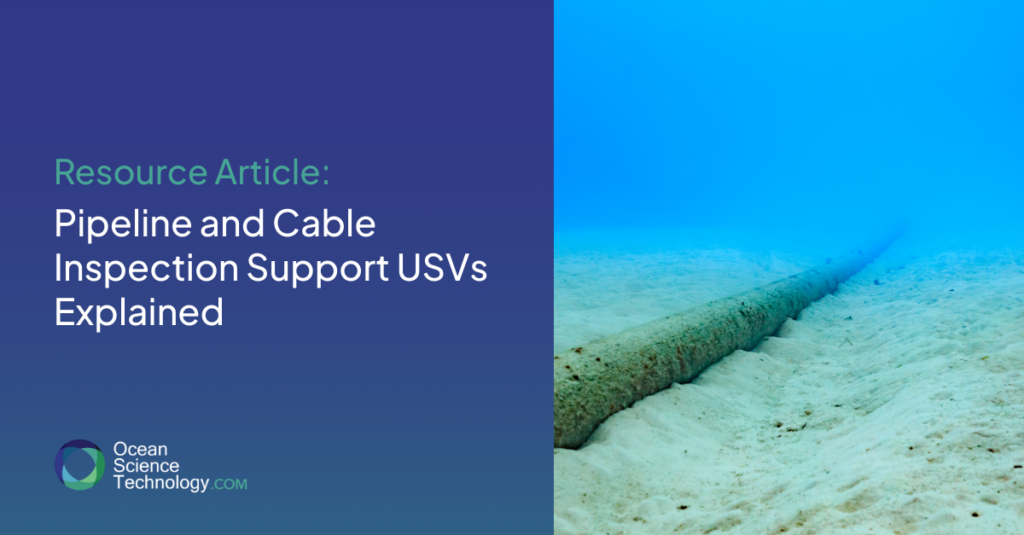
Offshore pipelines and subsea cables form the backbone of modern energy and data infrastructure, yet their inspection depends on a tightly coordinated interaction between surface and subsea systems. While inspection itself is carried out by remotely operated vehicles, autonomous underwater vehicles, and seabed crawlers, uncrewed surface vessels increasingly play a critical supporting role. Inspection support USVs act as mobile surface platforms that extend reach, reduce cost, and improve operational flexibility without replacing the subsea assets that perform visual and sensor-based inspection.
Why Pipelines and Cables Still Need Surface Support
Subsea pipelines and power or telecommunications cables require routine inspection to verify structural integrity, burial depth, free-span development, external damage, and interaction with the seabed or environment. These tasks require close-range observation and measurement, which can only be achieved by subsea systems operating in direct proximity to the asset.
ROVs, AUVs, and tracked crawlers provide cameras, sonars, laser scanners, and contact sensors needed for inspection and survey. However, none of these platforms operates in isolation. Every subsea inspection mission depends on surface-side infrastructure for navigation reference, communications, power management, data transfer, and human oversight.
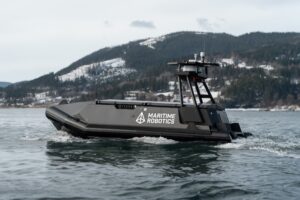
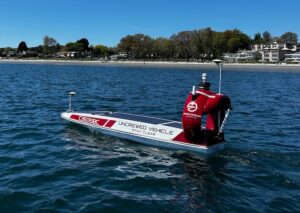
Mariner Uncrewed Surface Vessel by Maritime Robotics
Traditionally, this support has been provided by crewed offshore support vessels. USVs introduce an alternative surface layer for certain mission profiles, particularly in shallow water, nearshore environments, and repeat monitoring campaigns. Their role is not to inspect subsea assets directly, but to enable inspection by serving as a persistent, precisely positioned surface node.
Inspection USVs covered by this article:
What Inspection Support USVs Actually Do
Inspection support USVs perform surface-level roles that would traditionally require a crewed vessel, while the inspection itself is carried out by a subsea asset such as an ROV, AUV, or crawler.
Typical USV responsibilities:
- Navigation and station keeping above the inspection corridor
- Communications relay between subsea systems and operators
- Mission supervision and safety monitoring
- Deployment and recovery support for subsea vehicles
Support USVs do not normally conduct visual or sonar inspection themselves. Their role is to enable inspection by providing positioning, control, and data transmission for the subsea system.
Surface Versus Subsea Responsibilities in Inspection Operations
A clear distinction between surface and subsea roles is essential for understanding how inspection campaigns are actually executed.
Surface responsibilities (including USVs)
Surface platforms handle the enabling functions that make subsea work possible:
- Navigation, collision avoidance, and compliance with maritime rules
- Dynamic positioning / controlled loitering above the inspection corridor
- Communications relay linking subsea vehicles to operators
- Where applicable: power distribution, plus mission safety and system health monitoring
Subsea responsibilities (inspection vehicles)
Subsea vehicles perform the inspection task itself:
- ROVs: visual inspection, sonar imaging, metrology, touchdown verification
- Crawlers: seabed interaction for detailed burial and exposure assessment
- AUVs: pre-programmed survey lines for wide-area route assessment and anomaly detection
Why this matters
This division of responsibility counters common misconceptions around autonomy. Unmanned surface vehicles do not replace subsea vehicles or human expertise — they provide the surface infrastructure that enables subsea inspection to be conducted more efficiently across a wider range of operating conditions.
DataXplorer™ Survey by Open Ocean Robotics
Why Operators Use USVs Instead of Crewed Vessels
The adoption of support USVs is driven by practical operational considerations rather than novelty. Cost reduction is a primary factor for shallow-water and nearshore inspection campaigns where the overhead of a large offshore vessel is disproportionate to the task.
Reducing personnel exposure is another driver. USVs remove crew from hazardous or remote environments, particularly during repetitive monitoring operations or in congested coastal zones. Smaller logistics footprints simplify mobilization and demobilization, making regional inspection programs more flexible.
USVs also enable persistence. Operators can conduct repeat inspections along the same pipeline section, return to previously identified anomalies, or maintain long-term monitoring presence without committing a crewed vessel for extended periods.
Importantly, USVs are not positioned as universal replacements. Deepwater inspections involving heavy ROV systems, complex intervention tasks, or high-power requirements continue to rely on conventional offshore support vessels.
Typical Inspection Scenarios Where USVs Make Sense
Support USVs are best suited to specific operational scenarios. Shallow-water pipeline inspection is a common application, particularly for export lines, infield flowlines, and coastal infrastructure. Nearshore and landfall cable inspections also benefit from the maneuverability and reduced footprint of uncrewed surface platforms.
Post-installation surveys represent another use case in which USVs can support ROV or AUV verification runs along newly laid pipelines or cables. Targeted re-inspection following anomaly detection allows operators to respond quickly without remobilizing large vessels.
Environmental monitoring conducted alongside infrastructure inspection is increasingly integrated into campaigns. USVs can support subsea inspection while simultaneously hosting surface or water-column sensors to collect complementary data.
Technical Considerations When Using USVs for Inspection Support
USV support craft operate within defined technical envelopes that shape mission planning. Payload capacity and deck layout determine which subsea systems can be deployed and how launch and recovery are executed. Power availability limits the size and endurance of supported ROVs or auxiliary equipment.
Communications architecture is a critical factor. Operators must account for latency, bandwidth, and redundancy across radio, satellite (SATCOM), and acoustic links. Weather and sea-state constraints influence launch and recovery limits and station-keeping performance.
Human-in-the-loop control models remain central. While surface navigation and station keeping may be automated, subsea inspection tasks rely on operator oversight, decision-making, and intervention. These USVs are designed to integrate with supervised autonomy rather than eliminate human control.
Regulatory and Operational Constraints
Regulatory compliance shapes how and where inspection support for USVs can be deployed. Collision avoidance requirements, operational restrictions in shared waterways, and flag-state or coastal-state regulations all influence mission design.
Remote supervision, insurance acceptance, and client requirements must be addressed early in the planning process. These factors do not prevent the use of USVs but define the operational framework within which they can be deployed responsibly and credibly.
Where USVs Fit in Modern Subsea Inspection Strategies
Inspection support USVs are best understood as complementary surface platforms within mixed fleets. They increase flexibility by enabling inspection in environments and at frequencies that are impractical with crewed vessels alone. They lower costs for suitable missions while maintaining human oversight and operational control.
Rather than enabling autonomous inspection, USVs enable more inspection. By supporting ROVs, AUVs, and crawlers with positioning, communications, and coordination, they allow operators to adapt inspection strategies to the realities of modern offshore infrastructure management.