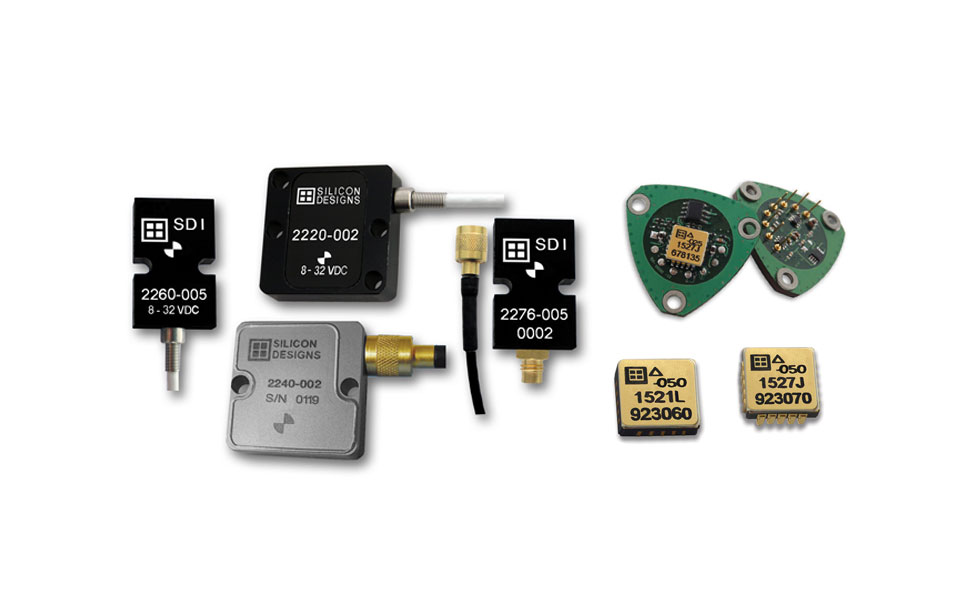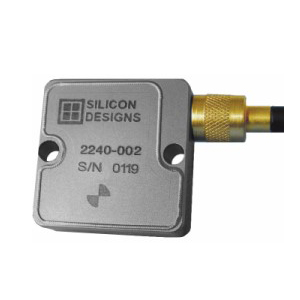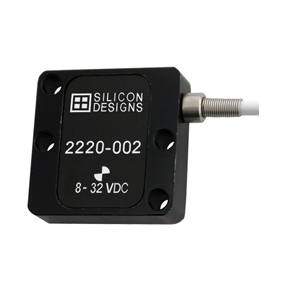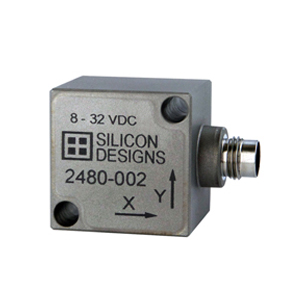


Silicon Designs Inc. has introduced the Model 1523, a precision industrial microelectromechanical systems (MEMS) accelerometer designed for applications where temperature-related changes can affect measurement accuracy.
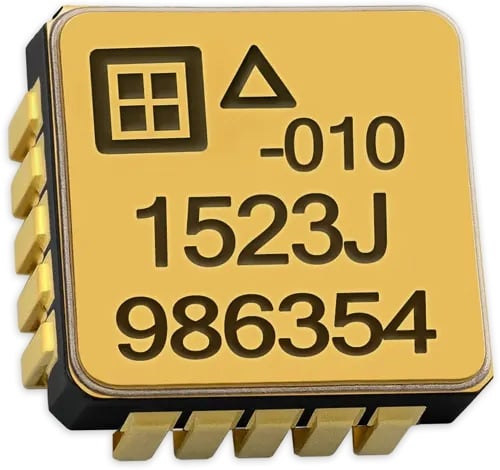
The Model 1523 is the highest-performing accelerometer in the company’s industrial surface-mount range, offering tighter limits on bias and scale-factor temperature coefficients without requiring a move to an inertial-grade sensor.
Designed for applications operating across changing temperatures, the accelerometer specifies a bias temperature coefficient of ±25 parts per million (ppm) of span/°C and a scale-factor temperature coefficient of -50/+25 ppm/°C across an operating temperature range of -55°C to +125°C.
Individual Thermal Calibration and Verification
Each Model 1523 accelerometer undergoes individual thermal characterization and calibration during production, followed by climate-chamber verification of bias and scale-factor performance over temperature.
The accelerometer provides continuous response down to 0 Hz DC, enabling the measurement of static and very low-frequency acceleration alongside dynamic motion within its usable bandwidth. Additional features include a low-noise differential analog output, ±4 V differential full-scale output, a 5,000 g peak mechanical shock rating, and a hermetically sealed ceramic J-lead package.
Each unit is individually serialized and supplied with a calibration report documenting measured bias, scale factor, linearity, operating current, and frequency response.
Measurement Ranges and Applications
The Model 1523 is currently available in three standard measurement ranges: ±10 g, ±25 g, and ±50 g.
The accelerometer is designed for applications requiring tighter limits on temperature-related measurement errors than Silicon Designs’ standard industrial accelerometers provide, while retaining the analog architecture and interface of its industrial surface-mount family.
Potential applications include precision instrumentation, industrial automation, robotics, structural monitoring, machine condition monitoring, seismic measurement, inertial sensing, and test and measurement.