
Knight Optical highlights how optical filters can improve image quality, measurement accuracy and detection performance in subsea 3D imaging and hydrocarbon leak detection, where absorption, scattering, pressure and salinity create challenging operating conditions.
Water absorbs light unevenly across the spectrum, with red wavelengths absorbed fastest and blue-green light penetrating furthest. For this reason, many subsea imaging systems operate in the blue-green region, where water transmission is relatively high.
Suspended particles also scatter light back toward cameras, reducing contrast and producing haze, particularly when artificial illumination is used. For 3D imaging and surveying, scattering and refractive effects can introduce noise and distortion that compromise measurement accuracy and 3D reconstruction fidelity.
In laser-based 3D imaging, narrow bandpass filters are often matched to the illumination wavelength to help reject ambient and backscattered light and improve measurement accuracy. More generally, optical filtering can improve signal-to-noise ratio, contrast and color fidelity while preventing unwanted out-of-band light from reaching the sensor.
Filters for Subsea Imaging Systems
Bandpass filters transmit a specific, narrow wavelength range while blocking wavelengths outside it. In laser line scanners, structured-light systems and subsea LiDAR, they are commonly matched to the illumination wavelength.
Longpass filters transmit wavelengths above a defined cut-on point while blocking shorter wavelengths. Shortpass filters transmit wavelengths below a defined cut-off while blocking longer wavelengths, making them relevant where longer-wavelength thermal or infrared (IR) content needs to be excluded.
Neutral density filters reduce light intensity evenly across the spectrum without shifting color, helping manage exposure when artificial illumination risks overexposing the sensor.
In systems using high-power illumination, IR radiation can introduce unnecessary thermal loading within the optical assembly. Hot mirrors reflect IR while transmitting visible light, while cold mirrors reflect visible wavelengths and transmit IR away from the illumination path.
Hydrocarbon Leak Detection
Oil, gas and related compounds have characteristic spectral signatures at specific infrared wavelengths. Optical filters can isolate these wavelengths to improve differentiation between hydrocarbons and the surrounding underwater environment.
SWIR and MWIR wavelengths are commonly used for hydrocarbon detection, although wavelength-dependent water absorption must also be considered. Filter center wavelength and bandwidth need to balance hydrocarbon contrast with underwater transmission while maintaining sufficient signal strength.
Many subsea monitoring systems use multiple filters to compare different wavelength bands, helping distinguish hydrocarbons from their surroundings and reduce false positives.
Specifying Filters for Subsea Operation
Filter selection must account for wavelength, transmission requirements, environmental durability, pressure resistance and Angle Of Incidence (AOI). Materials, coatings and substrates must withstand prolonged saltwater exposure, while filters and mounts may need to tolerate significant pressure without compromising optical performance.
AOI is particularly important for interference-based coatings because spectral performance can change with angle. Off-axis systems and fixed illumination geometries therefore need to achieve the specified spectral performance at their intended operating angle.
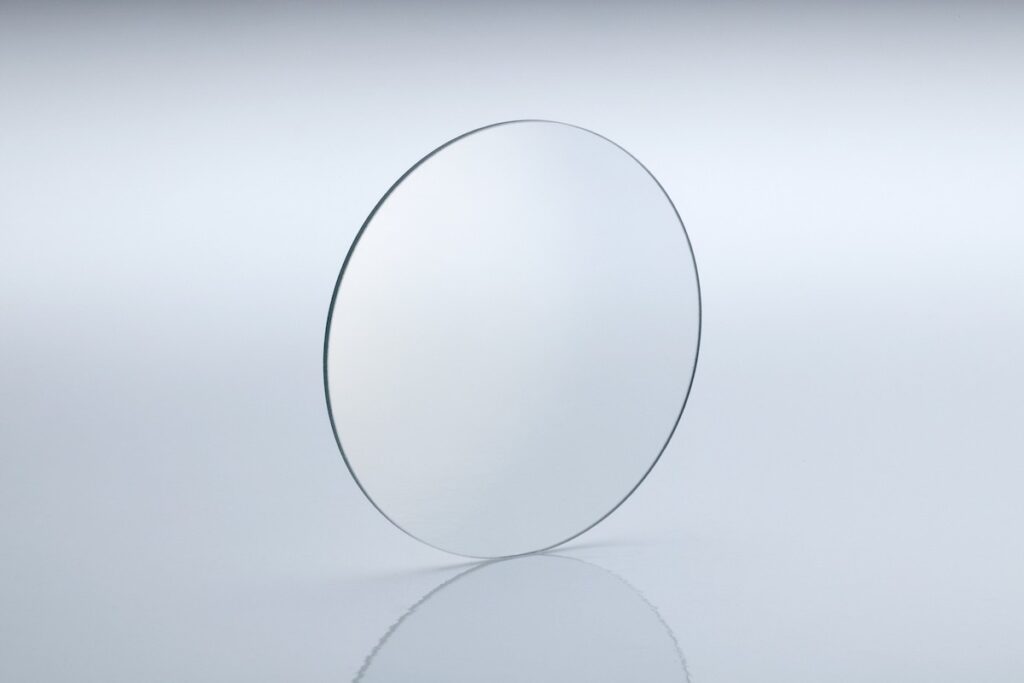
Knight Optical supplies stock and custom optical filters, including bandpass, longpass, shortpass, neutral density, hot mirror and cold mirror designs, with substrate and coating options tailored to demanding subsea environments.
Find out more about Knight Optical’s stock and custom optical filters for subsea imaging here.