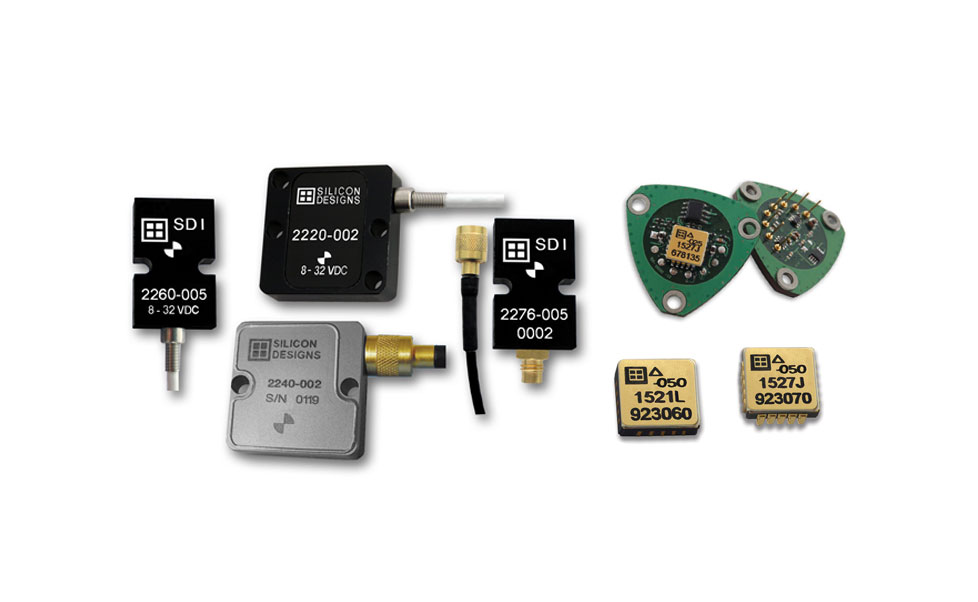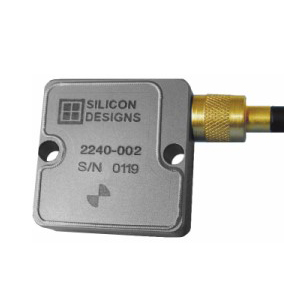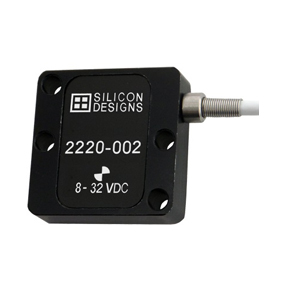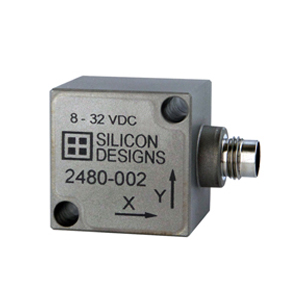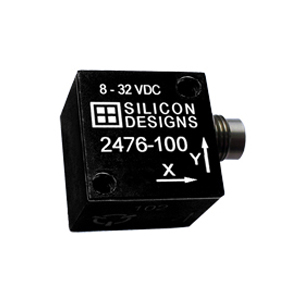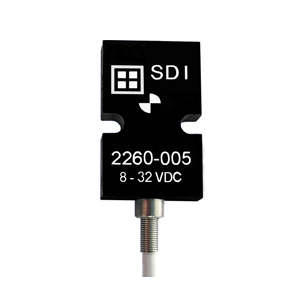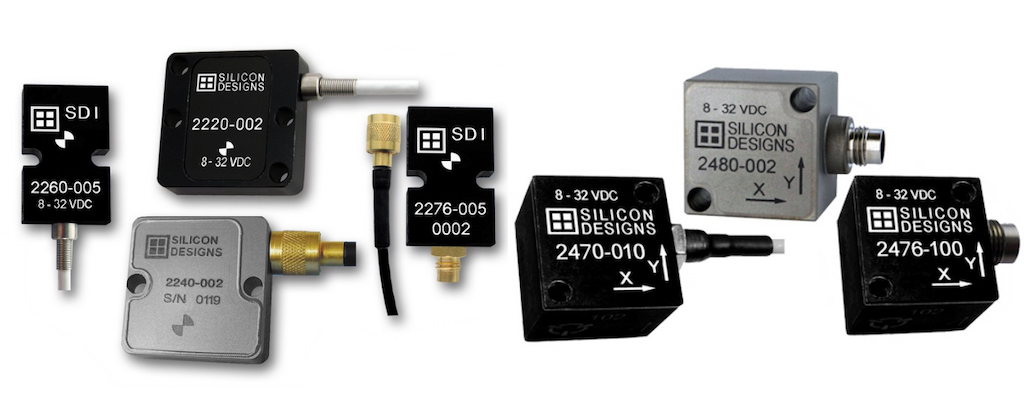


Silicon Designs’ SDI Models 2240 and 2480 are hermetically sealed MEMS DC accelerometers developed for acceleration and vibration sensing where moisture, contamination, temperature extremes, or mechanical stress may affect instrumentation. Read more >>
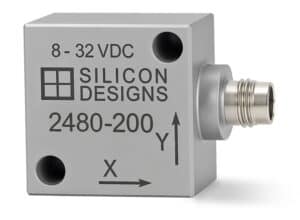
SDI 2480-200
The 2240 sits within the company’s 1-axis range, while the 2480 is configured as a 3-axis module.
Both models combine corrosion-resistant titanium enclosures with thermally stable electronics, internal damping, and low impedance outputs. Available measurement ranges extend from ±2g to ±400g, with frequency response reaching beyond 4000 Hz in selected configurations.
Hermetic Construction for Environmental Protection
The 2240 and 2480 are housed in hermetically sealed titanium cases designed to protect the internal sensing components from moisture and particulates. Their lightweight cases carry an IP67 rating.
Specialty connectors are rated to IP61 and can meet IP67 when appropriately sealed with a boot, sleeve, or heat shrink. Silicon Designs recommends sealing and protecting the cable connection during installation for best results.
Mounting can be accomplished with two screws, adhesive, or a magnet. Shielded cabling and connector options are available for custom installations, and the specialty connectors accommodate customized cable lengths.
Measurement Ranges and Frequency Response
The 2240 and 2480 are offered in ±2g, ±5g, ±10g, ±25g, ±50g, ±100g, ±200g, and ±400g measurement ranges. Differential sensitivity, frequency response, output noise, and maximum mechanical shock capability vary between these configurations.
For the ±2g version, differential sensitivity is 2000 mV/g and typical differential output noise is 10 μg/√Hz. Typical 3 dB frequency response spans DC to 525 Hz, while the minimum 3 dB response is DC to 300 Hz and the typical 5% response is DC to 250 Hz.
At ±400g, differential sensitivity is 10 mV/g and typical differential output noise is 475 μg/√Hz. Typical 3 dB frequency response extends from DC to 4200 Hz, with a minimum 3 dB response of DC to 2400 Hz and a typical 5% response of DC to 2000 Hz.
Maximum mechanical shock, measured at 0.1 ms, is 2000g peak for the ±2g and ±5g configurations. Versions from ±10g through ±400g are rated to 5000g peak.
Output Stability and Power Requirements
Thermally stable electronics and internal damping help the accelerometers resist signal drift associated with temperature fluctuations and mounting stress. Their specified operating temperature range extends from -55 to +125°C.
Both models accept +8 to +32 VDC power. Onboard voltage regulation and an internal voltage reference eliminate the requirement for a precision power supply, while integrated amplifiers provide low impedance outputs capable of supporting cable lengths of up to 2000 feet.
These characteristics allow the sensors to be installed in mobile systems and exposed locations where operating conditions may vary.
Differential and Single-Ended Connections
Silicon Designs specifies differential operation using both AOP and AON output signals for optimal performance from the 2240 and 2480. Single-ended operation is also supported when a differential connection is unavailable.
The accelerometers generate differential analog AON and AOP output voltage pairs that vary according to acceleration. These outputs operate differentially around a common-mode voltage of approximately 2.5 V.
At zero acceleration, nominal differential output is 0 VDC. At positive and negative full-scale acceleration, output reaches +4 VDC and -4 VDC, respectively. The output scale factor remains independent of the +8 to +32 V supply voltage.
For single-ended operation, Silicon Designs recommends connecting AOP and GND to the instrumentation while leaving AON disconnected. Using this arrangement reduces both the signal-to-noise ratio and sensitivity ratio by half compared with a differential connection.
Specified output options are ±4 V differential and 0.5 V to 4.5 V single-ended.
Calibration and Traceability
Each 2240 and 2480 is calibrated and individually serialized for traceability. An initial calibration report accompanies each unit and provides additional data covering linearity, output, phase, and frequency response obtained during testing of that particular accelerometer.
The combination of hermetically sealed titanium construction, measurement ranges from ±2g to ±400g, a -55 to +125°C operating range, differential and single-ended connectivity, and low impedance outputs provides a range of configuration options for acceleration and vibration measurement where environmental exposure must be considered.