


The Global Sourcing Hub for Marine, Subsea & Offshore Technology
Discover cutting-edge solutions from leading global suppliers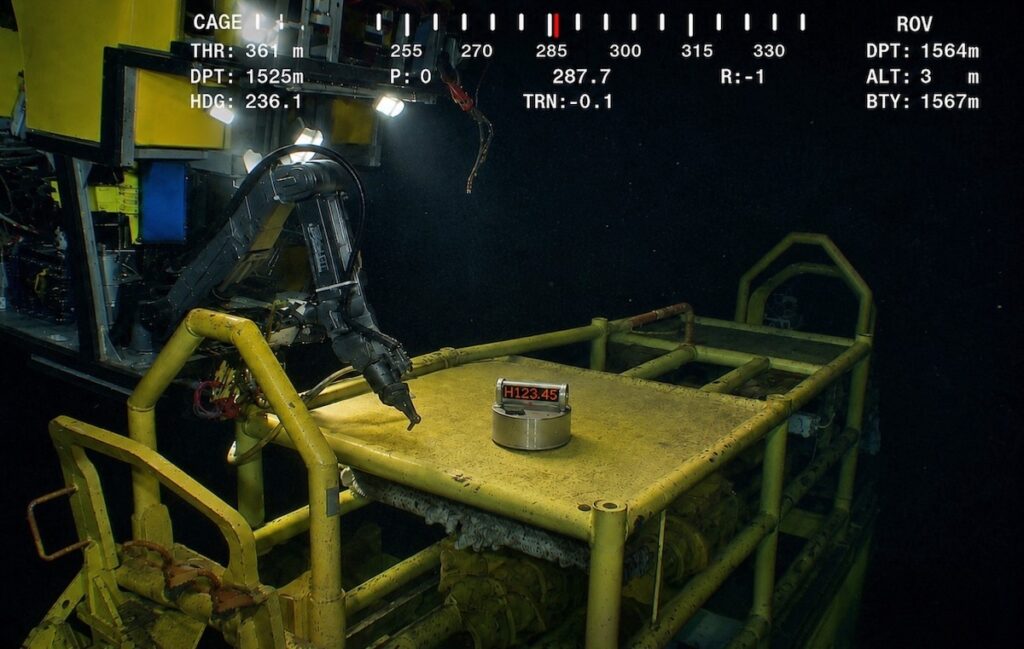
A self-contained subsea orientation tool from Zupt allows remotely operated vehicles to instantly measure structure heading, pitch, and roll without relying on external communications or acoustic data links.
The Subsea Static Heading Sensor features an integrated LED display optimized for seawater visibility that can be read directly by ROV cameras from distances exceeding three meters. Designed for rapid deployment, the device powers on automatically upon deployment and conserves energy until it is moved or rotated, with an internal rechargeable battery providing at least eight hours of operational life. The display angle is adjustable to match specific subsea deployment environments, and customizable LED colors further enhance readability in varying water conditions.
Housed in titanium rated for depths down to 4,000 meters, the compact unit relies on a MEMS Inertial Measurement Unit to capture real-time spatial data. Onboard accelerometers deliver continuous pitch and roll measurements with accuracy levels better than 0.1 degrees. For heading performance, optional motorized rotation enables quadrant-based gyrocompassing, providing accuracy approaching that of high-end inertial navigation systems at a lower cost profile.
To cater to diverse operational requirements across subsea positioning, monitoring, and offshore wind installation support, the modular device is offered in three distinct configurations. The tactical-grade IMU A version provides heading accuracy within 1.0 degree Sec Lat. RMS after an eight-minute alignment alongside pitch and roll accuracy of under 0.05 degrees RMS across a 0 to 45 degree tilt range. The mid-grade IMU B alternative achieves heading accuracy within 5.0 degrees Sec Lat.
RMS and pitch and roll accuracy under 0.1 degrees RMS. A cost-optimized IMU C model eliminates internal rotation to focus exclusively on static pitch and roll accuracy under 0.1 degrees RMS. Additionally, the sensor’s modular design permits future system upgrades without needing to replace the primary titanium housing.