The Global Sourcing Hub for Marine, Subsea & Offshore Technology
Discover cutting-edge solutions from leading global suppliers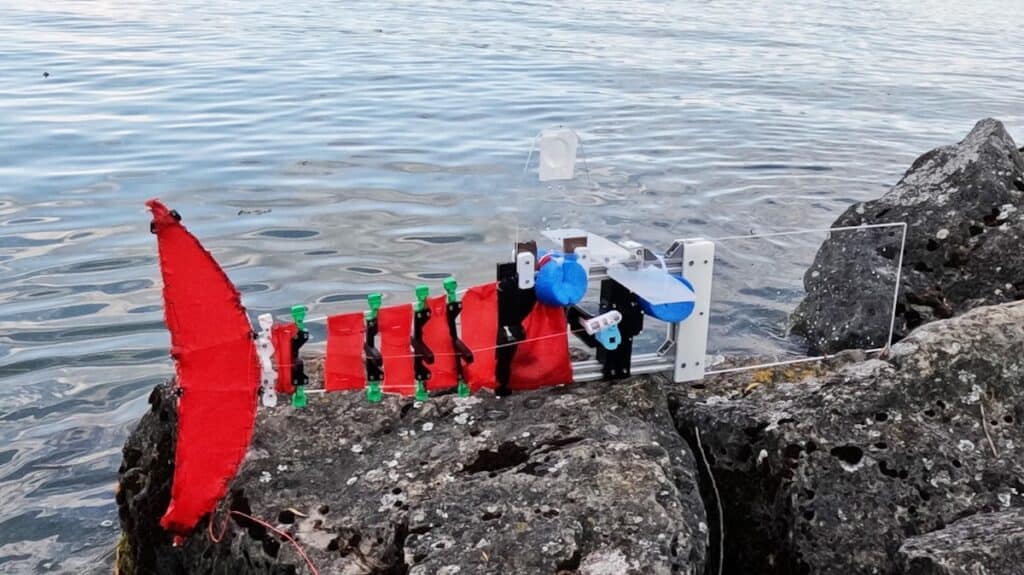
Engineers at EPFL and New York University have developed a bio-inspired robotic fish that can be scaled nearly fivefold in size while maintaining similar fish-like swimming behavior across different environments.
Conventional propeller-driven underwater vehicles can face limitations in complex aquatic settings, as spinning blades can entangle in vegetation, disturb sediment, or startle the wildlife being studied. While fish-inspired robots offer an alternative by flexing their bodies rather than relying on propellers, existing designs are typically built for a particular size and application, meaning scaling them up or down can require substantial redesign.
Nana Obayashi, first author on the study published in npj Robotics, stated, “Right now, if you want to monitor a creek and then monitor a lake, you basically need two different robots, built and tested from the ground up. The environments we care about don’t come in one size, so we don’t think the tools should either.”
Obayashi, currently an assistant professor of mechanical and aerospace engineering at the NYU Center for Robotics and Embodied Intelligence, led the project while completing her PhD in the Computational Robot Design & Fabrication Lab, led by Josie Hughes, in EPFL’s School of Engineering.
The team’s robot, named ScaFi (Scalable Fish), models its movement on species such as cod and mackerel, which concentrate much of their body bending toward the tail. ScaFi features a rigid forward section coupled with a flexible tail formed from fiberglass rods, with a single motor pulling two crossed tendons to produce the S-shaped bending motion used for propulsion.
The key to scaling the design is the diameter of the fiberglass rods. As ScaFi increases in size, the rods become proportionally thicker to preserve similar tail-bending behavior, while the basic motor mechanism and crossed-tendon actuation system remain unchanged. This approach could reduce the engineering effort required to develop fish-inspired robots for environments ranging from shallow creeks to larger bodies of water, while also giving researchers a way to study how swimming performance changes with scale.
Testing ScaFi Across Different Scales
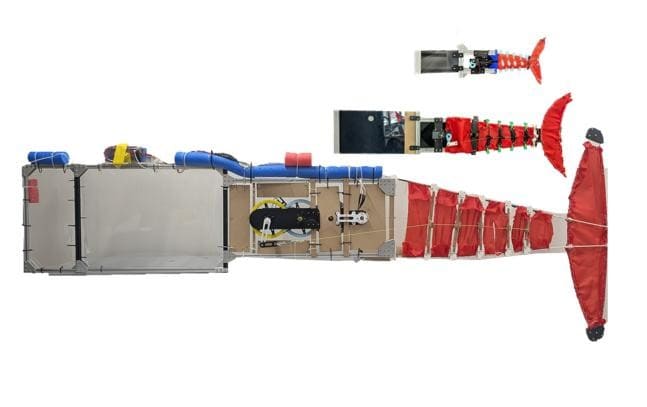
Researchers constructed three ScaFi prototypes measuring 0.6, 1.1, and 2.9 meters in length. In collaboration with the Unsteady Flow Diagnostics Lab led by Karen Mulleners at EPFL, the team found that the smallest robot produced swirling water patterns similar to those generated by real fish. Across all three sizes, the swimming motions also aligned closely when adjusted for body size, indicating that the scaling approach preserved the fish-like gait as the robots increased nearly fivefold in length.
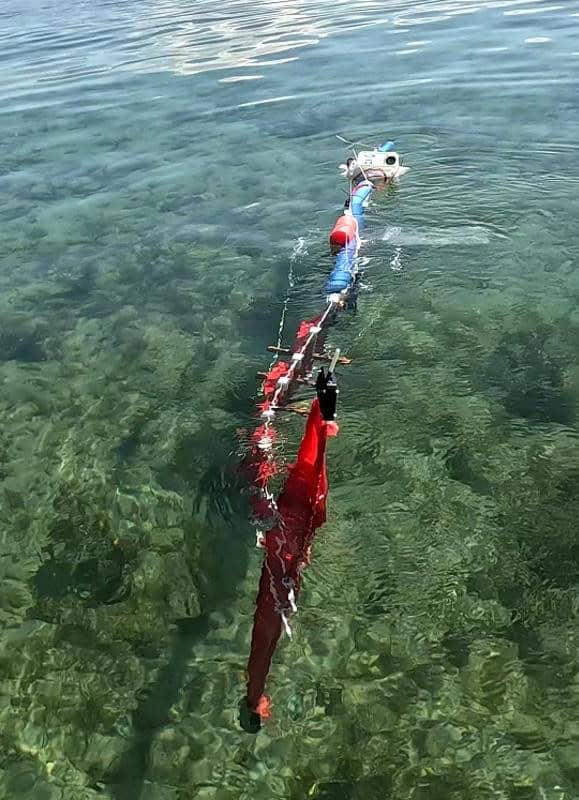
The robots were also tested in the field. The medium-sized ScaFi was deployed in a Swiss stream, the largest was tested on Lake Geneva, and the smallest operated in creeks only 15–30 centimeters deep. During the stream deployment, the robot continued swimming even after a GPS dropout.
Field testing also highlighted key performance trade-offs associated with dimensional scaling. While the swimming motion itself scaled successfully, energy efficiency proved more challenging. The two smaller robots performed similarly, but the 2.9-meter model was consistently less efficient and required a different, more powerful motor. The researchers suggest that drag and inertia may contribute to this difference, although the precise cause remains unresolved.
Size also affected the robots’ response to disturbances. The smallest prototype was the most agile but took longer to recover after being knocked off course, while the larger robots were less maneuverable but more stable.