The Global Sourcing Hub for Marine, Subsea & Offshore Technology
Discover cutting-edge solutions from leading global suppliers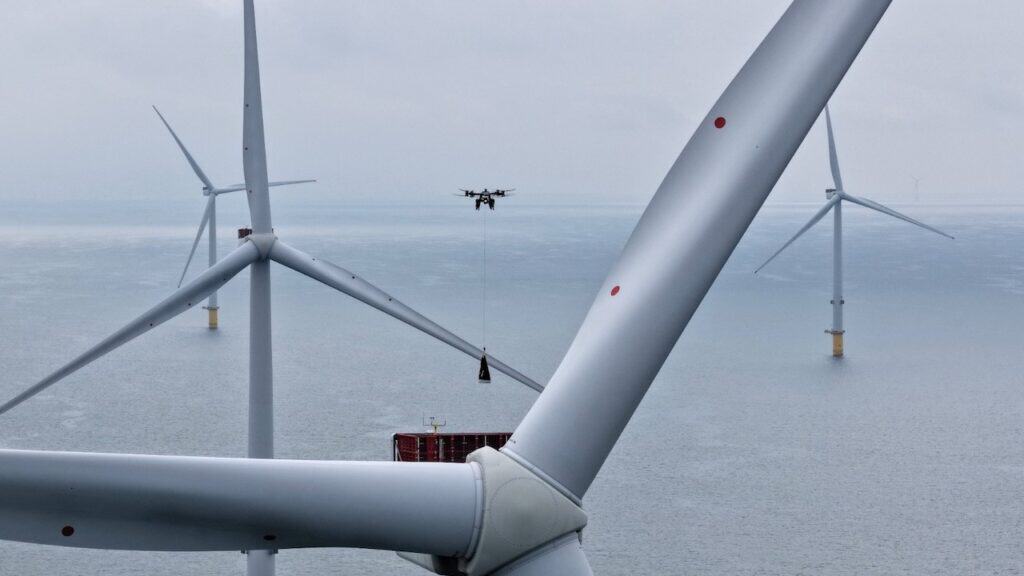
RWE and Ampelmann have successfully completed a six-week offshore cargo drone logistics campaign supporting maintenance activities at the Triton Knoll offshore wind farm.
Conducted between August and September, the campaign involved more than 250 flights transferring over nine tonnes of cargo between a Service Operation Vessel (SOV) and turbines at the 857 MW wind farm.
RWE, the UK’s leading renewable power generator, will take over full maintenance responsibilities for Triton Knoll in 2027 and is exploring how cargo drones can support its SOV logistics model to reduce costs and improve operational efficiency.
During the campaign, turbines were pre-loaded with tools, maintenance parts and safety equipment before technicians arrived at their worksites. Cargo could also be retrieved remotely after technicians had finished their shifts.
Ampelmann supported maintenance activities across the wind farm by delivering and collecting cargo directly to and from the nacelle and main access platform. Its drones are equipped with an unmanned pick-up system that allows cargo weighing up to 80 kilogrammes to be collected and released without personnel manually handling the load.
Since launching its Cargo Drone Services in 2024, Ampelmann has built up operational experience across a range of projects in Europe. The company has developed its own flight control software to automate flights between vessels and turbines.
Pilots remain responsible for the operation, supervising flights and intervening whenever required for safety, while the software handles routine flight execution.
Ampelmann has also automated the cargo pick-up process, with the drone, winch and pick-up hook working together as an integrated system to collect cargo without manual intervention during the pick-up sequence. According to the company, these developments shorten delivery and pick-up cycles, reduce pilot workload and make cargo drone operations easier to integrate into the day-to-day logistics of an offshore wind farm.
Thijs van ’t Geloof, Business Developer at Ampelmann, commented, “The productivity gains of our drone service are firmly established. By working into the night, we can turn vessel idle time directly into productive lifting work. We can also deliver and retrieve cargo remotely from operating turbines, allowing power generation to continue while we conduct our operations. In addition to reducing vessel movements, crane lifts and manual cargo handling, we increase the effective tool time of technicians by 15 to 20%.”
Morten Christiansen, RWE Engineering Manager at Triton Knoll Offshore Wind Farm, said, “We were delighted to work with Ampelmann on this trial at Triton Knoll because we believe cargo drones can significantly enhance the Service Operation Vessel-based logistics model. By reducing reliance on conventional craning operations, this technology can improve safety, efficiency and productivity, while optimise vessel utilisation and enabling more transfers each day. Supporting the validation of cargo drone logistics reflects our commitment to improving the long-term performance of our offshore wind fleet.”
Thijs van ’t Geloof, Business Developer at Ampelmann, added, “We would like to thank RWE, and the Triton Knoll site team in particular, for their commitment to this project. The important step they took was not simply proving that drones can move cargo offshore, but integrating them into the day-to-day planning of a wind farm and rethinking the logistical puzzle around technicians, vessels and cargo. Triton Knoll recognised that opportunity and actively reached out to us to explore it. We greatly value working with forward-looking sites like Triton Knoll that are willing to rethink how offshore operations are planned, because that is what is needed for cargo drones to develop into a truly scalable part of offshore logistics.”