


Unmanned Surface Vehicles (USVs)
Discover cutting-edge solutions from 4 leading global suppliers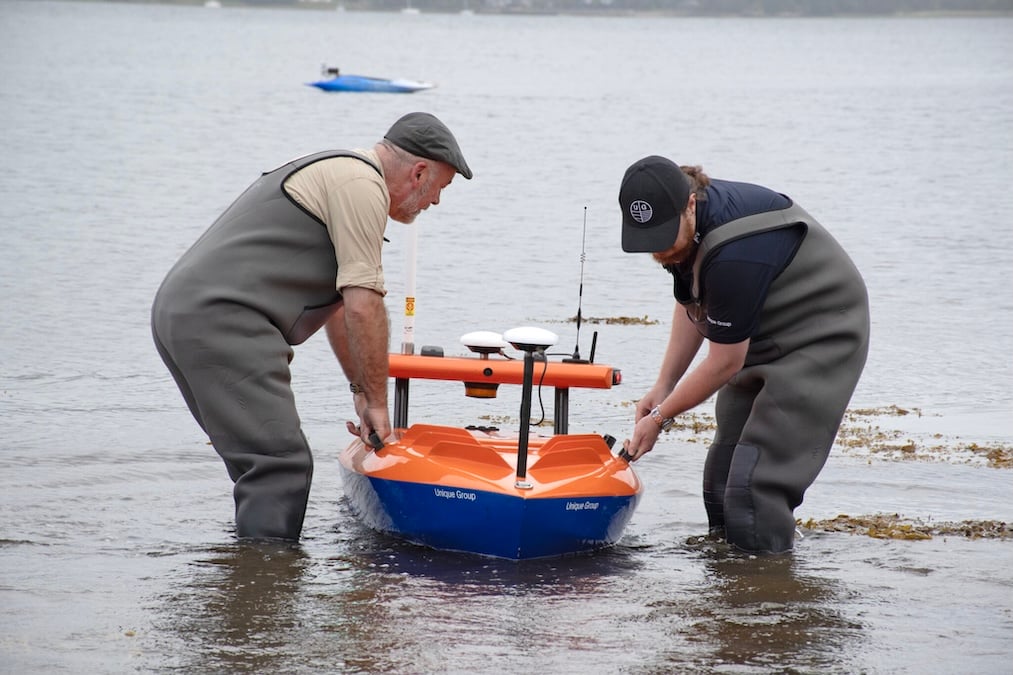
Unique Group details how its Uni-Mini Unmanned Surface Vessel (USV), integrated with a Ping DSP system, was deployed to conduct a high-resolution bathymetric survey in Loch Melfort, Scotland.
Undertaken in 2025 for Kilchoan Melfort Trust, the Scottish Association for Marine Science (SAMS), and the University of Glasgow, the project provides data to support habitat suitability modeling for the long-term restoration of native European flat oyster populations.
Uni-Mini Deployment in Shallow Waters
 The survey required a safe, environmentally responsible, and highly accurate approach to mapping shallow and ecologically sensitive areas within the Kilchoan Estate, where conventional survey vessels faced access and operational constraints.
Ultra-shallow waters restricted access for traditional manned survey vessels, while the loch’s remote location and difficult access required a low-logistics deployment approach. Conventional Multi Beam Echo Sounder (MBES) systems also presented limitations in shallow water, reducing achievable survey coverage. Numerous moored vessels further complicated navigation and obstructed survey lines.
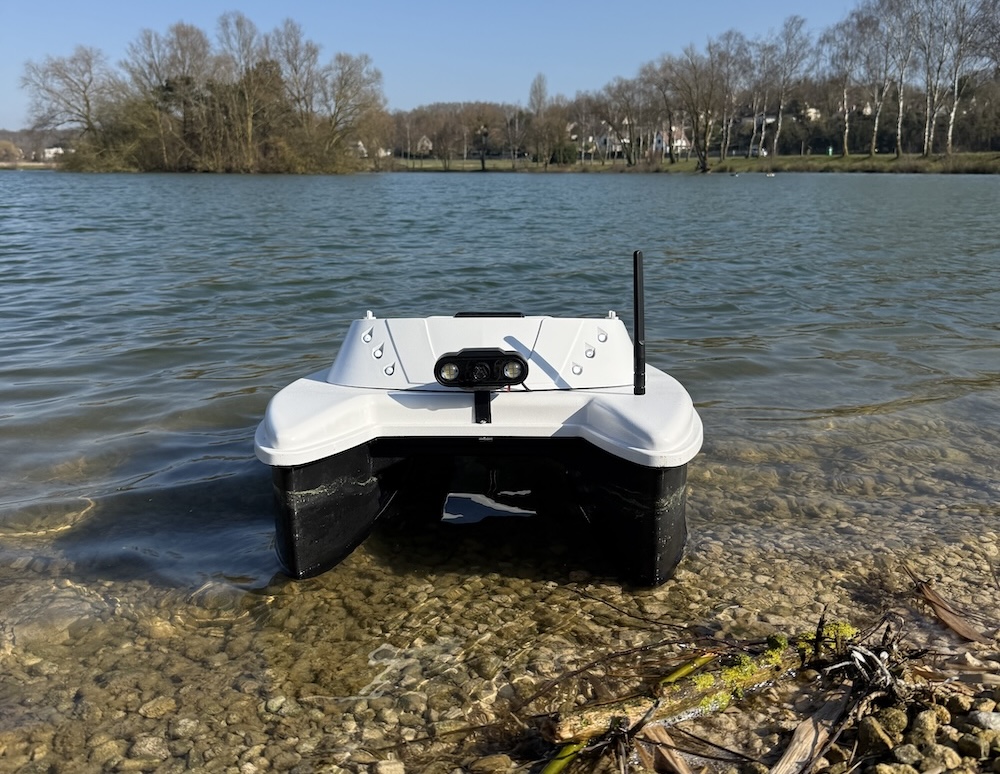
To address these constraints, Unique Group deployed its compact, fully electric Uni-Mini USV, which can be hand-carried and launched directly from remote shorelines without trailers or lifting equipment.
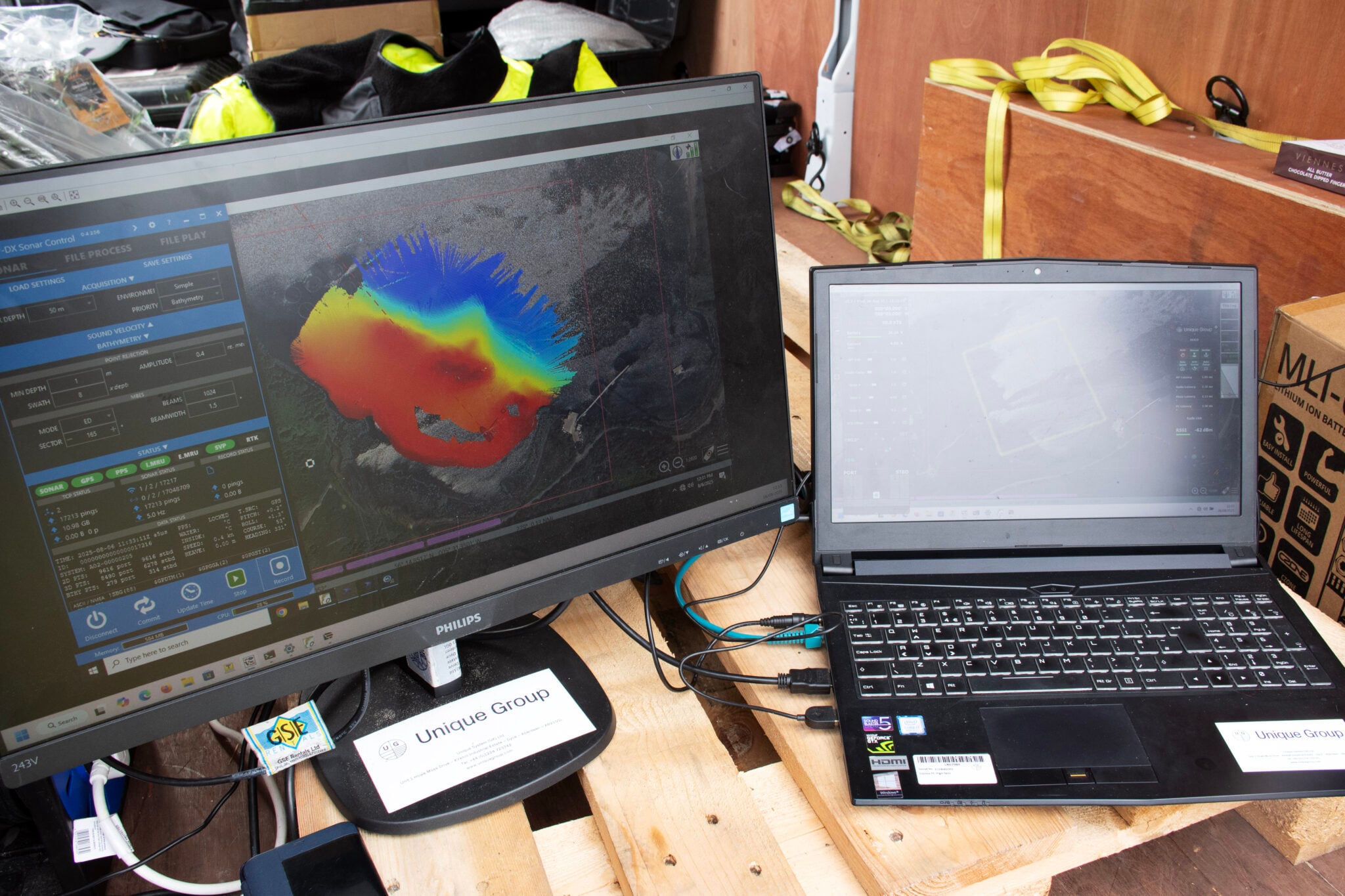
The vessel’s shallow 40 cm draft allowed it to safely access ultra-shallow areas that conventional vessels could not reach. Its integrated Ping DSP system was selected for its shallow-water performance, providing wider swath coverage and generating high-resolution 3D side-scan and bathymetric data.
During the survey, the Uni-Mini operated autonomously across open sections of the loch, switching to manual control in congested areas. A live video feed from its forward-facing camera supported navigation between moored vessels.
This combination enabled high-resolution mapping despite the site’s environmental and operational constraints. The USV’s fully electric operation also minimizes ecological disturbance and avoids emissions associated with fuel-powered vessels.
Supporting Oyster Habitat Restoration
The resulting dataset will help SAMS, Kilchoan Estate, and the University of Glasgow analyze and identify the most suitable areas for native European flat oyster settlement and long-term population growth.
The deployment also reduced survey time and costs while maintaining accuracy and reliability, with Unique Group providing end-to-end project management and technical support.
Commenting on the collaborative survey, Libby Smith, Project Manager at SAMS Enterprise, said, “The collaboration between Kilchoan Melfort Trust, the Scottish Association for Marine Science (SAMS), Unique Group, and the University of Glasgow represents an inspiring example of how cutting-edge technology can directly support ecological restoration activities.
“We were particularly impressed by the seamless joint deployment of SAMS ImpYak™ for taking water flow measurements, with Unique Group’s UNI-Mini for bathymetry mapping. Together, the datasets will be a powerful base for developing a habitat suitability model of the loch, and we look forward to building on the success of this trial.
“As a hub for research, testing and training, SAMS and SAMS Enterprise are well placed to support ecological restoration activities across Scotland and beyond, and we welcome opportunities to collaborate with organisations to make a lasting impact.”