Cetasol Visible Onshore

VideoRay ROV Modified for Subsea Threat Detection in Dstl-Led Royal Navy Trials

The Defence Science and Technology Laboratory (Dstl) has adapted the VideoRay Mission Specialist Defender ROV to help the Royal Navy detect and neutralize underwater threats and protect subsea infrastructure By Joe Macey / 18 Aug 2025

Remotely Operated Vehicles (ROV)

Discover cutting-edge solutions from 10 leading global suppliers
SUPPLIER SPOTLIGHT
Follow OS&T

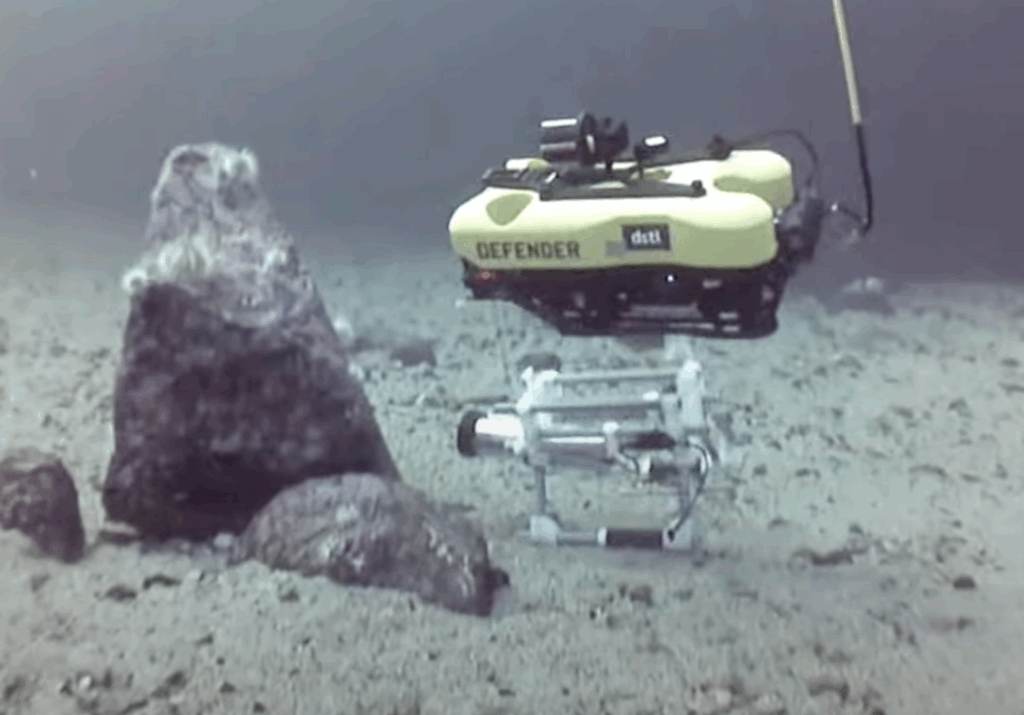
A modified version of VideoRay’s Mission Specialist Defender Remotely Operated Vehicle (ROV) is demonstrating its value as a subsea intervention platform in trials led by the UK’s Defence Science and Technology Laboratory (Dstl).

Developed in collaboration with industry partners, the system is being evaluated for its ability to identify and neutralize underwater threats such as unexploded ordnance (UXO) and sabotage to critical subsea infrastructure.

Dstl has integrated a range of bespoke technologies that allow the Remotely Operated Vehicle to detect and remotely place explosive charges to neutralize UXO. These adaptations enhance operational safety and reduce the need for human divers in dangerous environments, while enabling persistent underwater operations at greater depths and durations.

The Defender is also the ROV of choice for the MESR program of record for the US Navy following a $92.6 million five-year indefinite-delivery/indefinite-quantity (IDIQ) contract for the family of systems.

Dstl explosives engineer John said, “This technology would be a valuable toolset for keeping our Armed Forces safe whilst providing the public with value for money.

“This unique capability with its sensors, tools and cameras will give operators a real time ability to deal with these underwater hazards in a safe, effective and efficient way.”

The ROV’s modular architecture supports high-resolution video and sonar data transmission, providing operators with detailed situational awareness. It can be launched from a vessel or shoreline and maneuvered remotely to inspect, verify, and safely neutralize subsea hazards, including those near vital infrastructure such as undersea pipelines and communication cables.

The system is designed to work in conjunction with other autonomous and remotely operated platforms, enabling a scalable approach to seabed survey, threat detection, and intervention. Because the Defender ROV is not destroyed during its missions, it can be reused multiple times, enhancing cost-efficiency and reducing the environmental footprint of underwater operations.

Trials have been successfully conducted at multiple sites, including Horsea Island in Portsmouth, Portland Harbour, South Wales, and Norway. These exercises are supporting the development of operational tactics and techniques, while also driving forward innovation in maritime robotics and subsea defense technology.

This initiative highlights the potential of adapted commercial-off-the-shelf (COTS) platforms for national security and infrastructure resilience, showcasing the Defender ROV as a flexible, mission-ready tool for underwater threat mitigation and seabed intervention.

Posted by Joe Macey Joseph Macey is a Content Specialist at Ocean Science & Technology, where he has focused on emerging marine technologies since joining in 2022. He brings particular expertise in autopilot systems, AUVs, and subsea imaging. A graduate of Falmouth University in Journalism, Joseph began his career in 2019 as a local reporter. His background in journalism not only hones his reporting skills but also strengthens his ability to conduct in-depth interviews, allowing him to provide authoritative insights on the latest industry trends. Connect

THE WEEKLY eBRIEF

The latest offshore, subsea & marine technology news, straight to your inbox.

Get our weekly roundup of technology developments, new products and industry news.

By subscribing, you agree to receive the weekly OST eBrief newsletter from EchoBlue Ltd. Unsubscribe at any time using the link in every email. See our Privacy Notice.