

The Global Sourcing Hub for Marine, Subsea & Offshore Technology
Discover cutting-edge solutions from leading global suppliersEvoLogics tested its new harbour protection network during NATO Exercise REPMUS 2026, deploying underwater acoustic sensors, seabed fibre-optic cable and surface surveillance systems at the working fishing port of Sesimbra, Portugal.
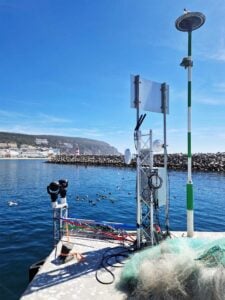
Land Sensor Station with Passive Sonar, Daylight Cameras and Antennas.
The deployment lasted nearly three weeks, with hundreds of alerts generated between September 7 and 17.
The network reported into the exercise’s NATO command system and was tested during two night raids in which a red team was tasked with entering the harbour from at least five nautical miles out, using combat divers, Autonomous Underwater Vehicles (AUVs), Uncrewed Surface Vessels (USVs) and small, fast boats.
Tracking Underwater and Surface Threats
The first night raid took place in calm conditions with clear visibility and moderate background noise. All three shore stations detected underwater drones entering the harbour area, while larger underwater drones were detected earlier in their approach.
The second raid presented more difficult conditions, with strong northeasterly winds, waves against the breakwaters and fishing vessel movements increasing acoustic interference.
Despite the increased noise, the network maintained continuous tracking, including following one underwater drone inside the harbour until the mid-raid break. USVs were also detected and logged, while a thermal camera maintained contact with a small open boat carrying two people at the harbour entrance. One USV was classified and released for reporting within 30 seconds of initial detection.
Red team divers entered from a nearby beach. Within 20 minutes, the seabed cable registered signals and contact was reported. Detection software flagged a possible diver near the harbour entrance, although further analysis is required to confirm the contact and exclude a false alarm.
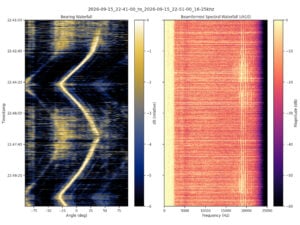
Acoustic bearing track of an USV passing a Sensor Station during a night mission at REPMUS 2026.
Combining Acoustic and Visual Surveillance
The harbour protection network comprises three shore stations, two sensor buoys, seabed fibre-optic cable, active sonar, day and thermal cameras, and Automatic Identification System (AIS) integration.
Passive hydrophone arrays installed at the shore stations and buoys measure the direction of underwater sounds without transmitting signals. Bearings from multiple stations can be combined to locate acoustic sources.
Active sonar provides distance measurements using transmitted acoustic pulses and returning echoes, while the seabed fibre-optic cable registers vibrations along its length, functioning as a distributed acoustic sensor.
Day and thermal cameras provide above-water surveillance, with AI software automatically marking vessels in the video feeds. AIS supplies information about vessels transmitting their identification data.
All stations are connected through fibre and radio links to a central server housed in a container on the pier. Operators can view sonar, video and vessel traffic information together, classify contacts and forward reports using NATO’s standard reporting format.
Supporting Maritime Incident Reconstruction
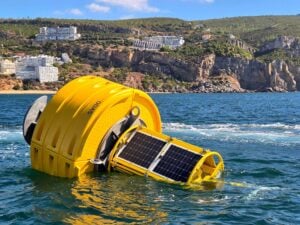
The damaged sensor buoy off Sesimbra.
During the deployment, a fishing boat damaged an EvoLogics sensor buoy. The team used acoustic signatures, sonar tracking, AIS data and video to reconstruct the collision, demonstrating a potential application of the network for accident reconstruction and maritime police investigations.
EvoLogics states that the harbour security network will be available in 2027.