The Global Sourcing Hub for Marine, Subsea & Offshore Technology
Discover cutting-edge solutions from leading global suppliers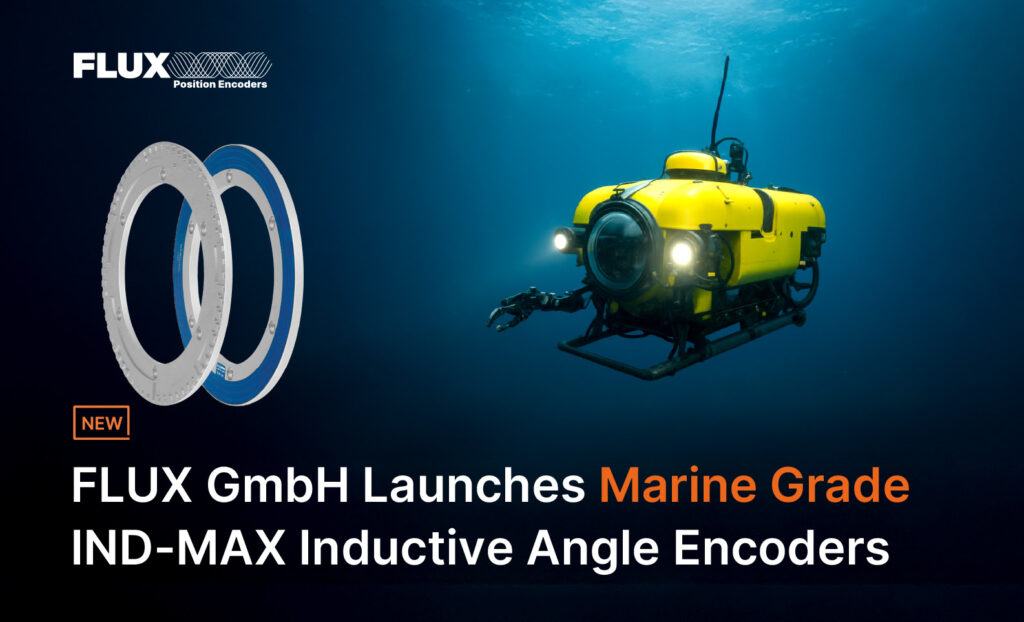
FLUX GmbH has expanded its IND-MAX inductive angle encoder family with the release of the IND-MAX-100 Marine Grade variant, specifically engineered for demanding naval and offshore applications.
The IND-MAX-100 utilizes a housing constructed from marine-grade stainless steel to provide exceptional resistance to corrosion, even under continuous saltwater immersion. This design ensures long-term reliability and precision in the harshest maritime conditions, where standard encoders typically fail. The corrosion-proof nature of the encoder makes it suitable for integration into ships, offshore platforms, and subsea systems.
This addition of the IND-MAX-100 broadens the utility of the IND-MAX series, offering greater flexibility for integration needs across both marine and general industrial applications.
Paul Tutzu, Managing Director and Founder of FLUX GmbH, stated, “Tailored for naval, offshore, and marine automation applications, the IND-MAX-100 reinforces FLUX’s commitment to delivering durable, high-performance sensing solutions for the world’s most demanding environments.”
Tutzu highlighted the technology’s advantage in challenging conditions, adding, “Unlike optical and capacitive technologies, which can become unreliable in harsh conditions, the IND-MAX encoder series is designed to deliver superior performance and durability, exceeding the limits of existing technologies.”
FLUX encoders are designed to offer a complete solution in a small package, providing outstanding accuracy, resolution, and repeatability. They are characterized by ease of installation and dependable operation in both clean and harsh environments.