

Impact Subsea, a developer of underwater sensing technology, explores the capabilities and configuration of its ISP360 Profiling Sonars in a podcast episode, focusing on precision subsea measurement and dual-sonar operation.
The ISP360 Profiling Sonar is a mechanically scanned profiling sonar for subsea measurement, delivering 1° acoustic angular resolution, an 80-meter range and 0.35 mm timing accuracy. This supports applications such as pipeline and trench profiling, asset positioning and seabed mapping.
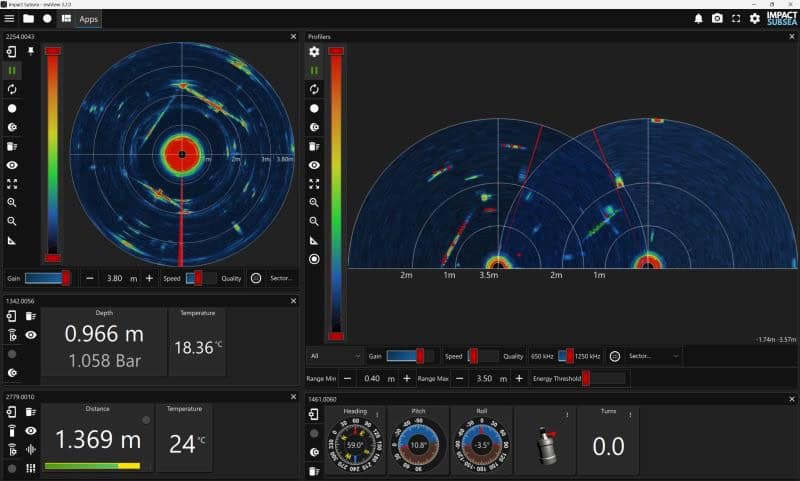
The discussion outlines how SeaView V3 software automatically detects and connects Impact Subsea sensors. When operating a single ISP360 profiler, the system uses a default 90° scanning window and a typical range setting of approximately 10 meters, with a minimum range of just under 0.5 meters for close inspection work.
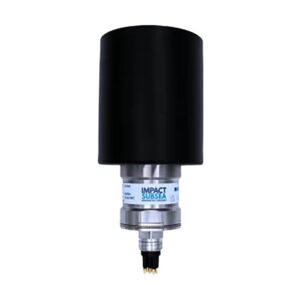
ISP360 Profiling Sonar.
Impact Subsea also details the configuration of dual ISP360 sonars on Autonomous Underwater Vehicles (AUVs) and Remotely Operated Vehicles (ROVs). Physical offset input and rotational alignment between the two profilers ensure accurate data alignment and combined output. SeaView V3 visually differentiates the sensors and allows individual or grouped adjustment of settings.
To improve data clarity in confined or acoustically noisy environments, operators can refine minimum and maximum range parameters and apply an energy threshold to exclude weak acoustic returns. The software also enables adjustment of the raw acoustic image, including gain, contrast and color palette.
For dual-sonar operation, one profiler is configured to Mode A IS³ acoustics and the other to Mode B IS³ acoustics. Using separate signaling schemes prevents acoustic interference and allows both systems to operate concurrently. Processed data can be streamed to log files or transmitted to third-party systems via configurable communications settings, supporting immediate analysis or later review.
Listen to the full podcast discussion and visit the ISP360 Profiling Sonar product page for further information.