Showcase your capabilities
If you design, build or supply Fleet-Class USVs, create a profile to showcase your capabilities and connect with visitors who have an active requirement for your solutions.


Select fleet-class USVs from qualified manufacturers and suppliers supporting naval task groups, maritime security forces, and distributed maritime operations. Fleet-class unmanned surface vehicles are military-grade platforms engineered for long-endurance missions, high payload capacity, and full integration with fleet command, control, and logistics systems.
Read the Technology Overview
Innovative Uncrewed & Autonomous Surface Vessel Technologies for Maritime Operations

If you design, build or supply Fleet-Class USVs, create a profile to showcase your capabilities and connect with visitors who have an active requirement for your solutions.

Fleet-class USV is an informal term for the highest-capability tier of military USVs, intended to operate in direct support of naval forces rather than as independent assets. These platforms emphasize interoperability, standardized command-and-control interfaces, and integration with fleet communications and mission-planning systems. Compared with small and medium USVs, fleet-class vessels offer greater endurance, payload capacity, and power margins, enabling advanced sensors, electronic warfare systems, and multi-mission payloads. They are designed for sustained operations alongside crewed combatants, extending sensing and operational reach while reducing risk to personnel in contested maritime environments.
Fleet-class USVs conduct persistent ISR using radar, electro-optical, infrared, and signals intelligence payloads to support maritime domain awareness and targeting.
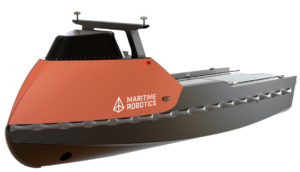
Mariner X Uncrewed Surface Vessel from Maritime Robotics
These vessels extend the sensing and operational reach of naval task groups by operating forward or independently under centralized command.
Fleet-class USVs provide early warning, threat detection, and layered protection for high-value naval assets and maritime infrastructure.
Large power and payload capacity allow integration of electronic support and electronic attack systems for spectrum awareness and denial missions.
Fleet-class platforms deploy and support mine hunting and neutralization systems while maintaining standoff from threat areas.
Unmanned surface vessels support naval patrols, escort operations, and interdiction missions in high-risk or manpower-constrained environments.
Monohull designs emphasize endurance, payload volume, and high-sea-state performance for blue-water naval operations.
Catamaran configurations offer increased stability and deck space for wide sensor arrays and mission payloads.
Hybrid systems balance fuel efficiency, acoustic management, and electrical power availability for multi-mission naval roles.
Modular payload architectures enable rapid reconfiguration between ISR, electronic warfare, and mine countermeasure missions.
Some configurations support remotely operated or autonomous weapon systems for force protection and combat support roles.
Compared to small and medium USVs, fleet-class unmanned surface vehicles deliver superior endurance, survivability, and mission versatility. Smaller platforms are typically constrained to short-range or task-specific roles, while fleet-class USVs operate as persistent, multi-mission naval assets.
Compared with crewed surface combatants, fleet-class USVs reduce personnel risk and operating costs while maintaining compatibility with naval command-and-control systems. Their unmanned nature enables deployment in high-threat environments without exposing crews to direct danger.
Fleet-class USVs are designed around standardized naval command-and-control architectures. Secure datalinks, satellite communications, and line-of-sight communications enable real-time mission supervision and coordinated operations with crewed and unmanned assets. Autonomy software supports navigation, collision avoidance, and mission execution under defined rules of engagement.
Navigation systems typically combine GNSS, inertial navigation systems, and sensor fusion to ensure reliable positioning in contested or degraded environments. Redundancy across propulsion, communications, and control systems is critical for mission assurance.
Fleet-class unmanned surface vehicles are developed in accordance with applicable military and naval standards governing safety, survivability, electromagnetic compatibility, and secure communications.
Interoperability with existing fleet systems, logistics chains, and mission planning tools is a primary requirement for naval adoption.
Compliance with collision regulations, autonomy governance frameworks, and defense cybersecurity requirements enables fleet-class USVs to operate alongside crewed vessels and within joint and coalition maritime forces.
Fleet-class USVs are increasingly central to modern naval force design, providing scalable, persistent, and interoperable unmanned capability aligned with future maritime warfare concepts.
 Searching Companies & Products

 Subscribe to the Weekly eBrief
The latest engineering and technical developments straight to your inbox - join thousands of engineers who receive it.
Subscribe to the Weekly eBrief
The latest engineering and technical developments straight to your inbox - join thousands of engineers who receive it.