Showcase your capabilities
If you design, build or supply Fisheries Research USV, create a profile to showcase your capabilities and connect with visitors who have an active requirement for your solutions.


Find USVs for fisheries research from specialized manufacturers and suppliers supporting ocean science operations, including fish stock assessment, hydroacoustic surveys, and ecosystem monitoring.
Read the Technology Overview

Innovative Uncrewed & Autonomous Surface Vessel Technologies for Maritime Operations

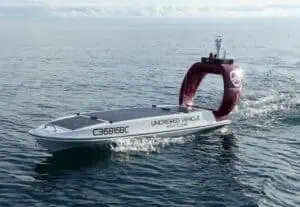
Reliable Solar-Powered USVs for Real-Time Oceanographic & Maritime Data Acquisition

If you design, build or supply Fisheries Research USV, create a profile to showcase your capabilities and connect with visitors who have an active requirement for your solutions.

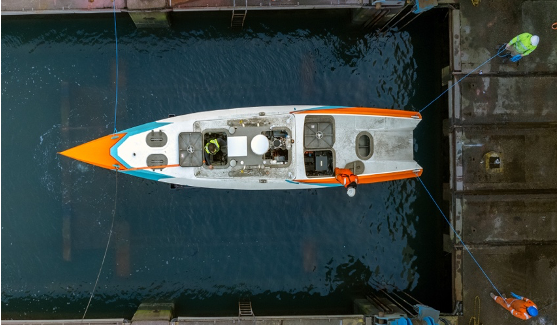
Fisheries research USVs are uncrewed platforms designed to run repeatable survey lines while carrying sensor payloads such as sonar, ADCPs, radar, lidar, and environmental instruments. Compared with crewed survey vessels, a survey USV can reduce cost and risk while enabling more frequent deployment for fisheries data collection, fish population surveys, and long-duration monitoring.
A typical fisheries research USV integrates GNSS-aided INS, marine autopilot, mission planning software, navigation software, telemetry systems, radio communication, and satellite communication to maintain track accuracy and transmit data. Power management systems coordinate battery packs, solar panels, propulsion systems, and onboard computers to support long endurance missions. Modular payload bays and sensor payload interfaces allow rapid reconfiguration between fisheries surveys, hydroacoustic surveys, and marine ecosystem research.
USVs are used for fish stock assessment by running consistent transects with stable speed control for echosounder and hydroacoustic sensor measurements. Repeatability supports comparable datasets across seasons and survey areas.
Fish population surveys benefit from autonomous surface vehicles that can operate in shallow or restricted waters where crewed access is difficult. Survey frequency can increase without proportionally increasing vessel time.
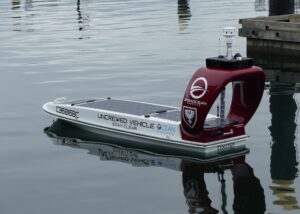
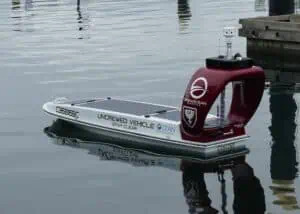
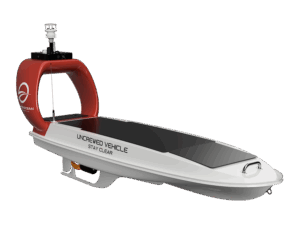
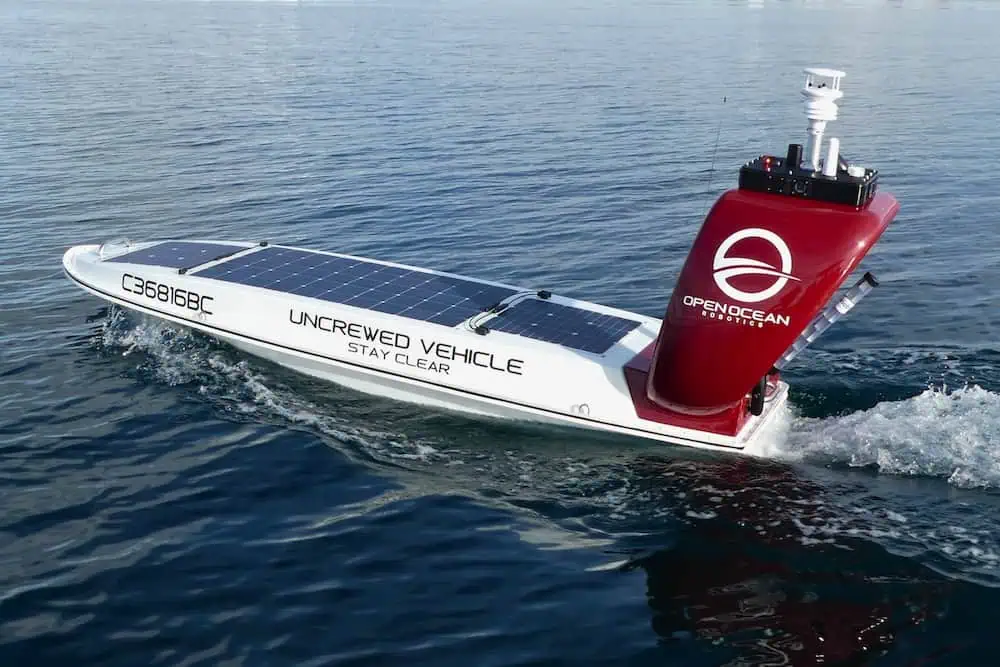
Unmanned Surface Vehicle for marine ecosystem research, DataXplorer Enviro, from Open Ocean Research.
Fisheries monitoring systems on USVs support adaptive sampling, including repeated corridors near spawning grounds, estuaries, and coastal fronts. Telemetry enables near real-time review for fisheries management science workflows.
Marine ecosystem monitoring combines fisheries science observations with oceanographic context, such as currents, temperature, turbidity, and surface conditions. Adding an acoustic Doppler current profiler helps link fish distribution to water column dynamics.
Hydroacoustic survey USVs can carry single-beam or multibeam echosounders to detect habitat features and biomass proxies. Low platform self-noise and consistent heading improve data quality when system integration is done correctly.
A catamaran USV offers strong lateral stability for sonar and echosounder mounting and can provide deck space for a data logger and sensor payload integration. It is often selected for hydroacoustic surveys in moderate sea states.
A monohull USV typically offers efficient hydrodynamics and can be suitable for long-endurance USV profiles. Hull selection should consider sensor draft, launch, and recovery constraints, and sea-keeping needs.
An electric USV prioritizes low acoustic signature and simplified propulsion system maintenance. Battery pack sizing and power management system performance become key drivers for mission duration and payload load.
A hybrid propulsion USV can extend endurance while supporting higher average transit speeds or heavier payloads. Integration complexity is higher, so attention to redundancy, safety interlocks, and maintenance planning is important.
A modular USV focuses on rapid payload swaps using standardized mounting, power, and data interfaces. This supports multi-mission scheduling across fisheries monitoring, marine data collection, and oceanographic surveys.
In USV deployments for fisheries research, subsystem selection directly affects data quality and operational reliability. Navigation performance depends on GNSS quality, IMU stability, and autopilot tuning to maintain steady speed and track, which is critical for repeatable transects. Communications design often combines radio communication for local operations with satellite communication for offshore USV missions, with telemetry system bandwidth matched to onboard computer storage and data logger capacity.
Sensor integration commonly includes sonar, echosounder, and ADCP payloads, and may add radar, lidar, and collision avoidance systems for detect-and-avoid functions. Payload bay layout should account for sensor alignment, vibration isolation, electromagnetic interference, and cable routing to avoid degrading hydroacoustic surveys. Propulsion system selection should consider acoustic impacts, cavitation risk, and controllability at survey speeds.
Unmanned surface vehicles can deliver more survey hours per budget unit and reduce personnel risk, particularly in remote, shallow, or hazardous environments. Crewed vessels still offer higher payload capacity, on-site troubleshooting, and complex sampling operations that require hands-on staff.
A fisheries research USV operates at the surface, enabling persistent communication, greater topside payload capacity, and simpler recovery. An autonomous underwater vehicle (AUV) can sample beneath the surface and reduce wave-induced sensor noise, but it typically offers more limited real-time communication and may involve more complex logistics.
Electric configurations can reduce acoustic and environmental disturbance, which can matter for sensitive fish population monitoring. Hybrid systems generally offer longer endurance and higher average power availability for multi-sensor payloads, at the cost of added integration and maintenance complexity.
Fisheries research USVs typically intersect marine navigation rules, data interfaces, and environmental operating requirements. Collision-avoidance design and operator procedures should align with the International Regulations for Preventing Collisions at Sea (COLREGs) and local maritime authority requirements. For marine electronics and bridge-adjacent equipment, IEC 60945 is commonly referenced for maritime navigation and radiocommunication equipment, while NMEA interface standards, such as IEC 61162 variants, may be relevant when integrating GNSS, IMU, and sensor data streams.
Where fisheries USVs are dual-use or tested alongside defense programs, it can be useful to understand applicable MIL-STD environmental and electromagnetic compatibility requirements and NATO STANAG references used for interoperability and testing regimes. The specific applicability depends on the acquisition context, operating area, and integration scope.
 Searching Companies & Products

 Subscribe to the Weekly eBrief
The latest engineering and technical developments straight to your inbox - join thousands of engineers who receive it.
Subscribe to the Weekly eBrief
The latest engineering and technical developments straight to your inbox - join thousands of engineers who receive it.