
Showcase your capabilities
If you design, build or supply Disaster Response USVs, create a profile to showcase your capabilities and connect with visitors who have an active requirement for your solutions.


Source USVs for disaster response from specialized manufacturers and suppliers supporting ocean science, environmental monitoring, and emergency maritime operations. Disaster response USVs enable rapid deployment, data collection, and situational awareness during oil spills, floods, hurricanes, tsunamis, and other coastal or offshore emergencies where human access is limited or unsafe.
Read the Technology Overview




Innovative Uncrewed & Autonomous Surface Vessel Technologies for Maritime Operations

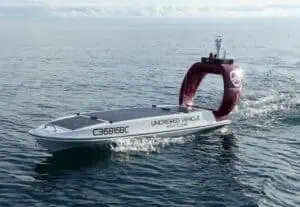
Reliable Solar-Powered USVs for Real-Time Oceanographic & Maritime Data Acquisition

If you design, build or supply Disaster Response USVs, create a profile to showcase your capabilities and connect with visitors who have an active requirement for your solutions.

Disaster response USVs are engineered to operate in hazardous marine environments, providing ocean science and emergency teams with rapid environmental assessment, emergency mapping, and real-time data collection after natural or industrial disasters. Deployed in nearshore, riverine, and offshore waters where debris and damaged infrastructure limit crewed access, these platforms combine advanced sensor payloads with autonomous or remote control, integrated navigation, and resilient communications to support sustained response and recovery operations.
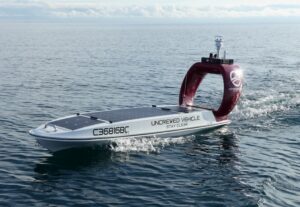
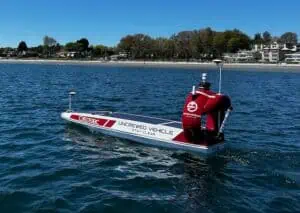
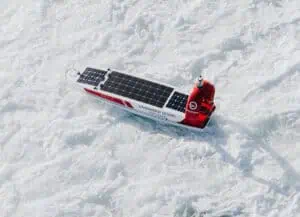
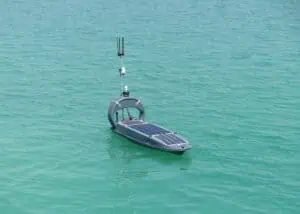
DataXplorer™ Listen by Open Ocean Robotics
Disaster response USVs are available in multiple configurations to meet varied operational requirements across ocean science and emergency response missions.
Autonomous USVs use onboard control software and sensor fusion to conduct missions with minimal operator input. These platforms are well-suited for persistent disaster monitoring, environmental surveys, and wide-area damage assessment.
Remote-operated USVs rely on real-time operator control through communication radios or satellite links. They are commonly used in complex environments that require direct human decision-making, such as search-and-rescue missions or debris-laden flood zones.
Hybrid control USVs combine autonomous navigation with remote supervision. This configuration supports flexible operations in which autonomy is required for endurance but manual control is necessary during high-risk maneuvers or close-proximity inspections.
Disaster response USVs support a broad range of ocean science and emergency management missions.
USVs equipped with environmental sensors, including fluorometers and imaging payloads, support oil spill detection, plume tracking, and surface contamination mapping without exposing crews to hazardous conditions.
In flood-affected coastal and inland waterways, USVs provide rapid situational awareness, infrastructure inspection, and emergency mapping to support response planning and recovery.
Following hurricanes, disaster response USVs assess port damage, shoreline erosion, and navigational hazards while operating in areas unsafe for crewed vessels.
USVs support post-tsunami surveys by mapping debris fields, bathymetric changes, and environmental impacts in nearshore and harbor environments.
Thermal cameras, radar units, and obstacle-avoidance systems enable USVs to assist in locating survivors and support coordinated rescue efforts.
Disaster response USVs integrate multiple subsystems to ensure reliable performance in demanding conditions. Hull design influences stability and endurance, while powertrains and battery packs determine mission duration and payload capacity. Navigation systems incorporating GPS/GNSS modules and inertial sensors support precise maneuvering, even in degraded environments.
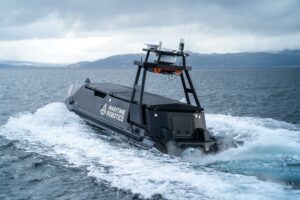
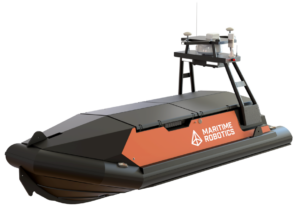
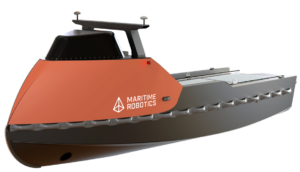
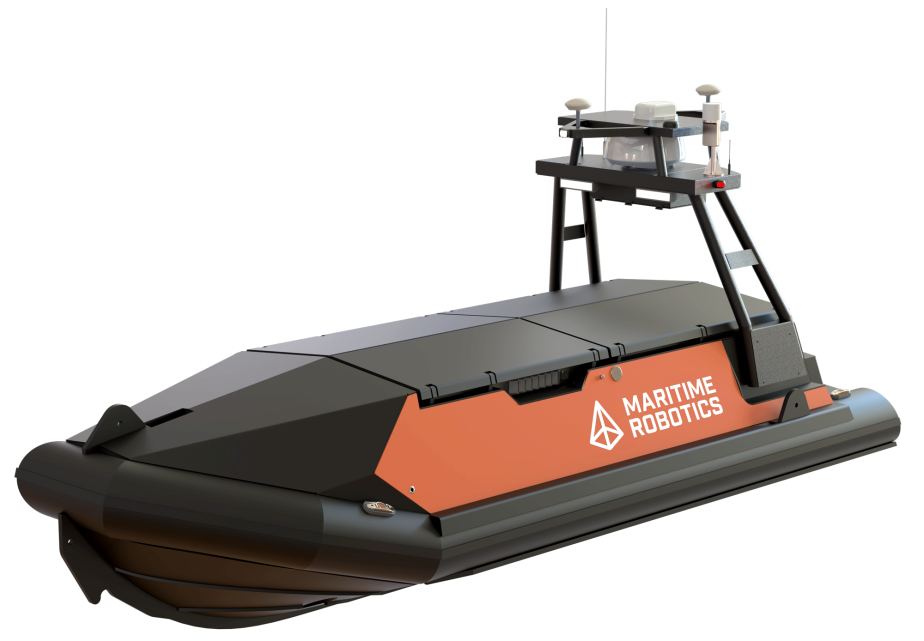
Mariner Uncrewed Surface Vessel by Maritime Robotics
Payload bays accommodate lidar sensors, thermal cameras, radar units, and environmental monitoring instruments. Communication radios and satellite links maintain connectivity during extended or beyond-line-of-sight operations. Mission computers manage sensor data, autonomy functions, and integration with external disaster monitoring systems.
Compared to crewed response vessels, disaster response USVs reduce operational risk, lower deployment costs, and enable access to hazardous or restricted areas. Unlike aerial platforms, USVs can carry heavier sensor payloads and maintain longer on-station endurance, making them suitable for sustained environmental assessment and monitoring.
Compared with autonomous underwater vehicles, USVs offer persistent surface-level observation, real-time communication, and easier payload reconfiguration, which are critical during rapidly evolving disaster scenarios.
Disaster response USVs used in ocean science and emergency operations may align with applicable maritime safety, electromagnetic compatibility, and environmental standards, depending on the deployment region and mission profile. Interoperability with existing command-and-control systems, data formats, and emergency response frameworks is often a key requirement.
Environmental durability, redundancy, and maintainability are critical considerations, particularly for operations in high sea states, debris-filled waters, or contaminated environments. Integration with broader disaster response logistics and humanitarian aid workflows further influences system selection.
Ocean science organizations, research institutions, and emergency response stakeholders typically evaluate disaster response USVs based on endurance, payload flexibility, autonomy level, and ease of integration with scientific instruments and data systems. Compatibility with existing environmental assessment tools and rapid deployment capability are often prioritized.
Disaster response USVs continue to play an expanding role in ocean science and technology by enabling faster, safer, and more data-driven responses to natural and man-made maritime disasters.
 Searching Companies & Products
 Subscribe to the Weekly eBrief
The latest engineering and technical developments straight to your inbox - join thousands of engineers who receive it.
Subscribe to the Weekly eBrief
The latest engineering and technical developments straight to your inbox - join thousands of engineers who receive it.