Showcase your capabilities
If you design, build or supply Acoustic Receivers, create a profile to showcase your capabilities and connect with visitors who have an active requirement for your solutions.


Acoustic receivers are underwater sensing devices that detect and process acoustic signals for positioning, communication, monitoring, and asset recovery in marine and subsea environments. Underwater acoustic receivers are essential where radio and optical systems are ineffective, supporting applications across oceanographic research, offshore energy, defense, and autonomous marine operations.
This category highlights leading acoustic receiver suppliers for fixed seabed installations, platform-integrated modules, or portable systems, operating passively or as part of active acoustic architectures.
Read the Technology Overview
Underwater Acoustic Tracking & Recovery Solutions for Mission-Critical Subsea Assets

If you design, build or supply Acoustic Receivers, create a profile to showcase your capabilities and connect with visitors who have an active requirement for your solutions.

Acoustic receivers are core sensing elements in modern marine and subsea systems. In environments where radio-frequency and optical signals are rapidly attenuated, acoustics provide a practical means for underwater sensing, communication, and positioning over meaningful distances. As a result, acoustic receivers support operations ranging from long-term oceanographic monitoring to Autonomous Underwater Vehicles (AUV) navigation and subsea asset tracking.
These devices detect and process pressure waves propagating through the water column, operating either passively by monitoring ambient and anthropogenic sound, or as part of active systems that receive signals for positioning, telemetry, or control. In most deployments, acoustic receivers are integrated within broader architectures, paired with transmitters, pingers, or full transceivers, and incorporated into acoustic systems that support navigation, recovery, and higher-level signal processing and data management.
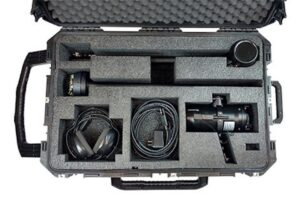
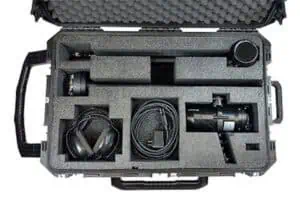
PRS-275, a diver & surface pinger receiver system, by RJE International
Fixed acoustic receiver systems are permanently or semi-permanently installed on the seabed or attached to subsea structures. You will find these most often in cabled observatories and offshore monitoring stations where continuous, long term data collection is paramount.
For these installations, engineers prioritize long term stability, minimal clock drift, and extreme robustness against the elements. Because they are often integrated with subsea power and fiber optic comms, they can handle high data throughput for real time monitoring. These are the workhorses for Passive Acoustic Monitoring (PAM), seismic observation, and baseline environmental impact studies.
Mobile receivers are built directly into the brains of moving platforms like AUVs, Remotely Operated Vehicles (ROVs), Unmanned Surface Vehicles (USVs), and underwater gliders. Here, the receiver is a vital node in the vehicle’s navigation and situational awareness suite.
Integration demands a ruthless focus on Size, Weight, and Power (SWaP) plus hydrodynamic efficiency. The housing must be shaped to minimize flow noise and drag, while the internal electronics require shielding against Electromagnetic Interference (EMI) from the vehicle’s own motors and sensors. Power efficiency is non-negotiable for battery limited gliders and AUVs that must remain “ears open” for the duration of a mission.
These systems are designed for agility. Portable receivers include standalone seabed loggers and drop and recover systems used for rapid surveys, equipment tracking, or short term experimental trials.
The defining trait here is ease of deployment. These units often feature internal power and high capacity onboard storage, allowing them to function entirely independently of external infrastructure. They are the primary choice for temporary positioning networks or for locating valuable assets equipped with acoustic pingers.
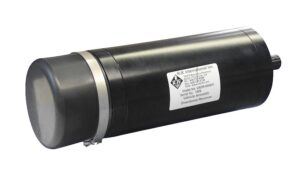
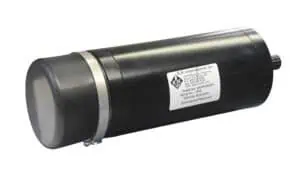
VADR-600M, a rugged passive pinger receiver, by RJE International
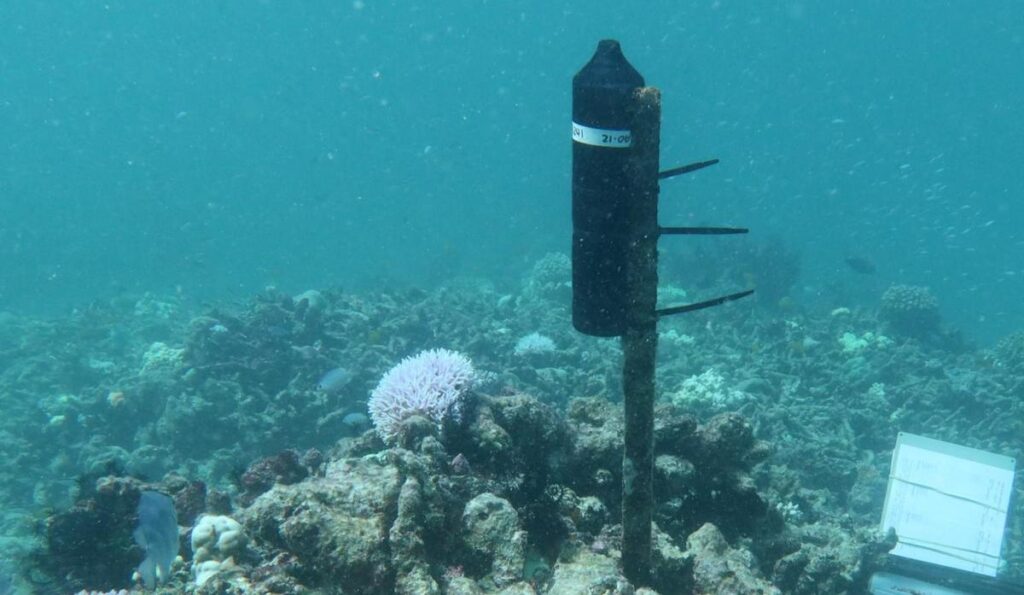
In the scientific realm, acoustic receivers allow researchers to see the environment without disturbing it. Passive systems capture ambient soundscapes, providing a non-invasive window into the behavior of marine mammals, fish populations, and shifting ecosystem dynamics.
By analyzing specific acoustic signatures, scientists can track migration patterns, assess biodiversity, and quantify the impact of human noise (such as shipping or offshore construction) on the marine environment.
In fish tracking studies, acoustic receivers detect and decode transmissions from tagged fish, enabling researchers to monitor movement patterns, habitat use, and population dynamics across fixed receiver arrays or through active tracking from vessels.
The offshore energy sector relies on acoustic receivers for precise positioning and asset tracking. They are the critical components in USBL (Ultra-Short Baseline), SBL, and LBL positioning systems. These systems guide ROVs during delicate inspection tasks and monitor the exact coordinates of wellheads and pipelines.
In deepwater environments where GPS is non-existent and visibility is zero, these receivers provide the primary (and often only) reliable source of positional data, significantly reducing operational risk during subsea construction.
For defense and government agencies, receivers provide underwater situational awareness. They are utilized to detect and classify underwater vehicles, monitor strategic waterways, and support unmanned maritime systems.
Integrated into autonomous platforms, they enable covert navigation and communication. In fixed port security installations, they provide a persistent acoustic fence to monitor sensitive offshore zones or harbor entrances.
The hydrophone is the sensory heart of the system. Most utilize piezoelectric materials that convert pressure variations into electrical signals.
Performance hinges on sensitivity, self-noise, and directivity. High sensitivity elements are vital for long range detection, while low self-noise is the priority for quiet, deep ocean environments. While a single element might suffice for simple detection, many modern systems utilize hydrophone arrays to enable directional reception and sophisticated beamforming.
The signals generated by a hydrophone are incredibly faint and require expert handling. The front end includes low noise preamplifiers and impedance matching networks designed to boost the signal without introducing distortion.
Engineers must choose between analog simplicity for low latency and digital flexibility for adaptive gain control. Modern designs favor digital front ends that integrate seamlessly into complex signal processing pipelines.
Once the signal is amplified, it must be cleaned. This involves filtering out of band noise and demodulating data. Timing is everything here. In positioning systems, a millisecond of clock drift can translate into meters of spatial error. Processing can happen at the edge on the receiver itself or be sent to a surface vessel, depending on the available bandwidth.
Whether it is USBL or LBL, the receiver is the component in the acoustic positioning system that does the math of time of flight and phase difference. Its performance determines the update rate and the ultimate accuracy of the navigation solution.
In a comms setup, the receiver decodes modulated data streams. This can range from simple wake-up commands to high speed telemetry. The receiver must be robust enough to handle the chaotic, multipath prone environment of the shallow water acoustic channel.
Top tier marine systems do not rely on acoustics alone. They fuse receiver data with Inertial Navigation Systems (INS) and Doppler Velocity Logs (DVL). In this context, the acoustic receiver provides the absolute position fix that prevents the INS from drifting over long duration missions.
The industry is moving toward customized acoustic receivers that offer higher intelligence at lower power costs. We are seeing a surge in smart receivers that perform on board signal classification (distinguishing between a biological sound and a mechanical one) before the data is even stored.
Furthermore, the move toward modular architectures and open standards is making it easier for integrators to swap components without redesigning the entire vehicle. These advances in low power digital electronics mean that the next generation of underwater acoustic receivers will be able to stay submerged longer, listen more acutely, and process more data than ever before.
 Searching Companies & Products

 Subscribe to the Weekly eBrief
The latest engineering and technical developments straight to your inbox - join thousands of engineers who receive it.
Subscribe to the Weekly eBrief
The latest engineering and technical developments straight to your inbox - join thousands of engineers who receive it.