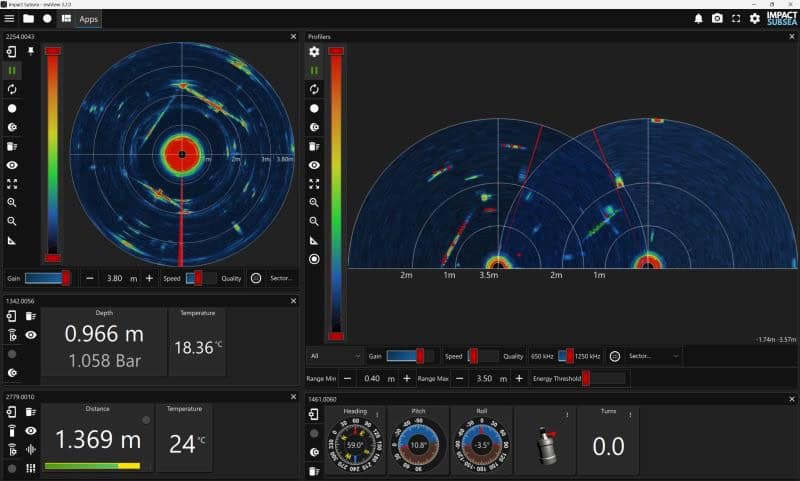

Impact Subsea has supported the development of a new obstacle avoidance pipeline for Autonomous Underwater Vehicles (AUVs) through the use of its ISS360 Imaging Sonar.
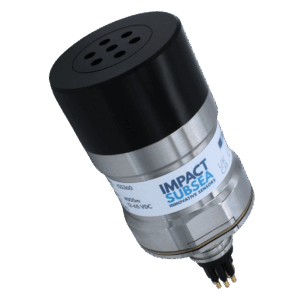
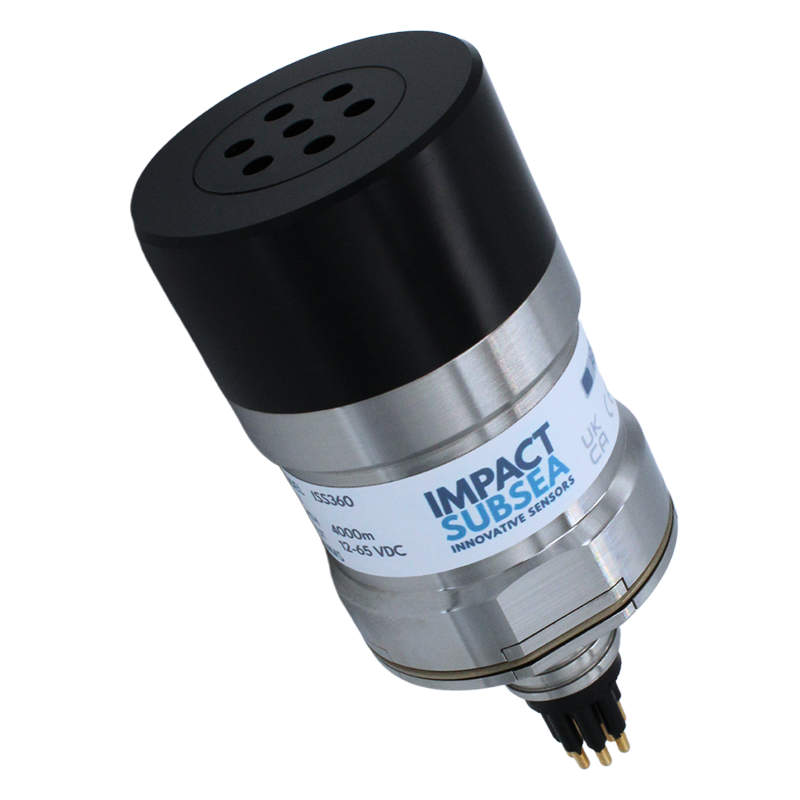
ISS360 Imaging Sonar
The work was conducted by Woods Hole Oceanographic Institution and focuses on improving autonomous navigation while reducing system size, power demand, and cost compared with traditional approaches.
The ISS360 imaging sonar combines a compact mechanical design with long-range imaging performance, making it suitable for shallow and deepwater operations. The sensor provides imaging ranges exceeding 90 meters and is depth rated to 6,000 meters and 4,000 meters. Titanium housings are used to ensure reliable performance in demanding subsea environments. A broadband transducer delivers strong image quality over extended ranges, and the design avoids slip rings, reducing mechanical wear.
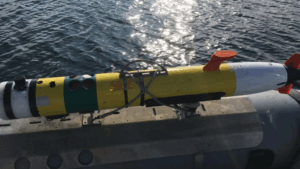
ISS360 Sonar (far left) Installed on the REMUS 100 AUV
For this project, the ISS360 was integrated with a REMUS 100 AUV to support a fully autonomous obstacle avoidance pipeline. The system was designed as a lower power and reduced form factor alternative to conventional sensing approaches, while still providing effective environmental awareness for navigation.
Integration was supported by the ISS360 Software Development Kit (SDK), which is freely available. The SDK enables direct integration of the sonar with vehicle systems and is provided as a single open source project written in C++17 and hosted on GitHub, simplifying incorporation into autonomy and navigation software.
During trials, the REMUS 100 AUV successfully demonstrated automatic obstacle avoidance using the new pipeline. Sonar data were processed to populate a cost map that informed vehicle behavior, allowing the system to detect obstacles and initiate avoidance maneuvers when operating in close proximity to hazards.
Jeffrey Kaeli, Research Engineer at Woods Hole Oceanographic Institution, said, “We’re really excited about the capabilities the ISS360 is enabling for AUVs”.
The research has been published by IEEE in a paper titled ‘Obstacle Avoidance Pipeline for a REMUS 100 Using an ISS360 Sonar’, which details the pipeline architecture, system integration, and performance results.
The ISS360’s compact size, pitch and roll measurement accuracy to 0.2 degrees, depth capability, and robust housing design supported its suitability for this and other demanding autonomous subsea applications.