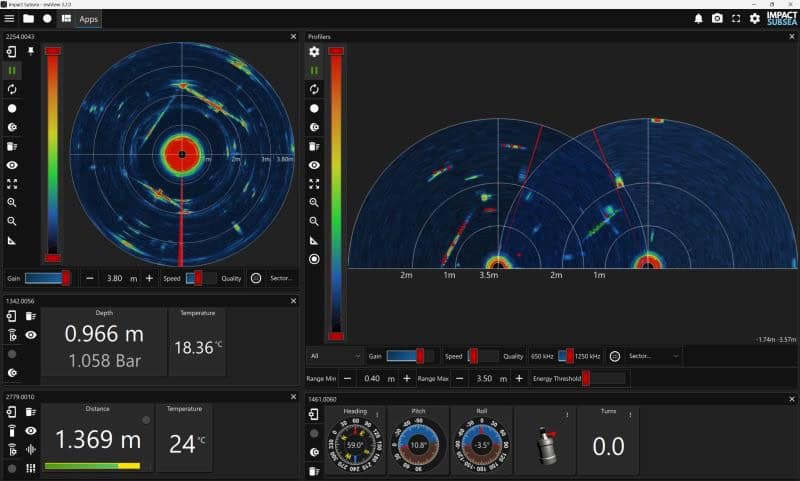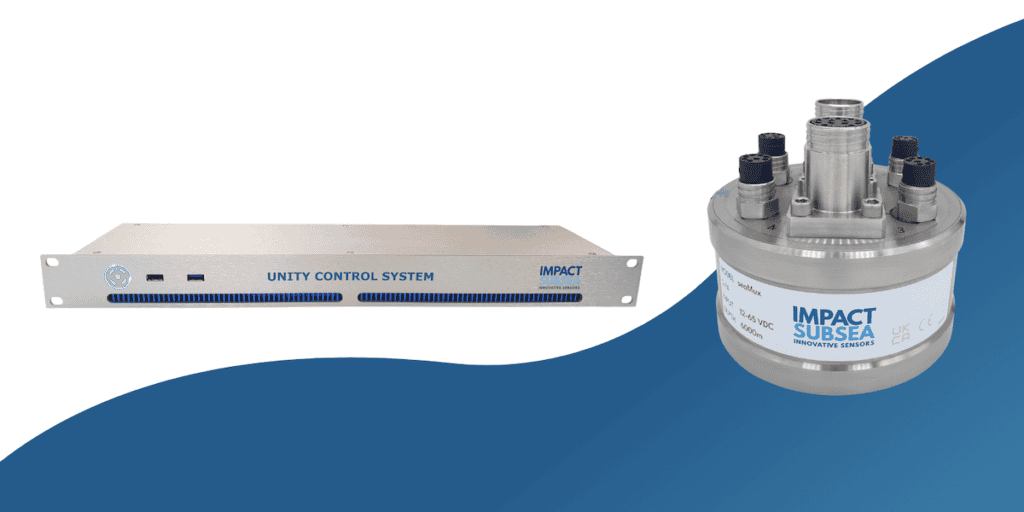



Impact Subsea, a developer of underwater sensing technologies for the marine industry, outlines the capabilities and design characteristics of its ISS360 and ISS360HD imaging sonars. Read more >>
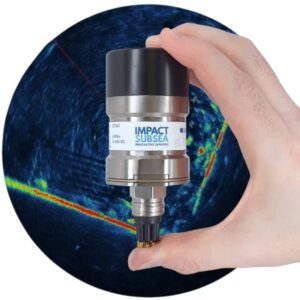
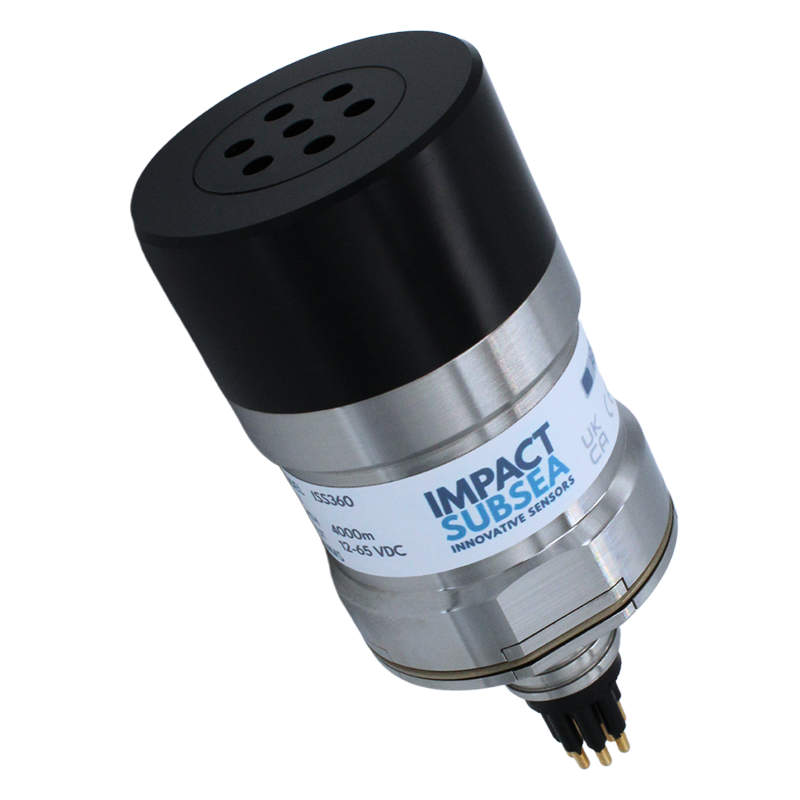
The compact mechanically scanned systems are widely deployed on Remotely Operated Vehicles (ROVs) and Autonomous Underwater Vehicles (AUVs), and are also used in standalone applications such as search and recovery. The sonars are used for target identification and obstacle avoidance, with the acoustic beam stepped 360° around the sonar to generate the sonar plot. Their compact size supports straightforward integration onto underwater vehicles.
Imaging Performance & Acoustic Resolution
Image quality is defined primarily by the systems’ range and angular resolution. The ISS360 provides 2.2° angular resolution at 700kHz with a range resolution of 2.5mm and a measurement range of up to 90 meters. The ISS360HD provides 1° angular resolution at 700kHz with the same 2.5mm range resolution and a maximum range of 100 meters. At shorter operating distances, both systems utilize CHIRP acoustic signaling between 600 and 900kHz.
The sonars also incorporate the Impact Subsea Signaling Scheme (IS³), which uses phase modulation and coding techniques to improve signal integrity, timing accuracy, and range resolution, while also reducing interference when multiple sonars operate in close proximity.
Scanning Performance & System Design
The ISS360 and ISS360HD employ a digital correlation technique to detect returning acoustic pulses, with incoming data processed directly through the digital correlator without filtering. This complete digital process avoids degradation of the incoming data and contributes to cleaner sonar imagery.
In a mechanically scanning sonar, scanning speed is theoretically limited by the travel time of the acoustic pulse to the maximum range and back again. The ISS360 and ISS360HD operate close to this theoretical maximum scanning speed. High scanning speeds are achieved through a combination of Ethernet communications capability and fast onboard processing.
In addition to RS232 and RS485 interfaces, the Ethernet connection provides a high-bandwidth communications path that avoids restricting scan speed, while the internal processor runs the digital correlator at high speed. Benchmark testing against other scanning sonars has shown the ISS360 can scan up to six times faster at shorter ranges.
Both sonars are designed with compact dimensions and robust construction. The ISS360 weighs 0.37kg in air and the ISS360HD weighs 0.76kg, supporting integration across a range of underwater vehicles. An inductively coupled transducer removes the need for slip rings, while a titanium housing provides a durable structure suited to subsea environments.
Additional features include fused communications lines, undervoltage protection, and reverse voltage protection. The systems operate with Impact Subsea’s seaView V3 software and can optionally include an integrated Attitude Reference System providing pitch and roll measurements.