
Teledyne Marine collaborated with Northwestern Michigan College’s Marine Technology program to provide students with direct experience operating the SeaBat T50-R multibeam sonar system during a spring 2025 field project.
The partnership positioned Teledyne’s equipment and expertise at the center of a hands-on training effort focused on sediment characterization in Grand Traverse Bay.
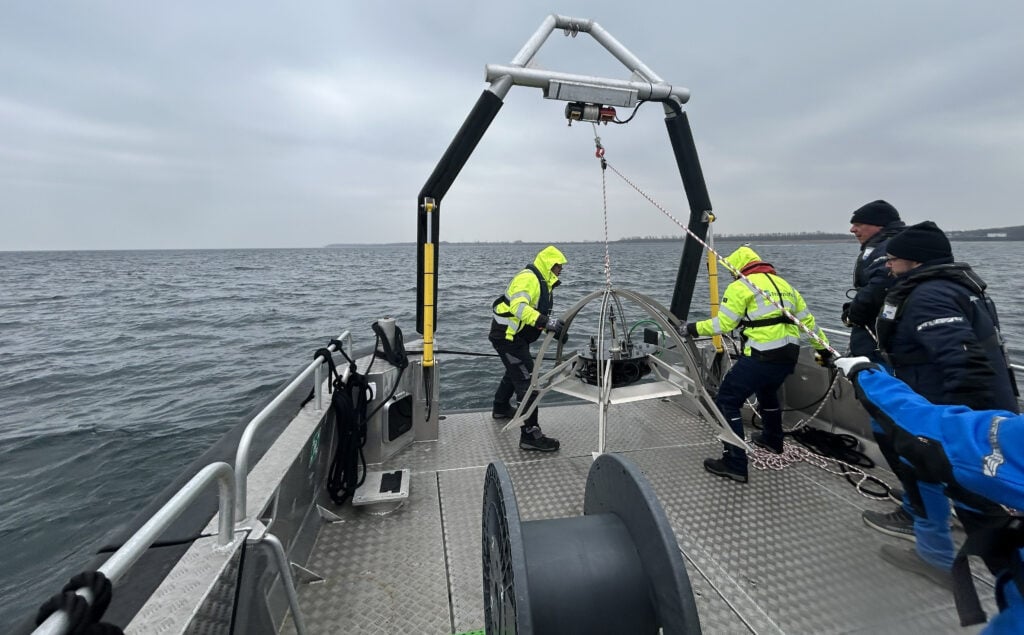
Teledyne loaned the SeaBat T50-R to NMC, and application engineer Geoff Crews supported integration aboard the college’s 56-foot research vessel, the Northwestern, using an over-the-side pole mount. Students then began collecting data for sediment mapping and grain-size assessment.
Focused survey objectives
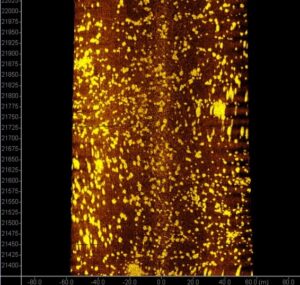
The group acquired acoustic backscatter across multiple sediment types and compared results with Ponar grab samples processed in the college’s laboratory. The primary aim was to collect seabed backscatter for sediment classification using the system’s Normalized Backscatter functionality, contributing to Lakebed 2030 and regional high-resolution mapping standards.
Students managed installation, calibration, and ongoing data collection, continuing operations independently after Crews’ departure. They also prepared technical summaries based on the acquired datasets.
John Lutchko, Director of the Marine Technology program at NMC, “This wasn’t just about students pressing buttons. They built this mission plan from scratch. One of them is already referencing this experience in job interviews.”
Consistent results in changing conditions
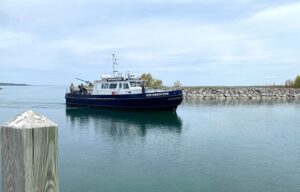
The SeaBat T50-R delivered stable performance despite variable weather and soft-bottom conditions. Students operated the sonar at 200, 300, and 400 kHz while running X-pattern and parallel lines in water depths from five to thirty meters, allowing them to evaluate frequency and survey-pattern effects on data quality.
Preparing a skilled workforce
The project demonstrated the value of collaboration between technology developers and training programs, supporting statewide workforce goals such as Michigan Reconnect and Achievement for All. Students gained practical experience with survey software, Ponar sampling, and grain-size analysis.
Reflecting on the project, Adyn McHugh said, “Being part of NMC’s partnership with Teledyne on the ground sampling project was an invaluable experience, both as a student and an early-career professional. Adding the Teledyne T-50R to my resume is a real asset. Combining software with real-world sampling, like using a Ponar grab and analyzing grain size, was something I hadn’t done before.”
With NMC’s Freshwater Research and Innovation Center planned to open within two years, faculty expect additional opportunities for students to work with advanced instrumentation.
As Mr. Lutchko emphasized, “We’re not just interested in borrowing gear. We want students to be trained by the people behind the technology.”
Kristine Beran, Sales Manager, Oceanographic/Scientific, Imaging & Instruments from Teledyne, added, “This is exactly why we support programs like NMCs, they’re preparing the workforce our industry depends on.”