Ship Security Alert Systems (SSAS) are covert ship-to-shore alerting systems used by vessels to report security threats without raising an onboard alarm. Installed across merchant ships, passenger vessels, offshore support craft, research vessels, and other eligible platforms, SSAS equipment transmits vessel identity, GNSS position, timestamps, and alert status to designated flag State and company security contacts.
This page showcases leading SSAS equipment suppliers, supporting discreet operation, message routing, power resilience, cybersecurity, and reliable connectivity in remote maritime environments.
If you design, build or supply Ship Security Alert Systems (SSAS), create a profile to showcase your capabilities and connect with visitors who have an active requirement for your solutions.
The Complete Guide to Ship Security Alert Systems (SSAS)
Overview by
William Mackenzie
Updated:
Introduction to Ship Security Alert Systems
A Ship Security Alert System (SSAS) is a covert alerting capability fitted to vessels to report security threats ashore without raising an onboard alarm. Under the International Maritime Organization (IMO) framework, the SSAS transmits a silent ship-to-shore alert to a flag Administration’s designated competent authority. This transmission identifies the ship, its real-time position, and indicates that the vessel’s security is compromised. This regulatory mandate sits within SOLAS Chapter XI-2 and the International Ship and Port Facility Security (ISPS) Code, applying to passenger ships, high-speed craft, mobile offshore drilling units (MODUs), and cargo ships of 500 gross tonnage and above on international voyages.
An SSAS functions strictly as a security tool rather than a general distress alarm. While GMDSS handles safety communications, AIS broadcasts tracking data to nearby traffic, and EPIRBs transmit emergency signals to search-and-rescue networks, the SSAS operates with absolute discretion. Activation produces no visible or audible indicators on board, routing the alert directly to specific shore authorities rather than surrounding vessels. IMO standards also dictate that SSAS operation must not impair or degrade the primary GMDSS installation.
The Operational Purpose of SSAS
The operational value of an SSAS relies on providing the master and the corporate security organization with an uncompromised communications path during a hostile event. In scenarios involving boarding, piracy, or unlawful interference, activating standard bridge alarms or open radio transmissions can increase danger to the crew.
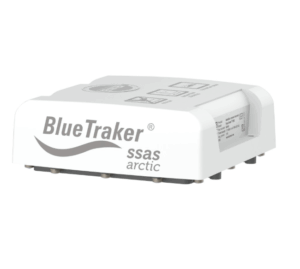
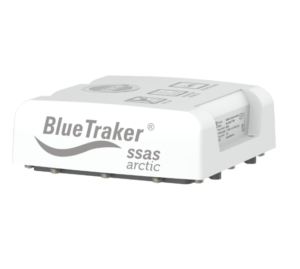
BlueTraker® SSAS Arctic from Iridium Communications
The SSAS supports the master, Ship Security Officer (SSO), and Company Security Officer (CSO) by sending a silent notification to shore-side response teams, keeping onboard awareness limited to a strict need-to-know basis. This framework aligns with the ISPS Code security roles and reinforces the master’s professional authority under SOLAS XI-2.
The implementation of this covert communication capability follows a highly structured technical sequence:
Manual activation: Triggered via independent switches on the navigation bridge and a secondary approved location.
Alarm suppression: Inhibits all local audio and visual indicators to maintain absolute operational discretion.
Position acquisition: Automatically extracts real-time GNSS coordinates along with a precise UTC timestamp.
Alert routing: Transmits the data packet securely over dedicated or modified satellite communications links.
Message delivery: Routes the payload directly to the pre-configured flag State and Company Security Officer.
Escalation workflows: Initiates immediate verification and shore-side coordination with regional security forces.
System reset: Clears the active alert state and archives transmission logs for post-incident compliance.
IMO guidance states that exact SSAS operational procedures and switch locations must be documented confidentially within the approved Ship Security Plan (SSP) rather than standardized across vessel classes.
Applications of SSAS Across Vessel Classes
Vessel Class
Primary Threat Environment
Operational Profile & Intent
Primary Escalation Path
Merchant Ships, Tankers & Container Vessels
Deep-sea piracy, armed robbery at anchorages, and high-value cargo theft.
Acted as a silent lifeline during boarding attempts, allowing the bridge team to alert shore before retreating to a secure onboard citadel.
Company Security Officer (CSO), flag State registries, and international anti-piracy naval coalitions (e.g., UKMTO).
Passenger Ships & Ro-Ro Vessels
Hostage scenarios or mass breach attempts targeting civilians.
Deployed for crowd control and panic mitigation; allows the crew to raise an alert silently without triggering a passenger stampede.
National security agencies, coastal counter-terrorism units, and state special forces.
Offshore Support & Subsea Construction
Hostile interference, sabotage, or unauthorized boarding near critical energy infrastructure.
Allows the bridge team to signal a crisis while supervisors safely pause or abort complex saturation diving or ROV maneuvers.
Maritime authorities, corporate security hubs of energy conglomerates, and regional coastal defense networks.
Research Vessels & Oceanographic Survey
Geopolitical harassment, grey-zone boardings, or detention in disputed maritime boundaries.
Functions as a low-friction diplomatic tool; avoids open radio distress calls that could escalate local political tensions with civilian scientists on board.
Flag registries and government diplomatic desks for state-level maritime diplomacy.
Superyachts & Expedition Craft
Targeted kidnappings, extortion attempts, and opportunistic piracy in remote zones.
Emphasizes privacy preservation and corporate insulation to ensure the security incident is managed without public media leakage.
Private maritime security centers, family offices, and specialized crisis-management insurers.
Fishing Vessels (Voluntary Installations)
Armed robbery, illegal boardings, or hostile encounters with aggressive foreign fleets.
Installed voluntarily to overcome extreme geographical isolation where standard VHF communication checks are insufficient.
Regional coast guards, local fisheries authorities, or commercial fleet management offices.
Core Components of an SSAS Installation
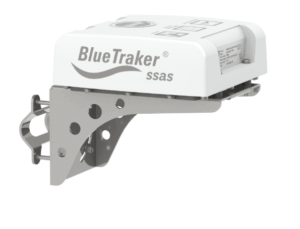
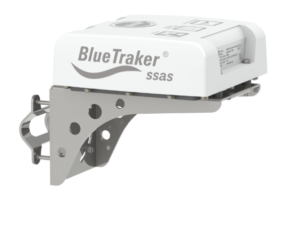
BlueTraker® SSAS from Iridium Communications
An SSAS installation relies on several specialized hardware and network layers to guarantee message delivery:
Activation buttons and hidden switch locations: Requires at least two activation points, including one on the navigation bridge. Switches must be mechanically shrouded against accidental operation without requiring complex multi-step procedures like breaking glass.
SSAS control unit or interface module: Monitors circuit loop integrity of the activation points, compiles vessel identity data, formats the alert message, and interfaces with the communication transceiver.
GNSS receiver and vessel identification data: Relies on an integrated or dedicated GNSS engine to provide coordinates. The unit must be configured with accurate IMO numbers, call signs, and MMSI data to prevent shore-side response delays.
SATCOM terminal or integrated communications bearer: Utilizes dedicated satellite hardware, ship-tracking terminals (such as Iridium SSAS configurations), or data messaging systems to ensure blue-water connectivity.
Antennas, cabling, power supply, and backup power considerations: Mandates antenna placement that maximizes satellite visibility and minimizes blockage from ship superstructure. System cabling must be hidden, and hardware must automatically switch to a dedicated backup battery bank if main power fails.
These components combine to form an autonomous safety layer separate from standard bridge systems. This hardware configuration ensures that the system remains operational even during a total shipboard blackout or terminal network failure.
SSAS Alert Data & Message Content
The transmitted data package must be structured for rapid transmission over satellite links and immediate parsing by shore-side systems.
SSAS Alert Data Field
Purpose and Engineering Relevance
Vessel name and IMO ship identification number
Provides immediate vessel recognition and reduces ambiguity if ships share similar names or change corporate ownership.
Call sign and MMSI
Links the alert transmission to official radio licensing records, maritime communications logs, and coastal tracking databases.
GNSS latitude and longitude
Delivers the exact spatial coordinates of the vessel at the precise moment the alert was triggered.
Date and time of position
Provides a Coordinated Universal Time (UTC) timestamp to help responders determine if the position data is current, stale, or inconsistent.
Vessel flag, owner, operator, and company security contact details
Automates routing and escalation logic to the correct Administration, Company Security Officer, and designated response teams.
Security threat indication and alert status
Contains a specific status flag that distinguishes a live security alert from routine tracking data, position reports, or network tests.
IMO MSC.1/Circ.1190 dictates that this core information must accompany the data packet when delivered to the designated recipient. Common causes of failed or ambiguous SSAS alerts include obsolete shore-side recipient details, expired satellite service subscriptions, physical blockages of the antenna, invalid or unlocked GNSS modules, mismatched vessel identifiers in registry databases, uncoordinated testing, and shore-side monitoring systems that receive the alert data packet but cannot map it to an active vessel registry.
SSAS Regulations, Compliance & Maritime Standards
Engineers, shipowners, and classification societies must adhere to a strict legal framework to ensure statutory compliance:
SOLAS Chapter XI-2 Regulation 6: Mandates the installation of an operational SSAS on all applicable vessels.
ISPS Code requirements: Details the integration of physical hardware testing and procedures into the confidential Ship Security Plan.
IMO performance standards: Enforces technical baselines under Resolution MSC.147(77) for covert activation and alternative power supplies.
MSC circulars: Outlines systemic hardware design boundaries (MSC/Circ.1072) and data payload formatting requirements (MSC.1/Circ.1190).
Flag State Administration requirements: Defines the explicit competent authorities and mandatory testing schedules unique to individual fleet registries.
Recognized Security Organizations: Empowers class societies to verify hardware configurations against active flag state requirements.
International Ship Security Certificate: Links SSAS validation directly to the legal status of the vessel’s primary security certification.
Failure to maintain compliance across any of these regulatory check-points results in immediate detention risks during Port State Control audits.
Emerging Developments in Ship Security Alert Systems
The technical architecture of modern alert systems is shifting from isolated, analog hardware toward dynamic, multi-layered digital security frameworks.
Digital fleet platform integration: Connects silent alert streams directly to onshore operations centers, instantly overlaying positional data with active LRIT feeds, weather maps, and live regional risk matrices.
Cybersecurity hardening: Introduces robust cryptographic encryption, role-based configuration access, and isolated bridge networks to prevent bad actors from intercepting or suppressing alert transmissions.
Multi-constellation GNSS integrity: Combines multi-network receivers with spatial anomaly detection to counter the growing operational threats of maritime GNSS jamming and spoofing.
Automated geofencing advisory workflows: Utilizes fleet software to execute silent diagnostics and automatically optimize terminal polling frequencies as a vessel enters predefined high-threat corridors.
These advancements significantly optimize shore-side response times and secure data validation during critical maritime security incidents.
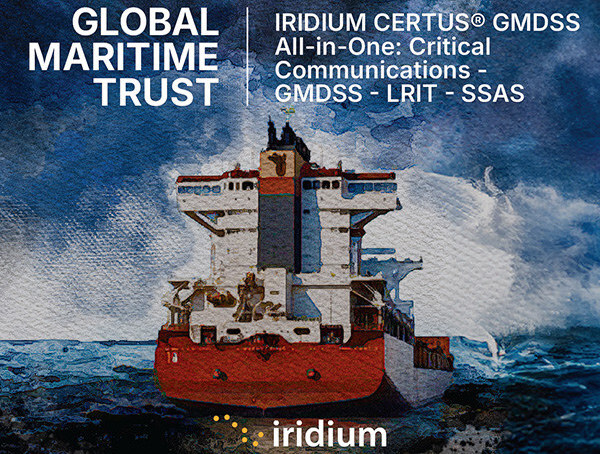
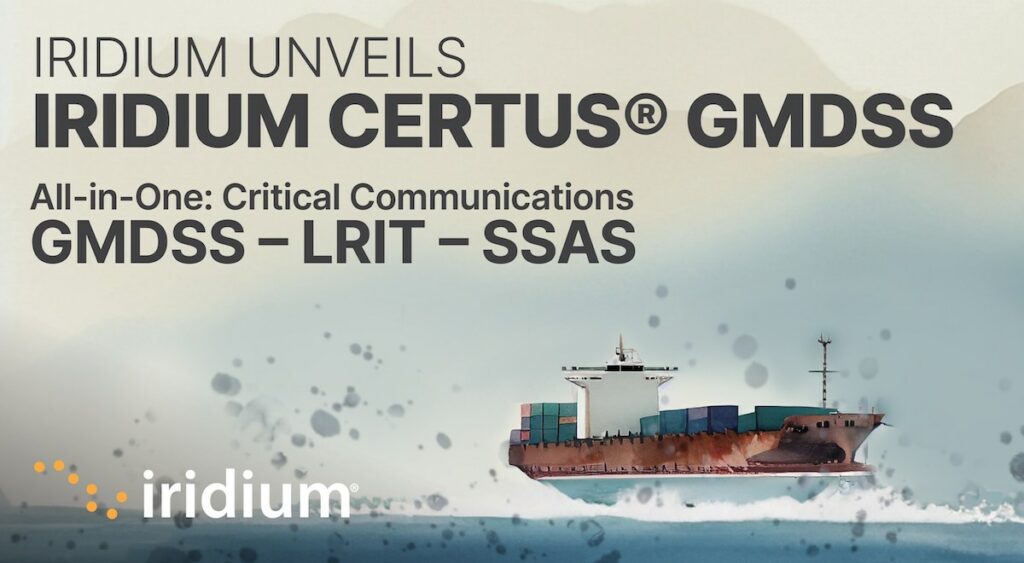
Iridium Communications is launching the Iridium Certus® GMDSS, a comprehensive maritime safety and communication service that delivers global distress alerting, safety voice, and MSI capabilities through a single terminal
OST has been showcasing Iridium’s satellite communication services and equipment, providing highly reliable connectivity for marine and maritime vessels and platforms
The new Iridium Certus® GMDSS is a comprehensive maritime safety solution, integrating distress alert, safety voice, and Maritime Safety Information (MSI) into one reliable terminal
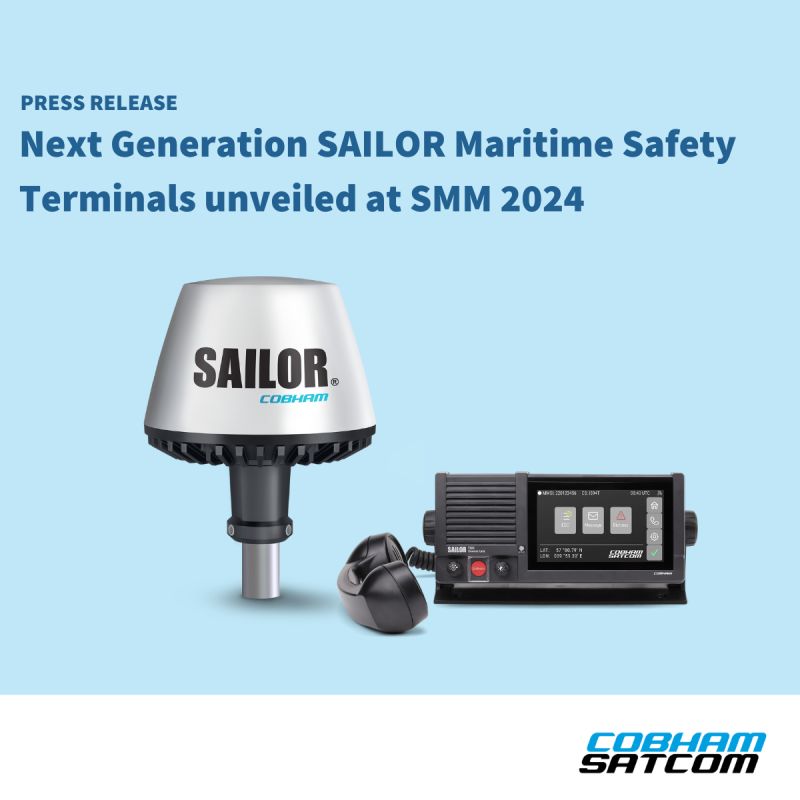
Cobham Satcom has launched a new range of advanced satellite Safety Terminals, designed for the GMDSS and able to integrate both LRIT systems and the SSAS into a single product
The latest offshore, subsea & marine technology news, straight to your inbox.
Get our weekly roundup of technology developments, new products and industry news.
THANK YOU FOR SIGNING UP
Thanks for joining us. Check your inbox.
We've sent you an email. Click the confirmation link to complete your subscription to the weekly eBrief. In the meantime, explore the latest news, suppliers and technologies.