Showcase your capabilities
If you design, build or supply 3D Printers, create a profile to showcase your capabilities and connect with visitors who have an active requirement for your solutions.


3D printers are digitally controlled additive manufacturing systems that produce marine and offshore components layer by layer from CAD data. In maritime operations, large-scale 3D printers are deployed in workshops, offshore maintenance hubs, and research vessels to fabricate functional parts, tooling, housings, and integration hardware on demand.
This page features suppliers of 3D printers for marine and offshore applications, including FDM, SLA, SLS, and metal powder-bed systems supporting polymers, composites, and corrosion-resistant alloys.
Read the Technology Overview


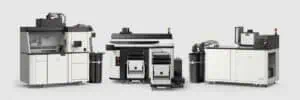
Industrial 3D Printing Solutions for Marine Robotics, Offshore Equipment & Autonomous Vessel Components

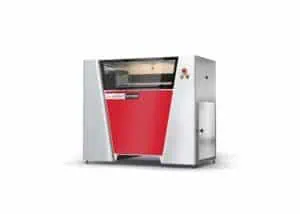
Large-Scale 3D Printing Equipment Manufacturer & Global On-Demand Part Service Provider

If you design, build or supply 3D Printers, create a profile to showcase your capabilities and connect with visitors who have an active requirement for your solutions.

3D printers are digitally controlled manufacturing systems that build physical components layer by layer directly from a CAD model. Unlike subtractive systems that remove material from a billet, 3D printers deposit, cure, or fuse material precisely where required. The platform comprises motion systems, energy sources like extruders, lasers, or projection engines, controlled material delivery mechanisms, and embedded software governing process parameters and part quality.
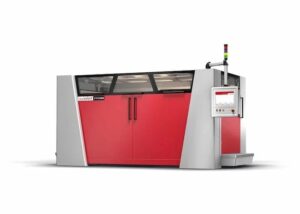
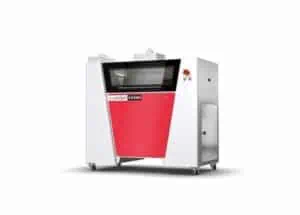
VX2000 high-efficiency sand mold 3D printer by voxeljet.
Within ocean science and marine technology operations, marine-grade 3D printers have moved beyond laboratory prototyping. They are now deployed in engineering workshops, offshore maintenance hubs, and increasingly aboard research vessels to produce functional components, tooling, fixtures, and integration hardware. For marine engineers, a large-scale 3D printer is a rapid-response fabrication asset that reduces logistics dependence, accelerates development cycles, and enables customization of components for unique subsea and offshore requirements.
Custom brackets, housings, and strain relief components are required when integrating new sensors onto buoys, gliders, or moorings. Engineers are also using additive manufacturing to create complex surface geometries that mimic natural textures to study or discourage marine growth on sensitive equipment.
Marine robotics programs use large-scale 3D printers for payload interfaces, fairings, and buoyancy module prototyping. For deep-sea applications, engineers must account for the fact that printed voids can act as pressure vessels. Solid infill or Pressure-Balanced Oil Filled (PBOF) designs are necessary to maintain structural integrity at depth.
Onboard printers enable production of replacement parts and protective covers during missions. This capability reduces downtime and supports adaptive experimentation. Digital inventories allow vessels to carry thousands of spare parts as files rather than physical stock, drastically reducing the carbon footprint of the maritime supply chain.
The ability to print bespoke cable organizers, bend restrictors, and breakout boots allows for rapid deployment of complex underwater sensor networks. These components can be tailored to the exact diameter and bend radius of specialized umbilical cables.
Additive manufacturing enables the creation of complex internal lattices and graded density structures. These are used to develop acoustic lenses, baffles, and damping components that are difficult or impossible to manufacture through traditional machining.
These subsystems collectively determine dimensional accuracy, material performance, environmental robustness, and process reliability when operating in marine workshops, offshore facilities, or onboard vessels:
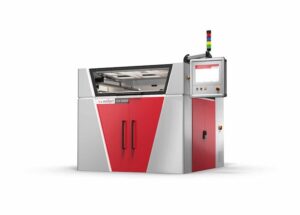
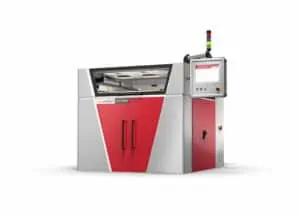
VX1000 industrial 3D printer by voxeljet.
Fused deposition modeling systems are widely used due to simplicity and material versatility. Enclosed architectures provide improved temperature control and protection from contamination. Typical outputs include brackets, cable guides, and jigs. For subsea use, FDM parts often require 100 percent infill or secondary resin sealing to prevent wicking or implosion of internal voids under hydrostatic pressure.
Vat photopolymerization systems provide superior surface finish and fine detail. Because each layer is chemically bonded to the next, SLA parts are inherently more watertight than FDM. These are well suited to sensor mounts, optical fixtures, and small fluidic components where fine features are critical.
Powder based systems produce strong, support free parts with good isotropy. In marine contexts, they are used for durable housings, ducting, and protective structures. Specialized materials like Nylon PA11 or PA12 offer high-impact resistance and low water absorption.
Laser Powder-Bed Fusion (LPBF) systems manufacture dense metal components from stainless steel, titanium, or nickel alloys. These are justified where corrosion resistance, high-strength, or complex internal geometries like internal cooling channels for electronics provide functional benefit.
Gantry based or robotic arm printers enable production of large tooling and even entire vessel hulls. These systems often use pellet extrusion to reduce material costs and increase deposition rates for structures up to several meters in length.
Build volume determines the maximum envelope of printable components and directly influences suitability for marine use cases. Instrument housings, ROV frames, and deck fixtures often exceed the capabilities of small format systems. Equally critical is dimensional repeatability. In marine environments where parts interface with seals, fasteners, and pressure housings, tolerances must be predictable. Industrial-grade systems offer tighter positional control, thermal management, and calibration routines than entry-level platforms.
Marine operations place a premium on availability. A 3D printer that requires constant recalibration or specialist intervention is poorly suited to offshore deployment. Throughput is defined by total cycle time including warm-up, material changes, and post processing. Systems designed for engineering environments emphasize automated bed leveling, self-diagnostics, and modular components that can be serviced without specialist factory support.
Selection is fundamentally linked to supported materials. Marine applications frequently require UV resistant polymers like ASA, chemically stable thermoplastics, corrosion resistant metals, or fiber reinforced composites. While open material systems offer flexibility, they require process control expertise. Closed material ecosystems provide validated performance but may restrict choice. The 3D printer must match the mechanical, thermal, and environmental demands of the intended application.
Salt laden air, humidity, and temperature variation present challenges for precision electromechanical equipment. Fully enclosed industrial 3D printers with filtered airflow and protected linear rails are better suited to coastal labs and vessel workshops. Corrosion resistant fasteners, sealed electronics, and conformal coated circuit boards extend service life. For shipboard use, vibration isolation and secure mounting are additional considerations.
Safety is a non-negotiable factor, particularly in confined vessel spaces. Resin printers generate volatile organic compounds. Powder-based systems produce fine particulates. Metal printers require inert gas handling. Laser classification and interlock systems must align with facility regulations. Proper ventilation, fire suppression compatibility, and hazardous material storage planning are essential before deployment offshore.
The maritime sector is currently witnessing a decisive shift from experimental innovation to proven industrial application, driven by a need for supply chain resilience and decentralized production:
 Searching Companies & Products

 Subscribe to the Weekly eBrief
The latest engineering and technical developments straight to your inbox - join thousands of engineers who receive it.
Subscribe to the Weekly eBrief
The latest engineering and technical developments straight to your inbox - join thousands of engineers who receive it.