


voxeljet details how 3D sand printing is advancing mold and core production for the casting industry, combining binder jetting technology with established foundry processes to enhance efficiency, flexibility, and design freedom.
As manufacturers face increasing demands for complex geometries, shorter lead times, and variable batch sizes, the company integrates additive 3D sand printing with conventional foundry technologies to optimize performance across the value chain while maintaining compatibility with existing casting workflows.
At the core of this approach is binder jetting for the tool-less production of 3D printed sand molds and cores for classic metal casting processes. By eliminating expensive tool making, 3D printed sand casting supports the realization of undercuts, complex geometries, and thin-walled structures that would be difficult to achieve using conventional methods.
Read the voxeljet whitepaper: 3D Printing for Sand Casting here >>
Production Advantages
voxeljet highlights three primary advantages of additive sand printing.
Cost efficiency stems from eliminating mold and tool construction. Complex geometries and smaller or variable batch sizes can be produced digitally and on demand, avoiding the cost-intensive tooling and changeovers of traditional processes.
Flexibility is enabled by industrial-scale 3D sand printing systems compatible with common foundry sands and binders. Hybrid manufacturing approaches allow only complex elements, such as sand cores, to be printed, while conventional methods are retained where suitable.
Time savings are achieved by removing mold-making stages. Additive production can reduce manufacturing times by up to 75%, with molds and cores produced within hours, accelerating prototyping and production schedules.
Binder Jetting Process
The binder jetting process builds molds and cores layer by layer. A coater spreads thin layers of sand across a build platform, and a printhead selectively deposits binder to bond defined areas. The sequence repeats until completion, with multiple components typically produced in a single job box to maximize capacity.
This fully digital workflow enables rapid iteration. CAD models are transferred directly to the printer, allowing mock-ups, prototypes, and production parts to be manufactured without tooling. Design adjustments can be implemented digitally at any stage.
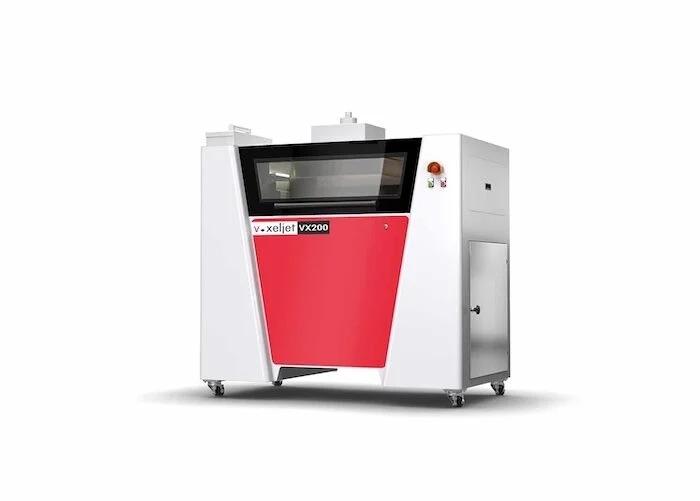
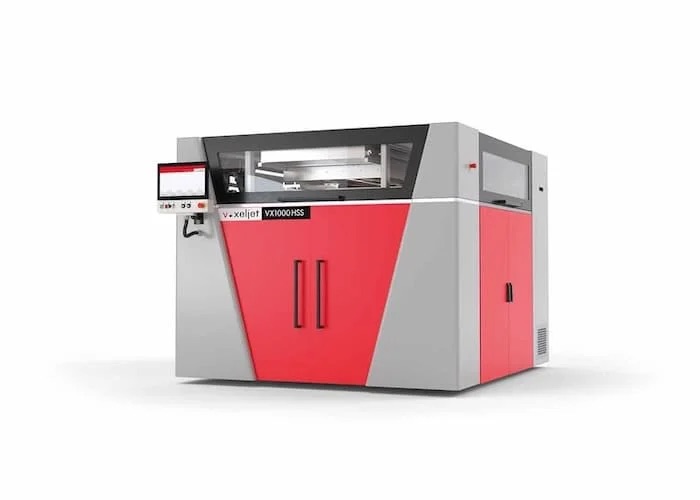
VX1000 3D printer.
Industrial Systems for Sand Casting
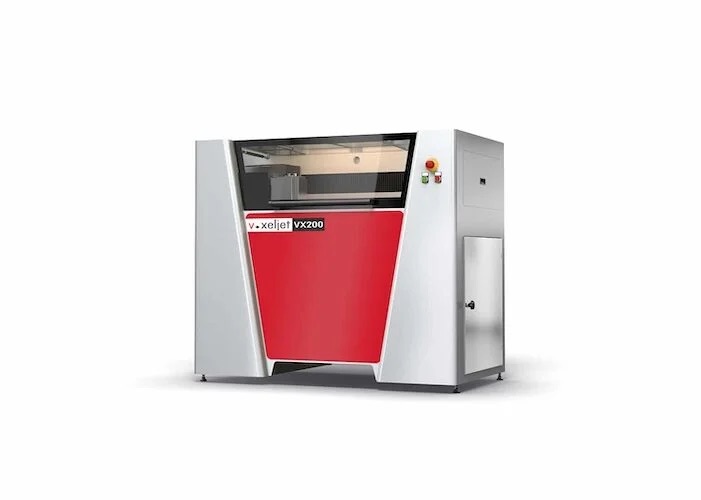
voxeljet offers a range of industrial 3D printers for sand casting applications.
- The VX1000 features a build volume of 1000 × 600 × 500 mm. It processes sand, plastics, and ceramics, and is suitable for medium-sized molds and cores for metal sand casting, as well as investment casting patterns and ceramic components.
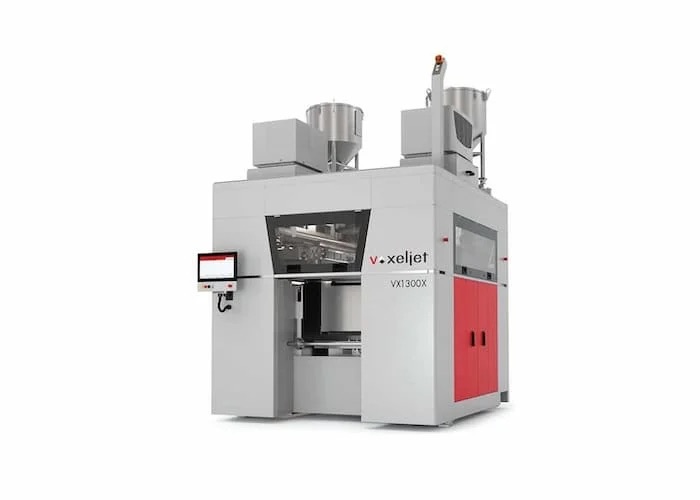
- The VX1300 X is designed for additive mass production on an industrial scale. It is ready for integration into IoT production environments and adapted for automated post-processing.
- The VX2000 includes a 2,000-liter job box and is designed for industrial sand casting applications. It is compatible with multiple sand types and with furan and phenolic resin binders from voxeljet.
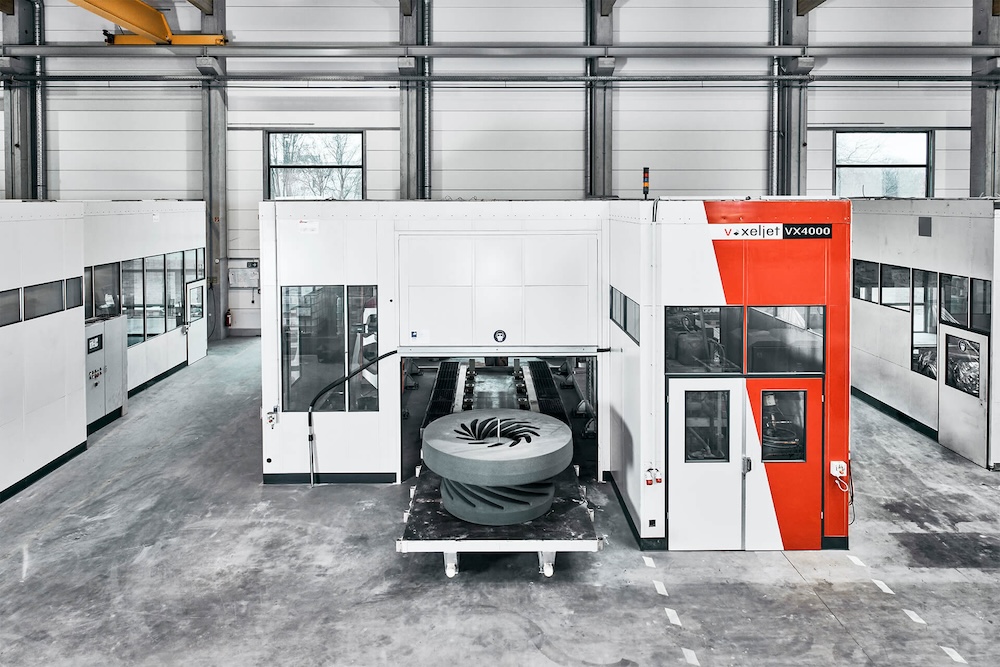
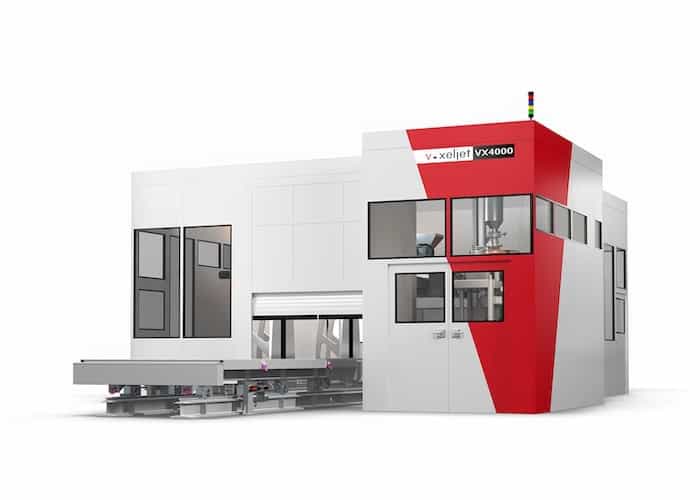
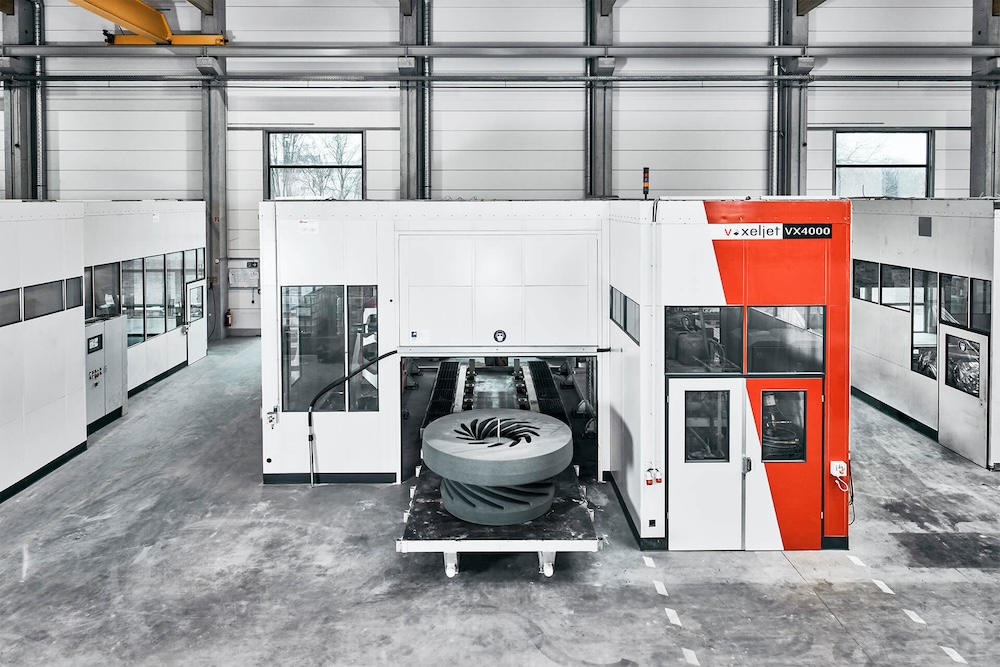
- The VX4000 has a continuous footprint of 4 × 2 × 1 meters and is designed for large-format sand molds. Its layering process ensures consistent build times and high part precision.
Materials and Industrial Support
voxeljet’s sand casting processes are based on furan resin, phenolic resin, and water glass systems. Supported sand types include quartz or silica sand, cerabeads, and bauxite in various grain sizes. Where required, post-processing can include epoxy resin infiltration or sealing.
The company’s Universal Binder Jetting systems are designed for continuous industrial operation. voxeljet also provides additive production backup capacity and global sales and service support.
Through established foundry processes and industry partnerships, voxeljet supports the production of complete castings in aluminium, magnesium, steel, iron, titanium, and bronze.
To find out more information, read the whitepaper ‘3D Printing for Sand Casting’ here >>