

Unmanned Surface Vehicles (USVs)
Discover cutting-edge solutions from 4 leading global suppliers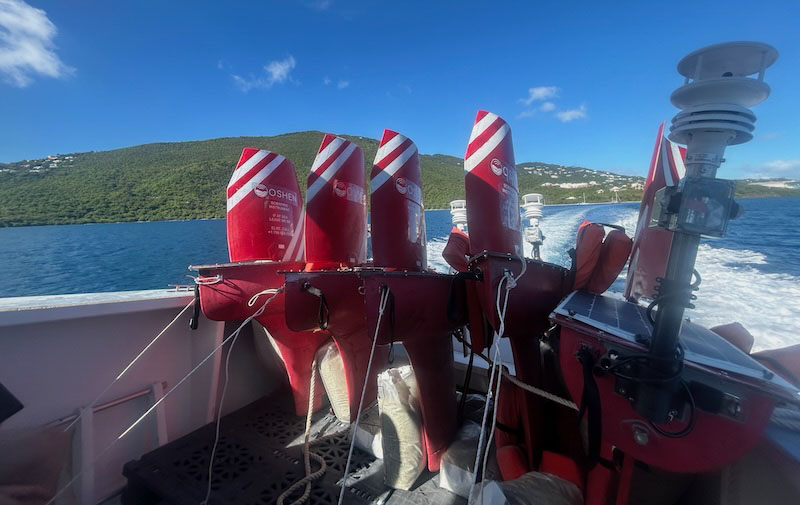
NOAA has launched five small Uncrewed Surface Vehicles (USVs) called C-Stars in the waters off the U.S. Virgin Islands to collect critical data to better understand hurricane development and activity.
The deployment was in partnership with the University of Southern Mississippi and with the robotics company Oshen, as the latest effort by NOAA to advance data collection to improve hurricane research and forecasting.
Two additional C-Stars will be stored in Gulfport, Mississippi, and will be ready for launch ahead of actively developing storms in the Gulf this fall.
NOAA has been expanding the use of uncrewed aircraft and marine systems to collect and use high-accuracy and time-sensitive data across its mission. These systems are a force multiplier for NOAA, supplementing NOAA’s traditional methods of data collection, often at lower cost, with increased safety and reduced risk, especially in remote or extreme environments.
A diverse array of uncrewed systems are already used in seabed mapping, marine mammal and fishery stock assessments, emergency response (including tornado damage assessments), and at-sea observations that improve forecasting of extreme events such as hurricanes, harmful algal blooms and hypoxia.
Greg Foltz, Oceanographer for NOAA’s Atlantic Oceanographic and Meteorological Laboratory (AOML), commented, “Understanding weather conditions where the ocean surface meets the lower atmosphere is key to predicting hurricane intensity. If these miniature uncrewed surface vehicles prove reliable, they could become a critical piece of NOAA’s hurricane observing system in the future.”
How the C-Star Works
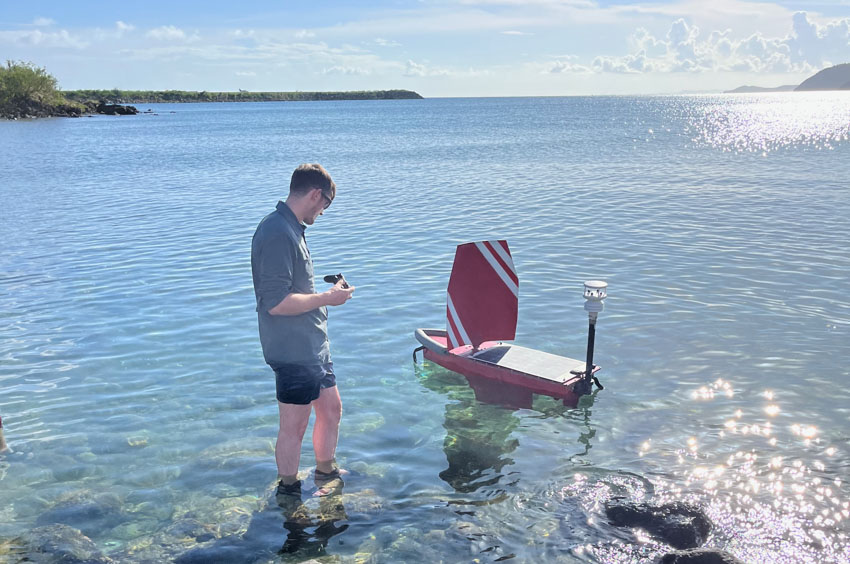
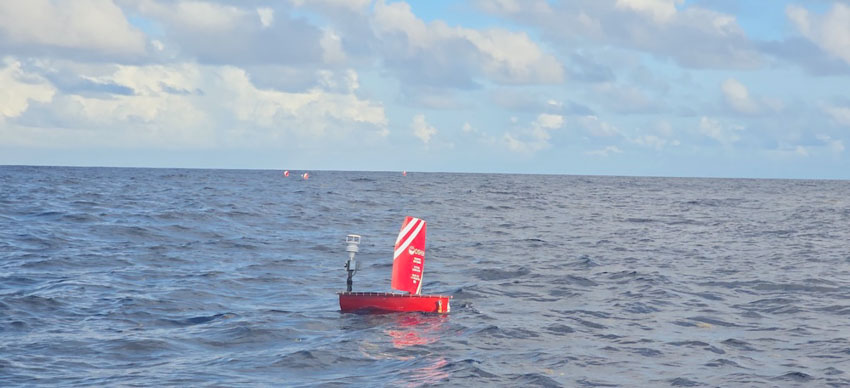
The C-Star was developed by U.K.-based company Oshen, which builds constellations of hand-deployable robots for ocean data collection. C-Stars operate individually or in fleets to provide coverage over wide ocean areas. Wind-propelled with solar-powered sensors, C-Stars transmit real-time data on wind speed and direction, sea surface temperature, air temperature, air pressure and relative humidity via satellite for forecasters and scientists.
C-Stars are also equipped with electric motor thrusters to improve positioning to intercept a hurricane or when winds are weak. Wave condition data, high-resolution images and movies will be available once the C-Stars are recovered.
Oshen mission specialists in the U.K. will remotely pilot the four-foot-long fiberglass USVs, which look like small sailboats. They will work with NOAA scientists at AOML in Miami and NOAA’s Pacific Marine Environmental Lab (PMEL) in Seattle to position them ahead of hurricanes. The C-Stars will operate experimentally over the next two months, transmitting near-real-time data, which will be automatically received, processed and distributed by PMEL to the World Meteorological Organization’s Global Telecommunications System, making it available to forecast centers globally.
Advantages of C-Stars
The C-Stars are small, measuring a sixth of the size of USVs used in recent years, making them easier to transport and launch. The Oshen team was able to use charter and fishing boats to deploy the C-stars off the coast of St. Thomas.
Leila Hamdan, Associate Vice President for Research, The University of Southern Mississippi, and professor in the School of Ocean Science and Engineering, stated, “We are excited by the role that C-Stars could play in improving hurricane forecasts, which have direct consequences for millions of people along the Gulf Coast. The University of Southern Mississippi is a natural partner for this effort as we bring deep expertise in autonomous systems and a history of collaboration with Oshen and NOAA. We’re excited to test new ways to gather critical data for NOAA’s mission.”
Anahita Laverack, Chief Executive Officer for Oshen, added, “Although C-Stars have navigated storms with towering 24-foot waves, hurricanes are a whole new level of challenge-but if it works, the long-term potential is huge. We believe that these new, small USVs can move the needle in how we observe and understand hurricanes.”
C-Stars have been used in the U.S. and Europe for a wide range of missions, from collecting ocean weather and temperature data to monitoring marine mammals.