
Securing ports and naval installations demands an integrated approach that spans surface, sub-surface, and aerial domains. Coastal threats, ranging from sea mines, rogue submarines, and diver incursions to unmanned threats like autonomous surface vessels (ASVs), uncrewed underwater vehicles (UUVs), and drones, require a layered defense posture. Port security solutions must be interoperable with naval defense systems, incorporating:
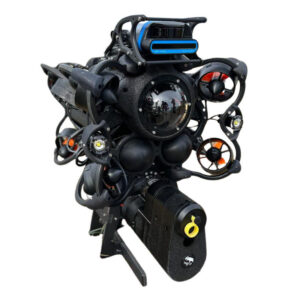
SRV-8 MDV by Oceanbotics.
- Mine countermeasures (MCM) employing towed array sonar, variable-depth sonar, synthetic aperture sonar, and mine hunting drones/UUVs.
- Explosive ordnance disposal (EOD) using dedicated robots and clearance divers.
- Counter-unmanned aerial systems (C‑UAS) ensure airspace integrity.
- C4ISR & maritime domain awareness, leveraging maritime patrol aircraft, ASW drones, and undersea surveillance infrastructure for acoustic intelligence (ACINT).
A Layered Defense Architecture
By combining surface patrol craft, anchored sonar systems, maritime patrol aircraft, and undersea sensor networks, ports can detect and neutralize threats early. Data fusion across C4ISR systems enables real-time threat classification and response coordination.
Surface and Aerial Domain Security
Counter-UAS & maritime patrol capabilities
Adversarial drones threaten port infrastructure, ships at berth, and personnel. Counter-UAS (CUAS) systems integrate radar, electro-optical/infrared sensors, and jamming or kinetic intervention to neutralize threats. Integration with C4ISR ensures automated detection and rapid interdiction.
Maritime patrol aircraft and ASW helicopters, equipped with dipping sonar, MAD sensors, and sonobuoys, extend domain awareness, offering rapid response and reconnaissance beyond visual range. These platforms, including UAVs, facilitate maritime patrol and surveillance, augmenting naval defense assets for port protection.
Surface asset defense & torpedo protection
Unmanned surface vehicles (USVs) with surveillance suites and kinetic modules can patrol nearshore zones. Torpedo defense systems, such as towed decoys and anti-torpedo countermeasure systems, safeguard moored or docked vessels. Lightweight torpedoes and ASW drones add depth to defense responses.
Sub-Surface Defense and Mine Warfare
Sonar systems and acoustic intelligence
Ports face underwater threats like sea mines, uncrewed submarines, or swimmer/delivery systems. Sonar systems, ranging from active sonar, towed arrays, variable depth and dipping sonar, to synthetic aperture sonar, provide image resolution, range, and target classification capabilities. UUVs and AUVs fitted with sonar can autonomously map seabeds and identify threats. Acoustic intelligence (ACINT) platforms intercept and analyze undersea acoustic signatures to classify and track submarines or uncrewed threats.
Mine warfare, MCM, and neutralization
Comprehensive mine countermeasures adopt a phased approach:
- Detection via sonar-equipped AUVs/UUVs and synthetic aperture sonar.
- Classification using acoustic and magnetic anomaly detection (MAD) sensors, supported by towed and variable-depth sonar.
- Neutralization by EOD robots or clearance divers, delivering mine neutralization charges or using small-grade explosives.
Subsea warfare systems, including seabed warfare and naval mine warfare solutions, protect fairways and harbor entrances. Lightweight EOD robots and mine-hunting drones can safely reach and neutralize buried or deployed mines.
C4ISR Integration and Data Fusion
An effective port defense hinges on high-level situational awareness. C4ISR systems collate data from radar, sonar arrays, patrol aircraft, ASW helicopters, USVs, UUVs, and EOD platforms. Real-time tracking, acoustic intelligence, and threat classification are combined using secure communication networks. Platforms such as maritime domain awareness centers enable command staff to implement early warnings, threat prioritization, and optimized allocation of response assets.
Naval Defense Product Ecosystem
From naval defense systems to component technologies, developers and integrators supply:
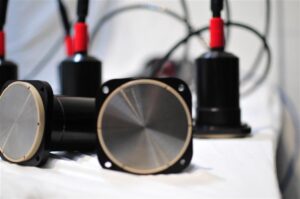
Field-Guard by ELWAVE.
- Naval electronic warfare (EW) suites for signal disruption and anti-submarine electronic countermeasures.
- Weapon delivery systems, including ASROC missiles, torpedo defense systems, anti-torpedo countermeasures, and lightweight torpedo interceptors.
- Uncrewed maritime systems, such as USVs, UUVs, mine hunting drones, Autonomous Surface Vessels (ASVs), and Autonomous Underwater Vehicles (AUVs).
- Underwater sensor networks, with acoustic communication nodes enabling real-time detection and coordination.
- EOD robots and clearance equipment, including remotely operated vehicles and robotic arms.
These offerings come from naval defense product manufacturers specializing in robust, MIL-STD-compliant systems.
Operational Considerations in Maritime Installations
Deployment strategy
Effective deployment of port security solutions requires balancing cost, operational complexity, and mission effectiveness:
- Sensor placement: Fixed sonar arrays provide continuous, localized monitoring, while mobile platforms such as ASVs, USVs, and AUVs enable adaptable, wide-area coverage.
- Platform interoperability: Uncrewed and crewed systems, USVs, UUVs, patrol craft, and aircraft should use standard interfaces for navigation, threat detection, and data integration.
- Response protocols: Defined procedures should guide the sequence from detection and assessment to interdiction, including EOD deployment and escalation when necessary.
Training and legal compliance
Teams must be qualified under naval EOD protocols, ASW operations, and drone counter-adaptation. Regulatory frameworks, such as no-fire zones around ports, must be respected. Standard operating procedures ensure safe intervention when dealing with floating mines, diver presence, or civilian vessels.
Future Trends in Port Security Technology
- Autonomous focus: ASWs and AUVs are being developed for complete mission autonomy, enabling repeatable mapping, detection, and neutralization.
- AI-powered sensor fusion: Applying machine learning to sonar, sensor data, and acoustic intelligence improves threat classification, reducing false positives.
- Advanced acoustic communications: Underwater sensor mesh utilizing advanced acoustic communications allows persistent networked domain awareness.
- Counter-UUV technologies: Planned additions like anti-UUV nets, directed-energy systems, and high-frequency active sonar for denying sub-surface corridors.
- SOF integration: Special forces units are being embedded for rapid EOD clearance, port hardening with reinforced sensors, and tactical response capabilities.
Port Security Solutions—The Maritime Defense Imperative
Robust port security integrates MCM, EOD, C‑UAS, C4ISR, maritime patrol platforms, and underwater defense systems into a coherent maritime defense framework. By combining cutting-edge sonar technology, ASW capabilities, autonomous platforms, and weaponized countermeasures, supported by comprehensive data networks, ports and waterborne installations are better equipped against evolving threats.