

The Global Sourcing Hub for Marine, Subsea & Offshore Technology
Discover cutting-edge solutions from leading global suppliers
Rijkswaterstaat, the executive agency of the Ministry of Infrastructure and Water Management in the Netherlands, has received its first DUS V1875 Unmanned Survey Vessel (USV), named REMO 1, from Demcon unmanned systems, marking an important milestone in future-proofing its services.
The handover took place during an official handover event organized by Rijkswaterstaat, where invited guests were shown a live demonstration of its advanced autonomous capabilities.
The DUS V1875 sets a new benchmark for autonomous hydrographic surveying in inland waters, especially in locations that are difficult to access. Developed and manufactured in the Netherlands, this compact and fully electric USV is designed for rapid deployment in locations that are difficult or unsafe to survey with traditional vessels.
The USV features a robust HDPE hull and a modular design featuring an interchangeable moonpool for easy interchanging of survey equipment. This design supports a wide range of sensors, including multibeam echosounders, side-scan sonars, Acoustic Doppler Current Profilers (ADCP), and water quality instruments.
The first version is fitted with an ADCP, enabling precise measurements of water flow and discharge, the volume of water passing through. Discharge is a key metric for understanding river and canal currents and an essential parameter for determining safe dike heights. Thanks to its flexibility, the vessel is suitable for diverse measurement and monitoring tasks, delivering reliable, detailed data for future-proof water management.
This small USV type is engineered with strict attention to operational safety, reliability, and minimal environmental impact. Its fully electric propulsion enables the platform to operate with zero emissions, while redundant systems and multiple safety features continuously monitor both the vessel and its surroundings to ensure safe operations. Advanced capabilities such as automatic collision avoidance and dynamic positioning enable highly precise autonomous navigation. This makes reliable deployment possible on regular waterways as well as in complex, confined environments, even beyond the operator’s direct line of sight.
In addition to its advanced technical capabilities, the USV is a sustainable alternative that actively contributes to reducing emissions from conventional vessels. By significantly lowering the ecological footprint of Rijkswaterstaat’s fleet, the platform reinforces the organization’s sustainable and future-oriented ambitions.
Ron Kolkman, Chief Information Officer at Rijkswaterstaat, commented on the collaboration, “It’s impressive to see how we were able to realize this vessel in about a year. The USV is a great Dutch product to be proud of.”
Fedor Ester, Managing Director of Demcon unmanned systems, added, “The delivery marks an important step towards further automation and sustainability in water management.”
Director of the Rijksrederij, Willem de Vries, stated, “This vessel is an example of how we can integrate modern technologies into our fleet. The delivery of this USV marks a new way of thinking about how we can provide services for our clients as innovatively and sustainably as possible.”
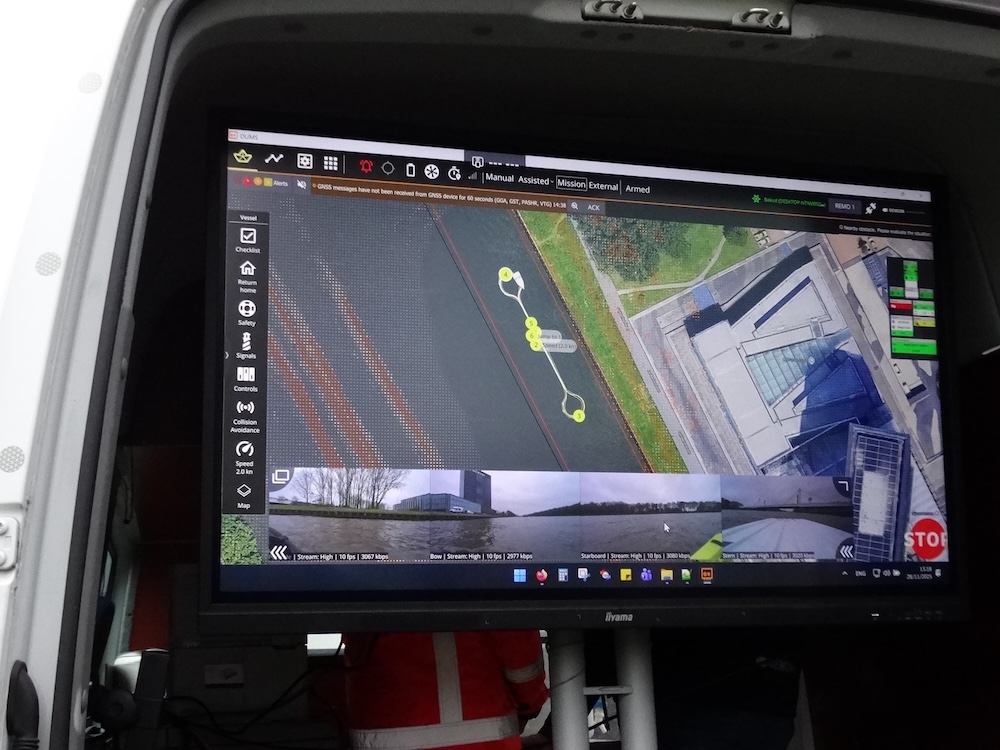
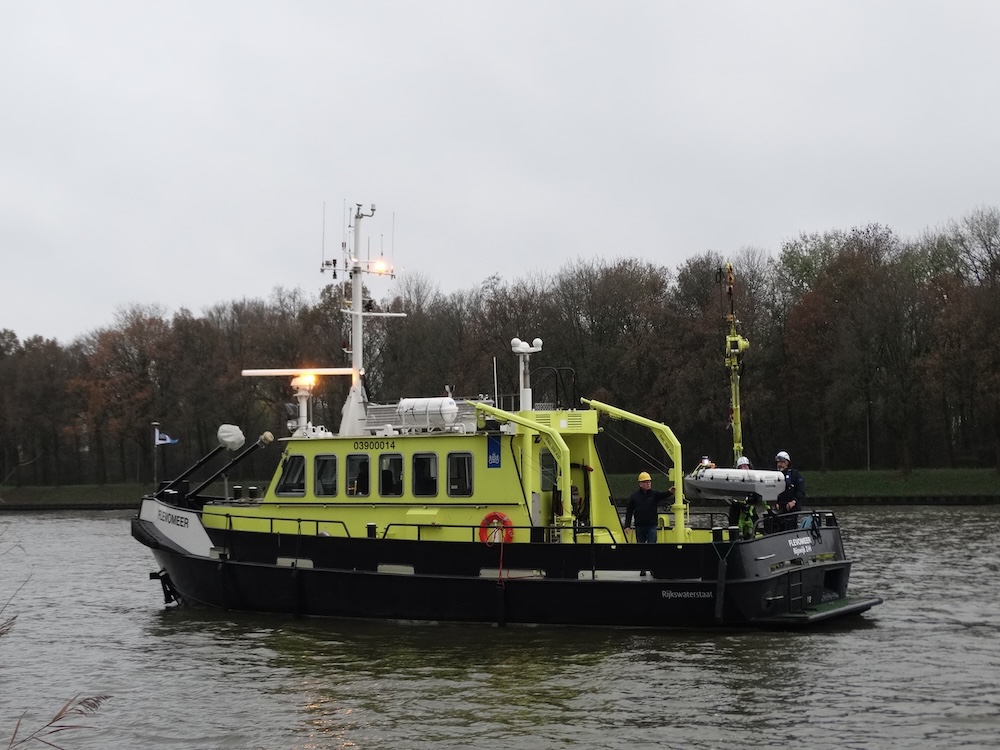
During the event, Rijkswaterstaat and Demcon unmanned systems showcased the DUS V1875 in operation on the Amsterdam Rijnkanaal. The USV was launched from the vessel Flevomeer, followed by an extensive demonstration. Guests observed live camera feeds from the USV in a van on the quay, while experts explained the vessel’s measurement systems and operational capabilities. The event concluded with a symbolic handover and a joint toast.
The next phase of the collaboration will focus on process integration and training.