

Subsea Imaging Systems
Discover cutting-edge solutions from 11 leading global suppliers
The successful application of ropeless fishing technology in California’s Dungeness crab fishery is driving the development of specialized offshore systems for deep-water lobster operations.
In 2025, a California Experimental Fishing Permit (EFP) facilitated the deployment of more than 25,000 traps using ropeless, on-demand systems. This initiative resulted in $1.4 million in landed crab with a gear loss rate of only 0.2 percent. Building on this performance, the technology is now being adapted for the more rigorous conditions of offshore lobster fisheries, which involve deeper waters, stronger currents, and longer groundline strings.
Ropeless or on-demand fishing gear eliminates the need for traditional vertical lines and surface buoys, which are typically used to mark and retrieve gear. Instead, the trap, line, and buoy remain on the seabed until the fisherman triggers a release using acoustic or timed-release technology. This method significantly reduces the risk of whale entanglement and minimizes gear interactions with maritime traffic and storm activity.
The transition to offshore environments required engineering adjustments to handle increased physical demands. Developed by Guardian Ropeless, the Guardian Offshore Sled is designed to manage large diameter rope, heavier buoys, and strong currents while ensuring consistent acoustic activation. The unit can hold up to 200 fathoms of line, allowing it to serve as both a trap anchor and a trawl endpoint.
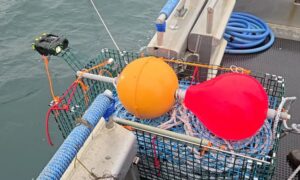 Russ Mullins, from Guardian Ropeless, comments, “We call this unit the Guardian Offshore Sled, which is designed for deeper-water, offshore lobster fisheries.”
Recent testing conducted alongside Sustainable Seas Technologies and CatchCam involved deployments at depths of approximately 70 fathoms in surface currents of 1.5 knots.
“This particular test was conducted in about 70 fathoms,” Mullins states.
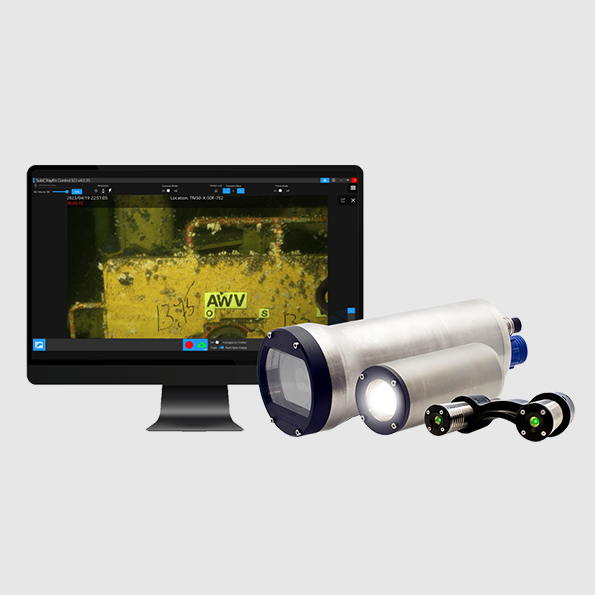
Underwater footage provided by CatchCam has been instrumental in refining the design of the offshore sled. By observing line deployment and buoy ascent in real-world conditions, engineers accelerated the development process and validated the reliability of the system.
Mullins adds, “This is the same CatchCam camera that we had in California when testing our ropeless gear in real world conditions.”
While ropeless gear is not expected to replace traditional methods in every fishery, it has emerged as a viable solution for reopening restricted areas. The maturation of this technology allows operators to maintain commercial viability while addressing environmental conservation requirements. CatchCam continues to support the integration of these systems by providing tools to observe and validate gear behavior underwater for operators exploring ropeless systems or looking to reduce bycatch.
Find out more from the CatchCam Technologies website.