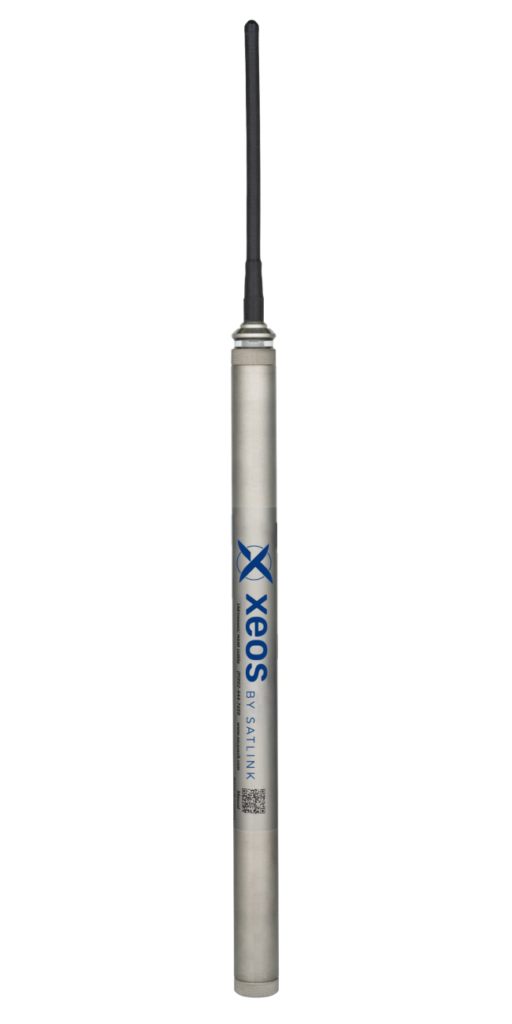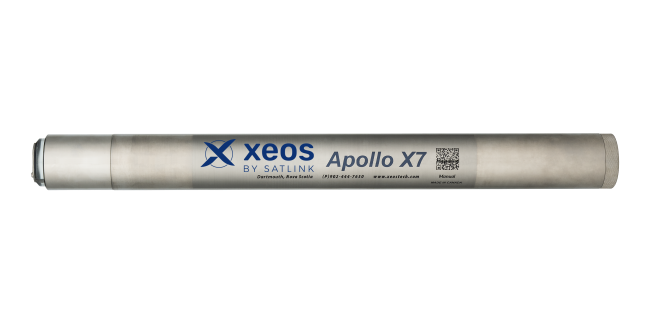

Xeos by Satlink’s Nemo X is a submersible two-way data relay and recovery beacon designed for autonomous and remotely operated marine vehicles operating in challenging offshore and deep-sea environments.
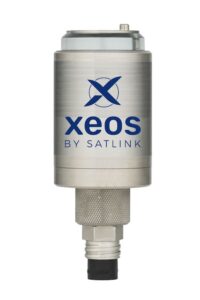
Nemo X
Combining Iridium Short Burst Data (SBD) communications, integrated GPS positioning, RS-232 connectivity, and recovery beacon functionality within a compact titanium housing, the Nemo X enables remote command and control, asset tracking, and recovery coordination for subsea platforms.
The system has also been configured for submerged vehicle power-loss sensing applications, allowing its integrated high-visibility LED flasher to activate automatically underwater in the event of ROV or AUV power loss. By separating the LED recovery flasher from the vehicle’s primary power supply, the visual recovery cue remains available during failure conditions where onboard systems may otherwise become unavailable.
Designed for deployment to depths of 7,500 meters, the Nemo X supports autonomous vehicle communications, marine sensor data relay, and remote monitoring applications while providing operators with satellite-based asset visibility and recovery support when surfaced.
Recovery Support for ROVs and AUVs
The Nemo X combines data relay functionality with asset recovery support for underwater vehicles and remote marine platforms. Designed as a bi-directional relay beacon, the unit incorporates RS-232 communications and Iridium Short Burst Data connectivity, enabling operators to exchange commands and operational data with deployed systems remotely.
The integrated LED flasher provides a visual reference during recovery operations both underwater and at the surface. The configured power-loss sensing capability allows the flasher to activate automatically during vehicle power-loss events, assisting operators in locating ROVs or AUVs more efficiently during retrieval operations.
When surfaced, the Nemo X acquires GPS positioning data and transmits location information to operators over the Iridium satellite network. The beacon also relays GPS coordinates to connected vehicles through its RS-232 interface. Once communication is established, operators can remotely send commands to the Nemo X for functions including flash-rate adjustments and updated vehicle tasking.
Two-Way Communications and Remote Monitoring
The Nemo X is designed for autonomous vehicle communications, marine sensor relay applications, and meteorological buoy data transmission. Utilizing Iridium SBD communications, the system supports near real-time remote data recovery and global two-way communications in marine operating environments.
The platform provides remote configuration and control capabilities for AUVs and connected marine systems, while also supporting relay-to-relay communications, wake-on-input triggering, and command-based output functions for external relay devices.
Compatible with XeosOnline monitoring software, the Nemo X enables operators to monitor incoming messages, track deployed assets, configure beacon settings remotely, and manage multiple systems through a centralized interface.
Ruggedized Design for Deep-Sea Operations
The Nemo X is housed within a pressure-tolerant titanium and glass enclosure designed for subsea operations to depths of 7,500 meters, with an optional 11,000-meter configuration available. The compact unit measures 10.31 cm in length and 5.08 cm in diameter, weighing 575 g in air and 390 g in water.
The platform operates from a 9 to 28 V external power supply and incorporates a low-power underwater sleep mode to reduce energy consumption during submerged operation. Additional features include integrated RS-232 communications, GPS positioning capability, two-way command and control functionality, and an LED flasher for enhanced visibility during recovery procedures.
By combining remote communications, recovery beacon functionality, and autonomous vehicle integration within a compact subsea-rated platform, the Nemo X supports marine operators deploying high-value mobile systems in environments where asset visibility and recovery coordination remain critical operational requirements.