The Global Sourcing Hub for Marine, Subsea & Offshore Technology
Discover cutting-edge solutions from leading global suppliers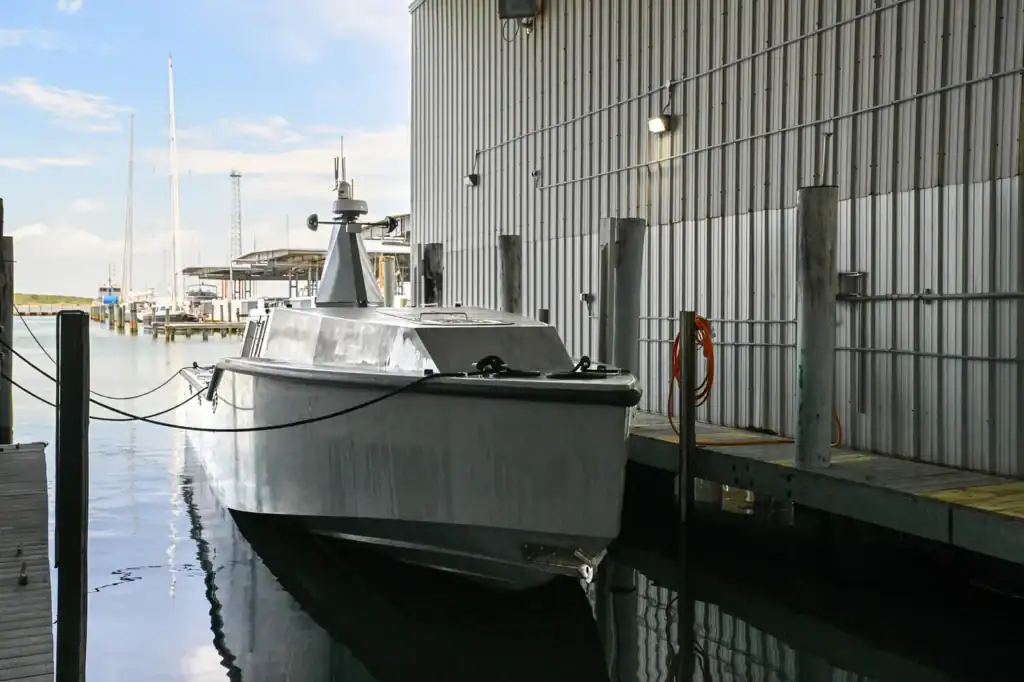
Saronic has officially launched its first Mirage, a 52-foot dual-use Autonomous Surface Vessel (ASV) designed to expand the capabilities of unmanned maritime operations.
This new vessel joins the 24-foot Corsair and 180-foot Marauder as the third flagship platform in the company’s expanding fleet, moving from initial design to launch in less than a year. The platform is currently beginning on-water trials at a privately funded test facility in Galveston, Texas, while the next hull is already moving down the production line at the company’s Austin headquarters.
Dino Mavrookas, Co-founder and CEO of Saronic, commented, “We launched our first Marauder four weeks ago, and today we’re putting another vessel in the water. This cadence is what our production model was built to deliver. With Corsair, Mirage, and Marauder now in full production simultaneously, we are delivering a full family of autonomous surface vessels at the speed and scale that makes real adoption possible.”
Built for complex maritime environments, the Mirage features a top speed of over 35 knots, an operational range exceeding 2,500 nautical miles, and a payload capacity of 3,500 pounds. These specifications more than double the range and payload capacity of the smaller Corsair platform. The vessel can operate completely autonomously or under remote human supervision, supporting missions such as maritime domain awareness, security, and aerial and surface detection.
The platform utilizes the same core autonomy stack validated across the rest of the fleet, incorporating passive perception and collaborative autonomy capabilities like navigation, tracking, and detection. Redundant communications and intuitive control interfaces support these systems. Furthermore, an open, modular architecture allows for the rapid integration of Government-Off-The-Shelf (GOTS) and Commercial-Off-The-Shelf (COTS) hardware and software solutions, including sensor packages and mission payloads, without requiring an engineering overhaul of the underlying vehicle. Control and mission planning are managed through Echelon, the company’s unified command-and-control platform.
Manufacturing takes place entirely under one roof at the Austin facility, where hardware and software are developed as an integrated system. The facility maintains the capacity to build hundreds of Mirage vessels and thousands of Corsair platforms annually. Initial on-water trials in Galveston will focus on validating the performance of the vessel across its full design envelope, building on previous reliability and autonomy testing conducted at the Gulf Coast site.