
The Global Sourcing Hub for Marine, Subsea & Offshore Technology
Discover cutting-edge solutions from leading global suppliers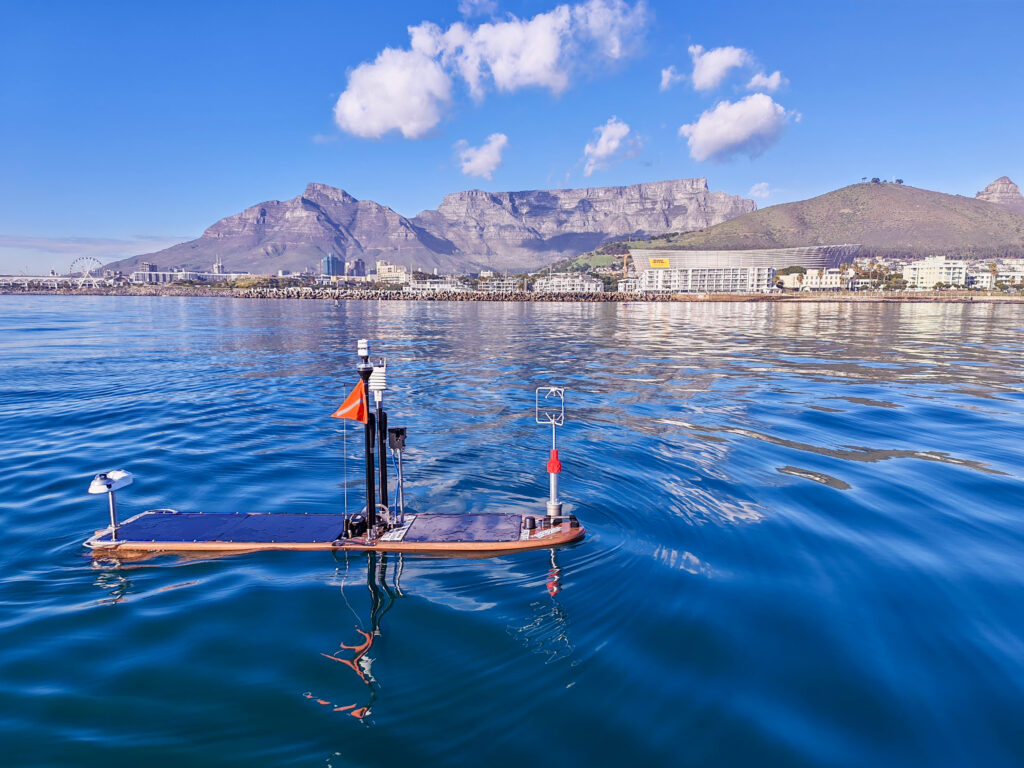
Researchers from the GEOMAR Helmholtz Centre for Ocean Research Kiel and international partner institutions are conducting a major field campaign off the coast of South Africa to investigate how small-scale ocean movements influence climate and marine ecosystems.
Running from 20 June to 29 July 2026, the campaign is the flagship experiment of WHIRLS, an ERC Synergy Project coordinated at GEOMAR. It focuses on the Agulhas Current region, where warm waters from the Indian Ocean meet colder waters from the Atlantic and Southern Oceans, creating intense turbulence, steep temperature gradients and vigorous exchanges with the atmosphere.
The ocean is a central component of the Earth system. It absorbs most of the excess heat generated by human activities, takes up a significant proportion of the carbon dioxide emitted into the atmosphere and supports ecosystems that are important for food security, economic activity and biodiversity.
Many of these functions are strongly influenced by fine-scale ocean structures such as eddies, fronts and filaments. These features span only a few kilometres and develop over periods ranging from days to weeks, but they play a disproportionately important role in ocean and atmospheric processes.
They influence exchanges of heat and carbon dioxide with the atmosphere, the vertical transport of nutrients from deeper waters and the spatial and temporal organisation of marine life. Because they are transient and difficult to observe, they remain inadequately documented, and their effects are not yet sufficiently represented in climate models.
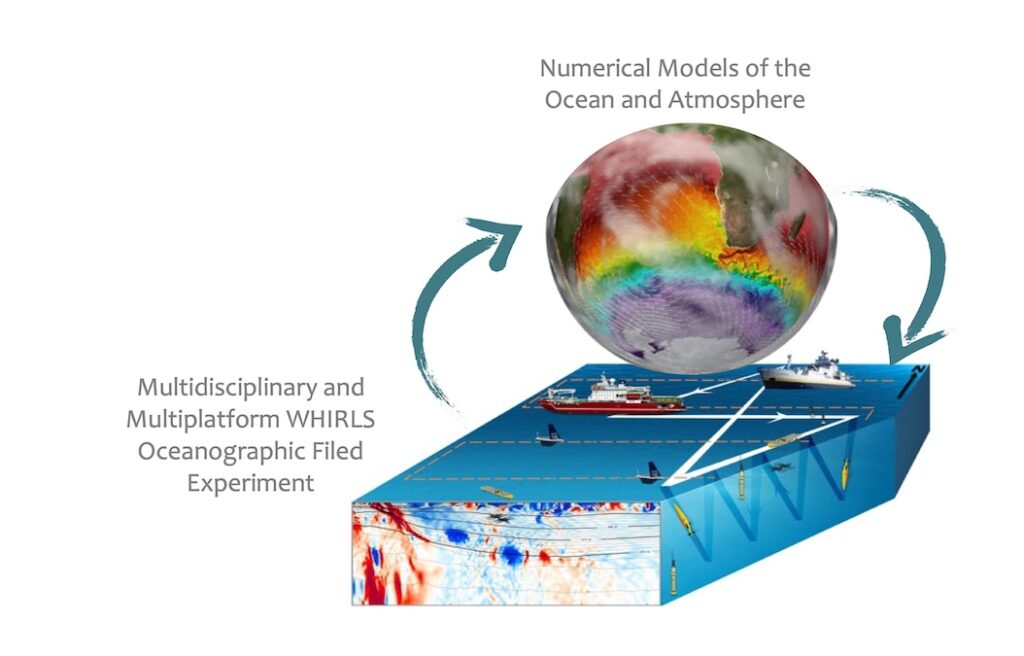
WHIRLS, which stands for Unravelling the impact of ocean fine-scale whirls on our climate and ecosystems, examines the ocean, atmosphere and marine ecosystems at the spatial and temporal scales where their interactions are most intense.
The Agulhas Current provides an important natural laboratory for this work. It is one of the most energy-rich ocean currents on Earth, and some of its warm water enters the Atlantic, contributing to the large-scale ocean circulation that distributes heat around the planet.
The campaign is taking place during the southern winter, when contrasts between the ocean and atmosphere become more pronounced. Storms occur frequently during this period, while fine-scale ocean processes are particularly active.
GEOMAR and its research partners are carrying out measurements across an area of approximately 40,000 square kilometres. Two research vessels, France’s MARION DUFRESNE and South Africa’s SA AGULHAS II, are working as mobile scientific observatories to investigate the three-dimensional structure of the upper 1,000 metres of the ocean and the lower atmosphere.
The ships are supported by an extensive fleet of autonomous platforms, including underwater gliders, wave gliders, sailing buoys, approximately 200 surface drifters, 18 profiling Argo floats and Saildrone-type marine drones.
Researchers are also conducting approximately 300 atmospheric soundings using radiosonde balloons and profilers. These observations are supplemented by laser-based wind measurements and aerial drones used to characterise the lower atmosphere. Together, this measurement network is designed to provide an unprecedented level of spatial and temporal resolution, enabling researchers to track the formation, development and dissipation of fine-scale ocean structures almost in real time.
Alongside the physical observations, WHIRLS includes an extensive biological and biogeochemical programme. Water samples are being analysed for nutrients and their isotopic composition, while plankton nets collect larger organisms.
Genetic and genomic analyses are providing detailed information about marine biodiversity, including viruses and bacteria that are otherwise difficult to observe. Acoustic systems are detecting zooplankton and fish, while observers are recording seabirds and marine mammals.
Fine-scale ocean structures can create areas with high concentrations of marine life, attracting larger predators. Observing organisms ranging from viruses to marine mammals alongside physical and chemical processes will provide an integrated view of the marine biome that is rarely achieved.
Coordinated at GEOMAR, the project is led by Arne Biastoch of GEOMAR in Kiel, Sabrina Speich of École Normale Supérieure in Paris, Sebastiaan Swart of the University of Gothenburg and Sarah Fawcett of the University of Cape Town.
Arne Biastoch, Professor of Ocean Dynamics at GEOMAR, summarised, “The comprehensive observation of these small-scale ocean processes and the life they support – from viruses to marine mammals – combined with advanced computer models, is unique. By bringing together fields that are usually studied separately, we will be able to understand how the ocean’s smallest structures influence climate and biodiversity.”
The observations will be combined with a comprehensive system of ocean and climate models, helping researchers place the campaign data within a broader spatial and temporal context. Beyond the four core teams, WHIRLS involves a broad international partnership spanning South Africa, Germany, Sweden, France, Italy, the United Kingdom, China and the United States, together with numerous research institutes and space agencies.
By observing physical, biogeochemical and ecological processes simultaneously, the campaign aims to provide essential insights for improving climate forecasts, better understanding the ocean’s carbon cycle and predicting how marine ecosystems may respond to climate change.