
Autonomous Underwater Vehicles (AUV)
Discover cutting-edge solutions from 9 leading global suppliers
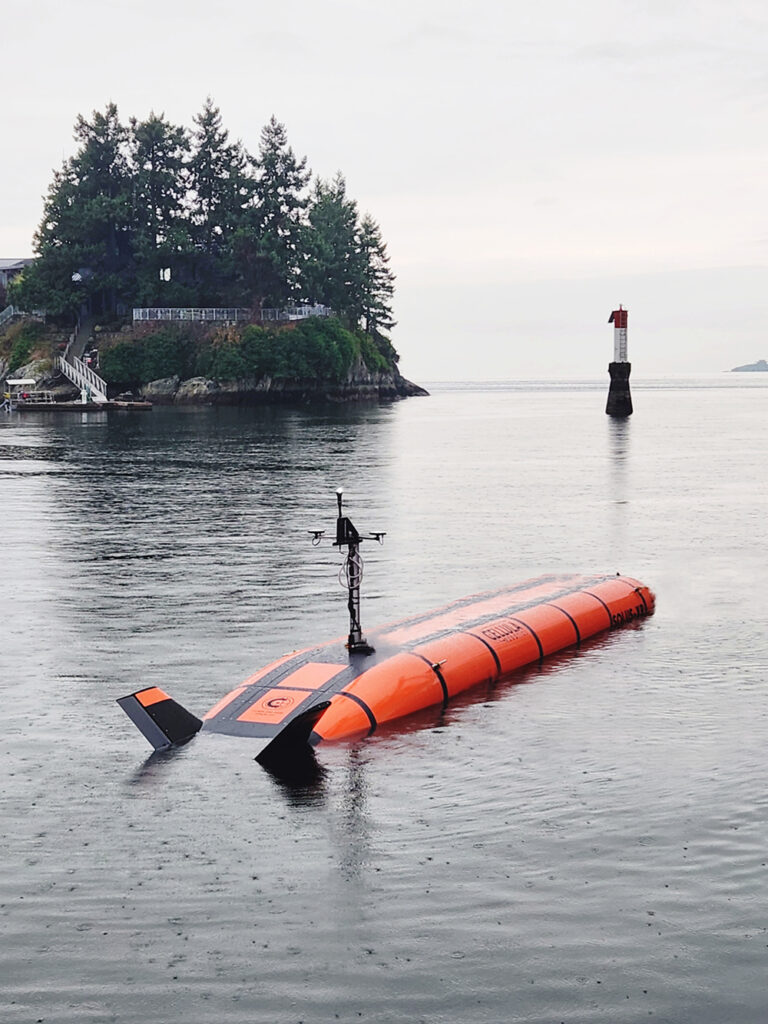
Schmidt Ocean Institute’s new Autonomous Underwater Vehicle (AUV) has completed its first scientific mission, supporting the rapid discovery of two previously unknown hydrothermal vent fields in the Doldrums Megatransform and Fracture Zone of the Atlantic Ocean.
The 35-day expedition onboard the research vessel Falkor (too) marked the maiden science deployment of the AUV The Childlike Empress. Working alongside shipboard sonar and the Remotely Operated Vehicle (ROV) SuBastian, the AUV helped the science team map and locate seafloor features in one of the least explored regions of the Atlantic.
AUV Mapping Supports Rapid Vent Discovery
Researchers first used Falkor (too)’s shipboard sonar to map the wider region before deploying The Childlike Empress to generate high-resolution seafloor maps and collect environmental data in selected areas. The maps enabled the team to identify precise coordinates for SuBastian deployments, leading to the visual confirmation of the first active hydrothermal vent field in what Schmidt Ocean Institute described as record time. Water data anomalies recorded in the region in 2013 and shared by the Brazilian Geological Survey also helped the team refine its initial search area.
Dr. Jyotika Virmani, Executive Director of Schmidt Ocean Institute, stated, “Mapping almost 147 kilometers squared at 1-meter resolution during our first AUV The Childlike Empress science mission with this team of experts rapidly uncovered hidden wonders of the deep sea.”
The two vent fields were discovered in and around the Doldrums Megatransform and Fracture Zone, a large, tectonically active system located about 800 miles off the northeast coast of Brazil. The system crosses the Mid-Atlantic Ridge, which forms the world’s longest mountain chain. While numerous hydrothermal vents have previously been identified along the Mid-Atlantic Ridge, these are the first known vent fields to be discovered in and around the Doldrums system.
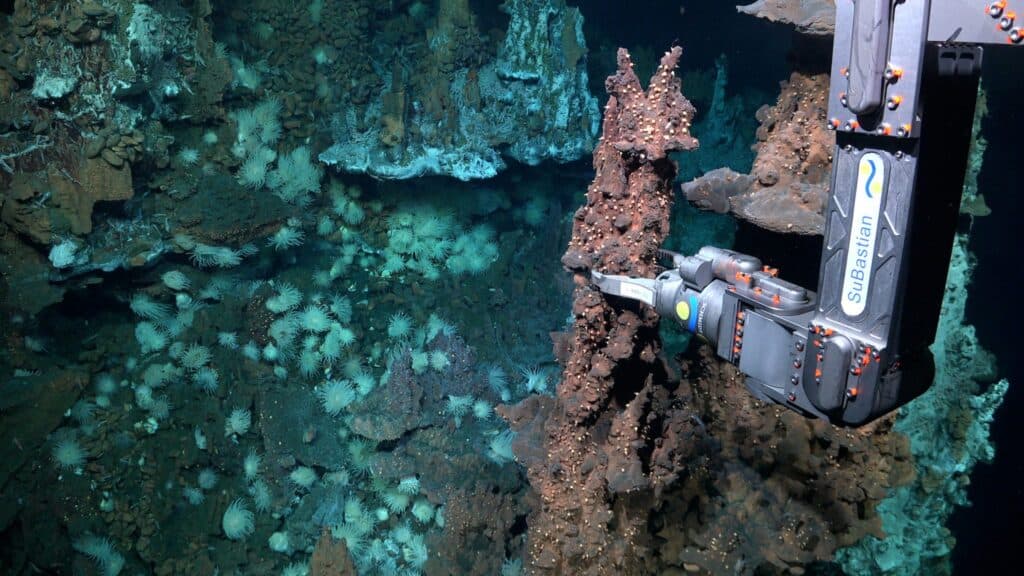
Initial observations suggest that both sites may be rare hybrid, heat-producing hydrothermal systems combining volcanic venting with serpentinization. This chemical reaction occurs when seawater interacts with rocks from the Earth’s mantle, producing heat and chemical energy.
The larger field covers approximately 99,000 square meters, or about 24 acres, and contains 23 hydrothermal vents, including 13 active black smoker chimneys. The team sampled superheated fluids reaching 280 degrees Celsius, or 536 degrees Fahrenheit.
Scientists also observed anemones, crabs and thousands of blind Rimicaris shrimp at the site. These animals rely on chemosynthetic bacteria that use chemicals in the vent fluids as an energy source. A second, smaller and weaker vent field was discovered 170 kilometers, or 105 miles, away during the expedition’s final SuBastian dive.
ROV Surveys Reveal Geological & Biological Findings
Researchers observed evidence of hydrothermal fluid circulation along faults, fractures and scarps during every ROV dive conducted across the Doldrums system. The findings suggest that transform systems may play a more significant role than previously recognized in drawing seawater into the oceanic crust and releasing it back into the ocean. They also indicate that hydrothermal venting may be more widespread in these regions than previously understood.
SuBastian was used to collect geological, biological and water samples, as well as sensor readings and push cores, for analysis onboard Falkor (too). During one operation, its pilots collected a geological sample from a hydrothermal vent chimney at a depth of nearly 3,890 meters.
The expedition also produced several notable deep-sea wildlife observations. SuBastian recorded two elusive bigfin squids from the genus Magnapinna, with one observed at approximately 3,634 meters below the ocean surface. Bigfin squids are known for thread-like tentacles that can reach up to eight meters in length. The team also captured the first footage of the barreleye fish species Winteria telescopa alive in its natural environment. The fish was recorded at a depth of 710 meters and is characterized by its translucent head and tubular eyes.
Dr. Aaron Micallef, Chief Scientist and senior scientist at the Monterey Bay Aquarium Research Institute, commented, “This discovery shows why exploration still matters. Even in the Atlantic Ocean, where plate boundaries have been studied for decades, there are still places where the first close look can reveal something entirely new. This expedition showed that even in one of the most remote corners of the ocean, our planet remains alive, dynamic, and full of surprises.”
The explored area lies in the high seas, beyond national jurisdiction. The expedition was one of several undertaken by Schmidt Ocean Institute in international waters since the passage of the United Nations Biodiversity Beyond National Jurisdiction Agreement in January 2026.